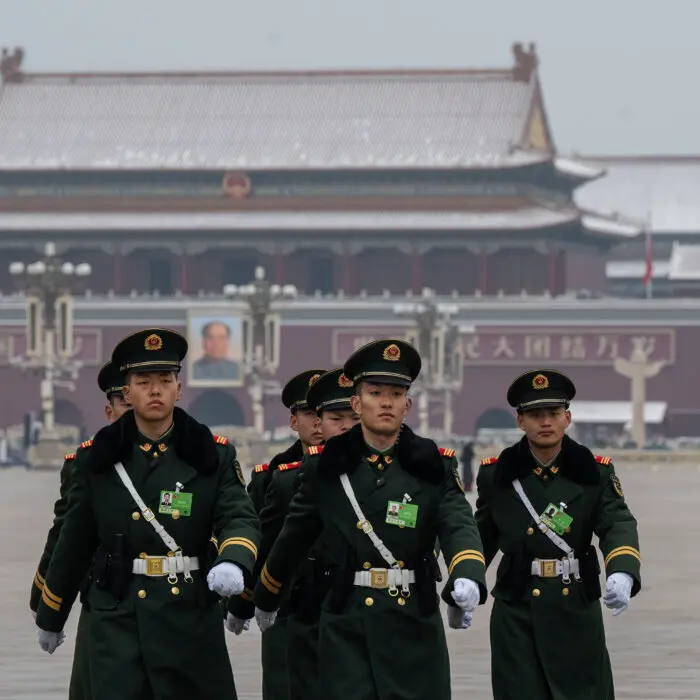
Beijing was still gripped by early-March cold as China’s annual “Two Sessions” meetings opened on March 4. Under near-freezing temperatures—with light rain and snow falling—large numbers of petitioners from across the country gathered before dawn near the National Public Complaints and Proposals Administration, commonly known as the National Petition Bureau.
Many said they had lined up overnight, hoping the start of the Chinese Communist Party’s (CCP’s) top political meetings—the Chinese People’s Political Consultative Conference and the National People’s Congress—might give them a rare chance to have their cases heard by central authorities.
For years, petitioners have traveled to Beijing during the Two Sessions, believing their grievances are more likely to draw attention when national leaders and officials are in the spotlight.
However, several petitioners told The Epoch Times that the trip often carries significant risks: local government “interceptors” sent to seize petitioners and send them home, tighter surveillance, and a system that frequently pushes complaints back to the same local authorities people accuse of ignoring them.
Long Lines Outside Petition Offices
On March 5, a petitioner from Shaanxi Province surnamed Hu told the publication that he arrived at the National Petition Bureau around 6 a.m. and was surprised by the size of the crowd.“There’s already a long line outside the petition office stretching along the street. Many petitioners are carrying luggage or bedding and waiting by the roadside to register and enter the reception hall,” Hu said.
A petitioner surnamed Li from Liaoning Province described similar scenes outside the Supreme People’s Court in Beijing. She said petitioners were still arriving near the National Petition Bureau during the Two Sessions, with many lining up overnight in hopes of securing a registration number.
“It snowed again in Beijing yesterday. It’s very cold and still snowing, but there are still a lot of people,” she told The Epoch Times. “From what I saw, there are at least a thousand people. They’ve already started lining up for tomorrow’s registration numbers.”
Li noted that some petitioners arrived before the Two Sessions began, while others stayed in Beijing for months due to unresolved cases.
“Many people’s problems still haven’t been resolved, so they can only keep waiting in Beijing. I came at the beginning of the year, and it’s already been two months,” she said.
Zhou, a petitioner from Sichuan Province, said petitioners were also gathering in large numbers near Xiannongtan, an area close to the petition bureau.
“There are petitioners everywhere in that area now. I heard there are nearly 2,000 people—it’s a huge crowd,” Zhou told The Epoch Times.
Many, she added, had already been in Beijing for a long time.
Tight Security and Interception Efforts
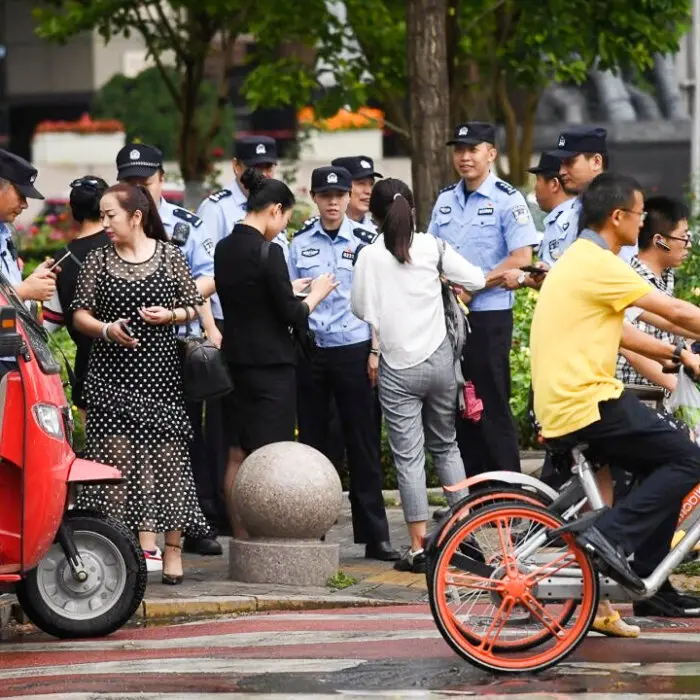
Li said that so-called interceptors—agents sent by local governments—were frequently seen near the petition bureau.“They mainly look for people from their own regions who came to Beijing. Once they find them, they take them away,” Li said. “Some are detained after being taken back, while others are placed under supervision.”
Another petitioner, surnamed Wang, from Jiangsu Province, told The Epoch Times she came to Beijing before the Lunar New Year to evade those interception agents. She said controls over petitioners tightened sharply across China during the Two Sessions, with some individuals unable to leave their hometowns.
“Many people simply can’t get out. As soon as someone buys a train ticket, they may be discovered because their ID information is recorded,” Wang said.
With the crowd outside the National Petition Bureau so large, Wang said she instead went to the area near the Supreme People’s Court.
“There are relatively fewer people over there because going there requires certain conditions,” she said.
Another petitioner, surnamed Liu, told the publication that interception agents from multiple local governments had also arrived in Beijing.
“This time, Liaoning [provincial authorities] sent dozens of interceptors. They grab people and take them back. Some are detained for 10 days, some are sent to psychiatric hospitals, and some are placed under house arrest for a month,” he said. “They use every method available.”
At the same time, a group of Beijing-based dissidents was also placed under official monitoring, according to a Beijing-based rights activist surnamed Li.
Why Many Say the Petition System Falls Short
For some petitioners, the trip to Beijing followed years of frustration with local authorities. A petitioner from Anyang in Henan province, surnamed Liu, told the publication he had spent years going back and forth between local governments and courts over a housing dispute involving his family without finding a resolution.“We’ve gone to many departments locally. Each one says to follow procedures, but the issue keeps dragging on without resolution. So we had no choice but to come to Beijing and try our luck,” Liu said.
Before the Two Sessions, Liu said he walked from Langfang in neighboring Hebei Province to Beijing in hopes of submitting his documents to petition officials.
Alongside petitioners from Shaanxi, Liaoning, Hubei, Sichuan, and Henan, people from Shanghai, Tianjin, and Shandong were also seen gathering near the National Petition Bureau and outside the Supreme People’s Court.
Li, the Beijing-based rights activist, said that every year during the Two Sessions, the capital becomes a focal point for petitioners hoping to elevate their grievances to the highest levels of government.
Many believe filing complaints in Beijing during major central government meetings increases the chances of attracting attention, he said. But he added that the petition system often provides limited results.
“Many petitioners think that once they reach Beijing, their problems can be solved directly,” Li said. “But in reality, most cases are eventually sent back to local authorities for handling.”
Li said the petition system is not an independent judicial remedy but an internal administrative channel in which the power to resolve many cases still rests with local governments.
China’s petition system was created in the early years of the Chinese Communist Party’s rule as a way for citizens to raise complaints with higher authorities. Over time, however, disputes involving land seizures, forced demolitions, and court rulings have piled up, sending a growing number of petitioners to Beijing each year.
Li said the system is meant to serve as a pressure valve for public grievances but is increasingly exposing deeper issues in China’s governance structure under the Communist Party’s rule.