In China, petitioning is an administrative system for hearing complaints and grievances from the public. Many petitioners travel to Beijing to seek justice for their grievances.
In practice, the petitioning process is merely a formality. It is widely reported by human rights groups that the regime routinely dismisses petitioners and often persecutes those who are dissatisfied with the CCP’s authoritarian rule.
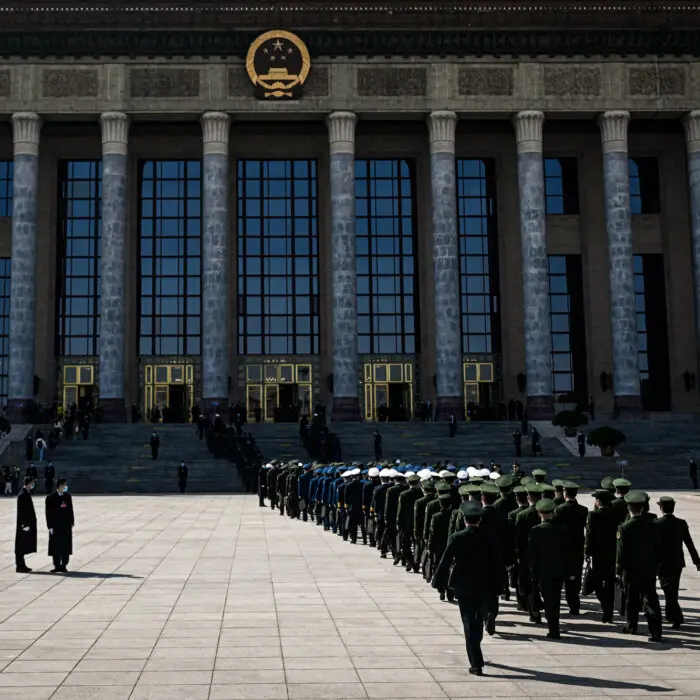
For years, the high-profile Two Sessions—which bring together delegates to China’s rubber-stamp congress and its top political advisory body—have been accompanied by heightened security. However, petitioners and rights advocates say this year’s clampdown appears particularly aggressive, with local authorities under pressure to prevent anyone from traveling to Beijing to file complaints.
Petitioners Describe Pressure, Removal
One petitioner from Baotou, China, who identified herself only as Qiqi for security reasons, told The Epoch Times that she was summoned to a local police station on March 2 and pressured to sign a written pledge.She said the document required her to promise not to travel to politically sensitive sites in Beijing, including Tiananmen Square, the Zhongnanhai leadership compound, foreign embassies, and venues hosting major meetings and events.

“[Petitioners] get detained as soon as they buy a train ticket [to Beijing],” she said.
According to Qiqi, officials warned that if petitioners reach central government authorities during the Two Sessions, local governments could face disciplinary penalties and heavy fines.
“They’re abusing their power to suppress ordinary people,” she said.
Several petitioners staying in Beijing ahead of the meetings have gone missing after encounters with state security personnel.
On March 2, Sun Airong and her son from Shandong Province were allegedly threatened at their Beijing residence by personnel tasked with maintaining “stability”—a broad term used in China for domestic security operations.
According to online accounts from fellow petitioners, individuals repeatedly knocked on Sun’s door the night before. When she did not respond, her electricity was cut off. She also received a phone call from local officials, which she did not answer. Witnesses allege that security personnel attempted to enter through a window. Several hours later, she could no longer be reached by phone.
In a separate incident the same day, another Shandong couple—Li Yanxiang and her husband, Li Hongcai—posted online appeals for help, alleging they were being unlawfully restricted by local officials while outside their residence.
Tang Zhaoxing, a petitioner from Fuzhou, China, was surrounded by dozens of security personnel from his home district while staying in Beijing on March 1, according to fellow petitioners. By mid-morning, he had allegedly been escorted out of the capital city and sent back to his hometown. His phone later went unanswered.
Preemptive Warnings, Disappearances
Even those who have not traveled to Beijing describe being subjected to controls.Sun Jinxiu, a petitioner from Gansu Province, told The Epoch Times that she was stopped by armed police on Feb. 28 while visiting a friend for the Lunar New Year holiday. She was taken to a local police station and held briefly.
She said that later, local officials transported her to a rural police station, where she remained confined in a vehicle until late at night.
“I have a 90-year-old sick mother at home who needs care,” Sun said, describing the measures as excessive and unlawful.
She also said that local authorities installed surveillance cameras directly facing her home starting on Feb. 25, monitoring her residence around the clock.
“They won’t even allow us to live our lives normally,” she said.
Some petitioners from Shanghai told The Epoch Times that they left their homes before the political meetings began, hoping to avoid detention.
Despite relocating, Liu said officials from Shanghai and local police in Shaanxi visited him and officially registered his presence, warning him not to travel to Beijing during the meetings.
Another petitioner, Lu Fuzhong, traveled to a village to lodge complaints against local court rulings before being taken back to Shanghai by security officials. His family told The Epoch Times that they lost contact with him shortly afterward.
The Epoch Times also learned that a third petitioner, Wang Ruyun, has also lost contact with friends and relatives.
Under the CCP, local regime officials are often evaluated in part on their ability to prevent petitioners from escalating complaints to Beijing, particularly during politically sensitive periods such as the Two Sessions.
Li Haihai, another petitioner, told The Epoch Times that the interception and monitoring tactics are unlawful.
“Seeking to defend one’s rights is legal,” he said. “Blocking that process and shielding wrongdoing should be subject to legal accountability.”
The Chinese regime has not publicly commented on the aforementioned individual cases.
As the political meetings are underway in Beijing, families of those who have lost contact with their loved ones told The Epoch Times that they are still waiting for answers.