China has pulled off its second “AI shock” in 18 months with Moonshot AI’s release of a new model that rivals U.S. frontier systems.
The July debut of Moonshot AI’s Kimi K3 model shook the markets, echoing what happened when China’s DeepSeek was unveiled in January 2025.
Since the July 16 release, the Philadelphia Semiconductor Index, composed of the 30 largest U.S.-traded chip stocks, fell more than 10 percent by the end of July. It has yet to fully recover.
Analysts have called it a “DeepSeek moment 2.0.”
However, Ethan Tu, founder of Taiwan AI Labs, has a different interpretation of the moment. To him, it’s more of a rerun of the “DeepSeek playbook.”
He cited the following pattern. Each time, Chinese models scored highly on benchmark tests, and Beijing used this to boost its public relations by raising doubts about the United States’ leadership in artificial intelligence (AI).
The ‘DeepSeek Playbook’
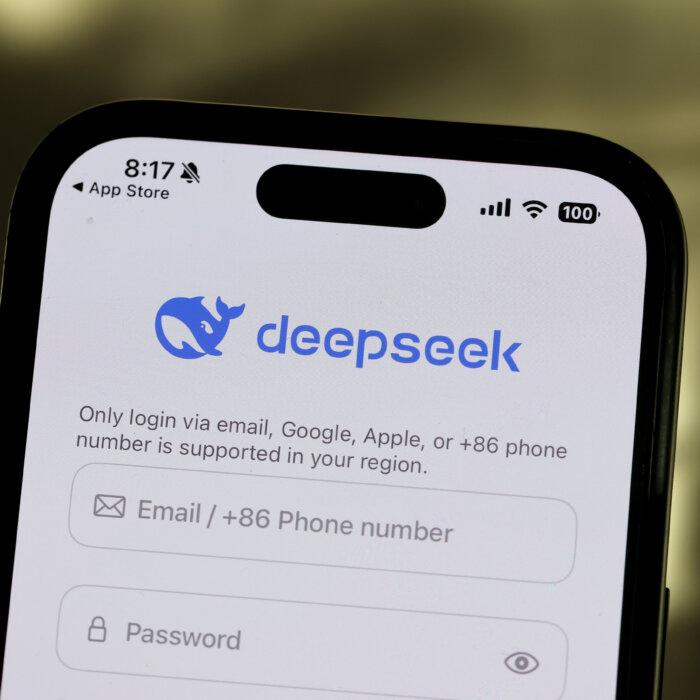
Soon after the “DeepSeek moment 1.0,” Chinese leader Xi Jinping held a meeting with Chinese AI business leaders and gave the founder of DeepSeek, Liang Wenfeng, a front-row seat. It happened at a time when Xi pushed for AI as a “new quality productive force” for China’s economic development.
This time, following the release of Kimi K3, Xi openly called on the world to use Chinese AI models. China is committed to providing AI services to the rest of the world, he said at the World Artificial Intelligence Conference in Shanghai on July 17.
He was directly challenging the United States because global AI market share is the key measure the Trump administration uses to gauge U.S. leadership.
Xi’s value proposition for Chinese AI models is that they are good enough, open, and at a much lower price. Tu, however, has a different assessment after his lab tested Kimi K3.
“The capabilities of an AI model absolutely do not just lie with the test scores,” he told The Epoch Times. In other words, a model built for exams may be far inferior to a model that can solve new problems.
The exams he referred to are performance benchmarks, or problems and expected results defined by frontier models. Hence, using their output to train another model—also known as distillation—can easily result in high scores.
On July 22, U.S. Office of Science and Technology Policy Director Michael Kratsios said that his office has reason to believe that Moonshot AI “distilled Anthropic’s Fable for the development of its K3 model.”
Tu confirmed that. He said Kimi K3 sometimes called itself “Claude,” which is the name of Anthropic’s family of models, including Fable. Last year, DeepSeek R1 also claimed to be ChatGPT.
Price is another area where the Kimi K3 advantage appears thinner upon a closer look.
Moonshot AI has priced its latest model at just half that of Claude Opus 4.8, a model with lower benchmark performance, according to Artificial Analysis, an independent third-party benchmarking site.
In his lab tests, Tu found that Kimi K3 would need to use twice as many tokens to perform a task, but speed is not part of the benchmarks. So the lower efficiency didn’t lower Kimi K3’s test scores. But for a model half as efficient, the half-price tag seems to be just compensation, rather than a competitive edge.
What Moonshot also didn’t disclose was Kimi K3’s hallucination rate, or when the model confidently guesses the wrong answers. Artificial Analysis evaluated the rate at 51 percent.
US–China AI Race: Infrastructure vs. Software
In Tu’s view, the U.S.–China AI competition landscape hasn’t changed much since the “DeepSeek moment” in January 2025. China is still behind, although the gaps differ across AI infrastructure and software.
James Lewis, a former diplomat with extensive experience in the U.S.–China tech competition, concurs. He is currently a distinguished fellow at the Center for European Policy Analysis and a senior adviser at the Center for Strategic and International Studies, both Washington-based think tanks.
The United States still has an advantage in AI infrastructure, although China is trying to make its own chips and data centers, he said, adding that China is a “real competitor” in AI software.
“If the U.S. can avoid missteps, it can still end up building the AI stack for the world, but that stack won’t be running purely American software,” he told The Epoch Times.
Lewis noted that some companies attracted by Chinese models’ lower price points are using a blend of American and Chinese AI software: Chinese for the basic tasks and American for higher-end tasks.
China tends to get lower-value customers, he added. He estimates China’s global AI coding share at 15 percent to 20 percent by revenue.
According to him, China’s commoditization of AI services won’t shock the U.S. economy, since AI isn’t a winner-take-it-all game. However, he added that China’s cheap AI models might be a big shock to Anthropic and OpenAI, the owners of Claude and ChatGPT, respectively.
While the DeepSeek moment was about AI reasoning models, or inference, Tu said the Kimi K3 moment was about coding and cybersecurity, the new frontiers where AI models compete.
He added that Beijing is not limited by talent or software capabilities, but by computing power.
DeepSeek’s founder holds a similar view.
In leaked notes from a May meeting Liang had with investors, he said China is mainly limited by chips. He also said that China is one to two years behind the United States overall in AI and two years behind in hardware.
Currently, China can only buy the H200 chips from Nvidia, which are two years behind the most cutting-edge Blackwell model.
‘AI Version of Jack Ma’
In the May meeting, Liang also said he would use the next round of financing to buy as many Nvidia chips as possible. His plan directly contradicts what Xi wants Chinese companies to do: stop using U.S. chips.
A few days after the meeting notes were leaked, Liang suspended the financing round.
Liang did so because “he doesn’t want to be the AI version of Jack Ma,” said Lewis.
Ma openly questioned China’s financial regulatory system, calling it “outdated supervision.” Days later in November 2020, Beijing called off Ant Group’s initial public offering. He eventually lost most of his ownership in the conglomerate he founded.
That may be China’s deeper constraint. Beijing needs its private tech sector to out-innovate the United States, but these same companies must avoid anything that could be deemed to cross a political red line.