Several kindergarten teachers have also tested positive for dangerously high levels of lead in their blood, adding to public outcry over the regime’s handling of the case and fueling suspicions that the official narrative may be incomplete or misleading.
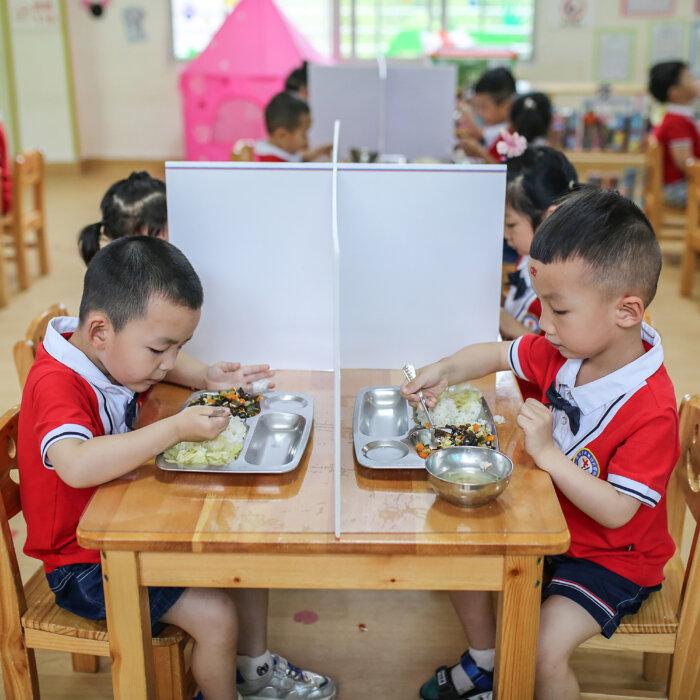
The scandal, which took place at the privately run Peixin Kindergarten in Tianshui city, in Northwestern China, drew national attention after Chinese authorities announced on July 8 that they had found high levels of lead in some foods served at the school. The authorities claimed that inedible paint had been used to make the food look more appealing.
Teachers Also Poisoned
According to Chinese state media The Paper, at least two kindergarten teachers were found to have blood lead levels well above safe thresholds. One teacher recorded 395 micrograms per liter, and another tested at more than 500 micrograms, compared to China’s upper limit of 200 micrograms per liter.Wang Li, a teacher at the kindergarten, told state media that she began experiencing dizziness and nausea weeks earlier but initially dismissed it as her menstrual sickness. Similar symptoms were reported among other staff.
Major Discrepancies in Diagnoses
Some parents now say that they no longer trust local authorities. A father of two who requested anonymity out of fear of retaliation told the Chinese-language edition of The Epoch Times that blood lead readings from Tianshui hospitals were dramatically lower than those from Xi’an, casting doubt on the reliability of the official tests.“My child’s test showed 140 micrograms per liter in Tianshui Hospital but 300 micrograms per liter in Xi’an Central Hospital,” he said. “Another child was marked below 20 micrograms in Tianshui but came back at 352 micrograms in Xi’an. Now, both children are receiving treatment in the hospital.”
The Xi’an Central Hospital is located in a much bigger city in the neighboring province and is widely viewed as more reputable than the local hospital in Tianshui, which was the reason some parents took their children to Xi’an for testing.
Zhao said that on July 2, the kindergarten suddenly notified parents to bring their children in for physical exams. The next day, parents were told samples had been sent to the provincial center for disease control. However, when parents requested written lab reports, officials refused to provide them and claimed that their children were fine.
Suspicious Circumstances
Chinese authorities have claimed that the lead poisoning was caused by the use of industrial coloring in school meals. Testing of food samples found lead levels more than 2,000 times the legal limit, according to Chinese state media reports.Nevertheless, many people in China expressed skepticism about the regime’s narrative.
“This is too much like what happened in 2006, where 211 people were poisoned in the same place,” another Xi’an resident who requested anonymity, due to fear of retaliation, told The Epoch Times. “I think the problem is at other levels. How come the test results [only] came from the hospital? They should be testing the kitchen and the chef; a chef can’t possibly have done this.”
Chinese netizens noted that Peixin Kindergarten is located near two industrial sites—a lead-zinc ore transit station operated by China’s state-owned Baiyin Nonferrous, and a metal logistics depot owned by Tianshui Dongxing Mining Company. Some now suspect that environmental contamination, rather than inedible paint, may be the real culprit.
Alleged Compensation Offers
As public frustration mounts, screenshots of alleged compensation packages have circulated online. According to one widely shared message, families of children with moderate poisoning (200–249 micrograms per liter) were offered 1,000 yuan (US$140) in “nutrition support” for a three-month period. For more severe cases (250 micrograms per liter and above), authorities promised free hospital admission, 6,000 yuan (US$840) in compensation for lost wages, and flexibility in future elementary school placement.Other reports suggest some families have already received lump-sum payments of 7,000 yuan (US$960) per child.
On China’s heavily censored social media sites, some of the victims’ parents expressed concern that the payouts are intended to silence dissent.
“Without public pressure, we would’ve had to pay for everything ourselves,” one mother wrote on Douyin, the Chinese version of TikTok. “Now they’re closing the book on this case, but the harm to [our] children will carry on for life.”
She added that to date, the parents still have not received a full explanation. “Who told the hospital to alter the numbers? Why weren’t any local officials investigated? If Xi’an hadn’t exposed the real test results, we might never have known the truth.”