This copy is for your personal, non-commercial use only. Distribution and use of this material are governed by our Subscriber Agreement and by copyright law. For non-personal use or to order multiple copies, please contact The Epoch Times Reprints.

The Epoch Times
The Epoch Times
AD
The Epoch Times
China Business & Economy

China’s JD.com Founder Wears an ‘Invisible Shackle’: Analyst

Google LogoMark Us Preferred on Google
China’s JD.com Founder Wears an ‘Invisible Shackle’: Analyst
Richard Qiangdong Liu, founder, chairman, and CEO of JD.com, speaks to employees as JD.com has its initial public offering (IPO) on the Nasdaq exchange in New York City on May 22, 2014. Andrew Burton/Getty Images
Mary Hong
9/22/2022|Updated: 9/22/2022
0:00

Liu Qiangdong, or Richard Liu, founder and chairman of JD.com, recently transferred his ownership of equity shares at two subsidiary companies after stepping down as CEO in April.

One Chinese affairs analyst believes Liu made the move in response to the Chinese Communist Party’s (CCP) campaign to target the business elite.

The Powerful Economic Players

JD.com, a Beijing-based online retailer and China’s largest e-commerce business by revenue, has more than 580.8 million active customers and a revenue of 951.6 billion yuan (about $148 billion) in 2021, according to its 2022 report.
Liu established the company in 2004. He was among Fortune Magazine’s “World’s 50 Greatest Leaders” in 2015. According to Forbes, he has a net worth of $12.3 billion as of Sept. 21.

Since the CCP tightened its antitrust regulation, Chinese e-commerce and tech companies—including Alibaba, Tencent, and JD.com—have faced a series of disciplinary warnings and fines.

In April 2021, Beijing’s market regulator summoned more than 30 Chinese internet companies, including JD.com, and warned them of “severe punishment” if they didn’t comply with competition rules.

The warning came after Beijing released its new anti-monopoly guidelines in February 2021. The rules targeted the big internet platforms; for example, e-commerce giant Alibaba was fined $2.75 billion in April 2021.

Then Liu stepped down from his post as executive director in September 2021 and as CEO in April 2022. He remained the chairman of the board.
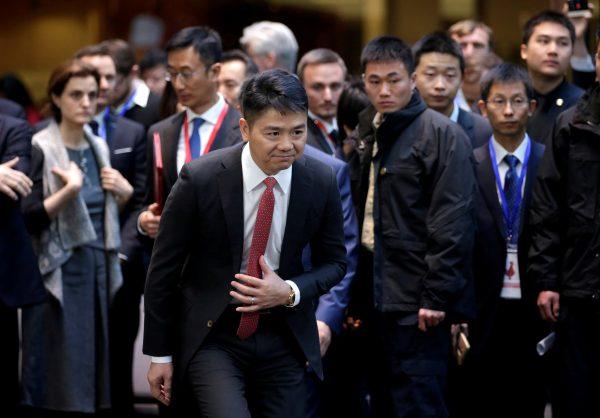
On Sept.16, JD.com’s subsidiaries, JD Health and JD Logistics, announced on the Hong Kong Stock Exchange that Liu agreed to transfer his 45 percent shares to JD Group Vice President Miao Qin.
Richard Liu, CEO and founder of JD.com, attend a France-Chinese forum on artificial intelligence at SOHO 3Q in Beijing on Jan. 9, 2018. (Jason Lee/Reuters)
Richard Liu, CEO and founder of JD.com, attend a France-Chinese forum on artificial intelligence at SOHO 3Q in Beijing on Jan. 9, 2018. Jason Lee/Reuters

The Invisible Shackles

Chinese affairs analyst Wang He told the Chinese language edition of The Epoch Times on Sept. 19 that Beijing is eliminating all of China’s prominent figures by tightening regulations—for fear of their dominance in the economy and in politics—to secure its one-party rule.

In recent years, China’s top business leaders—such as Alibaba’s Jack Ma, ByteDance’s Zhang Yiming, and Pinduoduo’s Chang Huangzheng—have taken early retirements.

Wang said, “The many Chinese Liu Qiangdongs are all wearing invisible shackles under the CCP’s ruling.”

Between 2019 and June 30, 2021, Liu resigned from at least 298 companies as president, chairman, and shareholder.

In six years, Liu has cashed out a total of $10 billion starting in 2016, according to Chinese media.

Wang said that Liu’s actions showed that he was trying to protect his interests, but he couldn’t stop the CCP. “Beyond the limit, the regime will hit him as hard as it dealt with Didi.”

Didi, the Chinese ride-hailing company, received a fine of $1.2 billion for allegedly breaking data security laws after a year-long probe, which forced the company to delist from the United States in July.

Wang said CCP leader Xi Jinping is tightening his grip on power and reining in political rivals and business leaders ahead of the Party’s 20th National Congress. The dictatorship will never allow uncontrolled development of private enterprises such as the internet giants.

“Through pressure, negotiation, reorganization, and control, the regime will remove its target’s economic and political influence.”

Cheng Jing contributed to this report.
Google LogoMark Us Preferred on Google
Mary Hong
Mary Hong
Author
Mary Hong is a former Epoch Times reporter based in Taiwan. She covered China news, U.S.–China relations, and human rights issues.
Author’s Selected Articles
The New York Times Has Become a CCP ‘Mouthpiece’ in Attempts to Discredit Falun Gong: Expert
Jan 10, 2025
The New York Times Has Become a CCP ‘Mouthpiece’ in Attempts to Discredit Falun Gong: Expert
Rights Activists Call Out Chinese Authorities for Allegedly Harassing Their Family Members in China
Jul 02, 2024
Rights Activists Call Out Chinese Authorities for Allegedly Harassing Their Family Members in China
‘Tyranny and Despotism’: Chinese Veteran Who Escaped Persecution Recounts CCP’s Corruption, Atrocities
Jun 30, 2024
‘Tyranny and Despotism’: Chinese Veteran Who Escaped Persecution Recounts CCP’s Corruption, Atrocities
Marriage Rates Decline in China Amid High Unemployment Rate
Jun 28, 2024
Marriage Rates Decline in China Amid High Unemployment Rate
Related Topics
China
e-commerce
JD.com
Richard Liu
AD
Add to My List
Save
The Epoch Times
Copyright © 2000 - 2026 The Epoch Times Association Inc. All Rights Reserved.