China monopolizes more than 80 percent of critical raw battery minerals used in U.S. military equipment, posing a serious national security threat, new research has found.
“In a hot war or even a cold one, Beijing could also weaponize the battery dependence of economic sectors ranging from cars to computers, communications, and construction,” the report stated.
China’s current stranglehold requires mining a surplus of critical minerals in the upstream battery production process. As it stands, Beijing makes approximately 85 percent of anodes, 70 percent of cathodes, and a whopping 97 percent of the anode precursors, according to the report, citing data from the International Energy Agency.
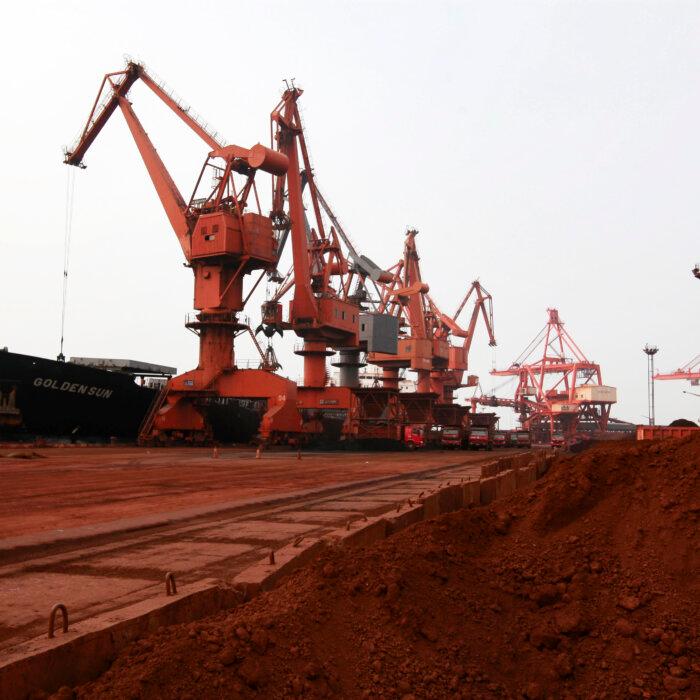
Throughout the entire supply chain, bottlenecks are used to weaponize mineral exports for geopolitical leverage. However, it’s proving to be complicated to diversify certain minerals, especially battery-grade graphite, with more than 95 percent processed by China, according to the report.
This is in part owed to China’s lax environmental standards, as the processing is “highly polluting,” and involves “discharging particulates into the air and dumping waste into local waters,” researchers said.

Another strategic hurdle is Beijing’s aggressive state subsidies that make Chinese companies temporarily immune to short-term market effects.
Those figures, according to the report, “dwarf” the 7.4 billion dollars that the United States allocated for EVs through 2017.
“This difference in scale is critical,” the report stated. “When subsidies, like those in China, reach the point where profitability is no longer a relevant consideration for an enterprise, companies are capable of leveraging a degree of power that can push out profit-based competitors.”
To combat this dynamic, the report suggested that the United States should step up domestic capacity for extracting critical minerals. Measures in this effort include incentivizing private investment, state encouragement, and streamlining the process to reduce inefficiency in the system.
“Permitting obstacles alone represent an estimated 40 percent of all delays in mining projects,” the report noted, while acknowledging robust guardrails protect “American communities from the pollution and safety hazards that citizens in China frequently face.”
Earlier this year, the Trump administration issued a series of executive orders aimed at boosting U.S. production and processing of critical minerals.
In April, another order promoted offshore mineral exploration, particularly targeting deep-sea polymetallic nodules rich in battery-critical elements such as nickel, cobalt, copper, and manganese. However, the FDD research warned that disturbing those nodules could impact global oxygen levels, underscoring the environmental trade-offs involved.
The report highlighted the need for alternative sources outside China, advocating strong cooperation with allies through “ally-shorting” and “China plus one” policies already adopted by companies such as Apple, Microsoft, and Black & Decker.
“America can—and should—use its trade power to force the creation of a better system,” the authors stated. “Regaining our leadership is not an impossible task. ... Our national security depends on it.”