
Dozens of websites linked to Chinese companies have been used to push Beijing’s propaganda overseas while pretending to be legacy Western outlets, according to a report by Graphika, which specializes in research into foreign influence.
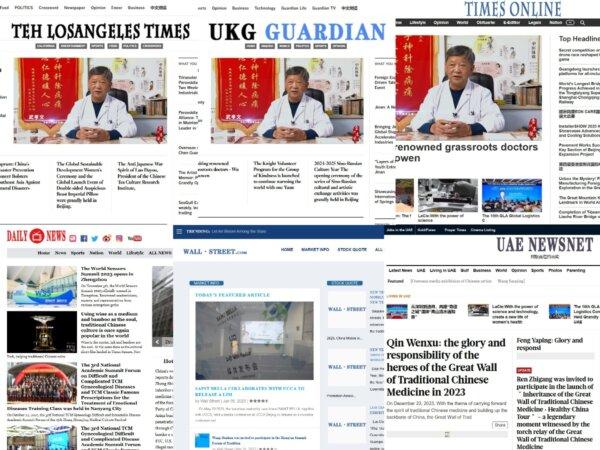
The websites copied design elements in order to fraudulently present themselves as such outlets as The New York Times, The Wall Street Journal, Los Angeles Times, The Guardian, and others. Aside from commercial and pro-China content, they also ran articles attacking Falun Gong, a faith group brutally persecuted by the Chinese Communist Party (CCP), according to the report.
“We identified evidence that these companies and/or individuals leveraged these domains in contracts to promote the activities undertaken by [CCP-linked] entities,” the report reads.
This tactic fits into the broader campaign waged by Beijing against the Falun Gong diaspora overseas, according to Levi Browde, executive director of the Falun Dafa Information Center, a nonprofit that monitors the CCP’s persecution of Falun Gong.
“This is not simply online disinformation. The campaign we see today is a blueprint for how a hostile influence operation run by Beijing can launder propaganda through fake ‘news’ brands and then use coordinated inauthentic accounts to push it into Western information ecosystems,” Browde said in a statement.
The CCP set out to eradicate Falun Gong, also known as Falun Dafa, in 1999 after government surveys revealed that between 70 million and 100 million Chinese had adopted the practice, which consists of slow-moving exercises and spiritual teachings based on the tenets of truthfulness, compassion, and forbearance.



The campaign has consistently targeted Shen Yun Performing Arts, a premier classical Chinese dance and music company founded in 2006. The company has long faced attacks and sabotage attempts, often involving Chinese consular officials pressuring theaters and local officials to cancel its shows.

The fake news sites discovered by Graphika are part of a new chapter in the campaign, Browde said.
“When malign actors spoof trusted outlets and amplify smear narratives through coordinated networks, it destabilizes public trust and can help legitimize transnational repression,” he said.
“It can also help recruit unwitting allies in the West by inflaming sentiments based on false narratives to disparage Falun Gong and Shen Yun. This is literally how the CCP shapes the thoughts and feelings of Americans.”
The fake news sites were created between 2020 and 2025 by various Chinese public relations and marketing companies. They usually publish a mix of content scraped from Chinese state-run media as well as articles designed to promote China and Chinese commercial products. Since 2023 or earlier, at least 10 such sites have been used to post anti-Falun Gong content, according to the report.
“The anti-Falun Gong content was likely placed on behalf of a covert actor, possibly one aligned with the [People’s Republic of China],” it reads.
Links to two of the anti-Falun Gong articles were repeatedly posted on social media by dozens of accounts seemingly associated with the CCP’s “Spamouflage” influence campaign, according to the report.
“The X accounts and Facebook pages demonstrated signs of inauthenticity similar to Spamouflage accounts, including using likely randomly generated usernames and stock profile pictures, having almost no following and followers, criticizing Falun Gong and Shen Yun, and posting identical content simultaneously,” it states.
The cybersecurity community has long been aware that the CCP uses fake news sites operated by private companies to spread its propaganda. In 2022, Google-owned cybersecurity firm Mandiant discovered more than 70 such fake media outlets. Multiple cybersecurity outfits then built upon that research, discovering a network of hundreds of sites with the capability to quickly deploy content around the world, as if centrally coordinated, according to an October 2025 report from the French Ministry of Armed Forces’ Institute for Strategic Research.
“The scope of this network, the similarity of disseminated content despite local adaptations, and the numerous revealed interactions between entities suggest strong capabilities for penetrating foreign audiences,” the October 2025 report reads.