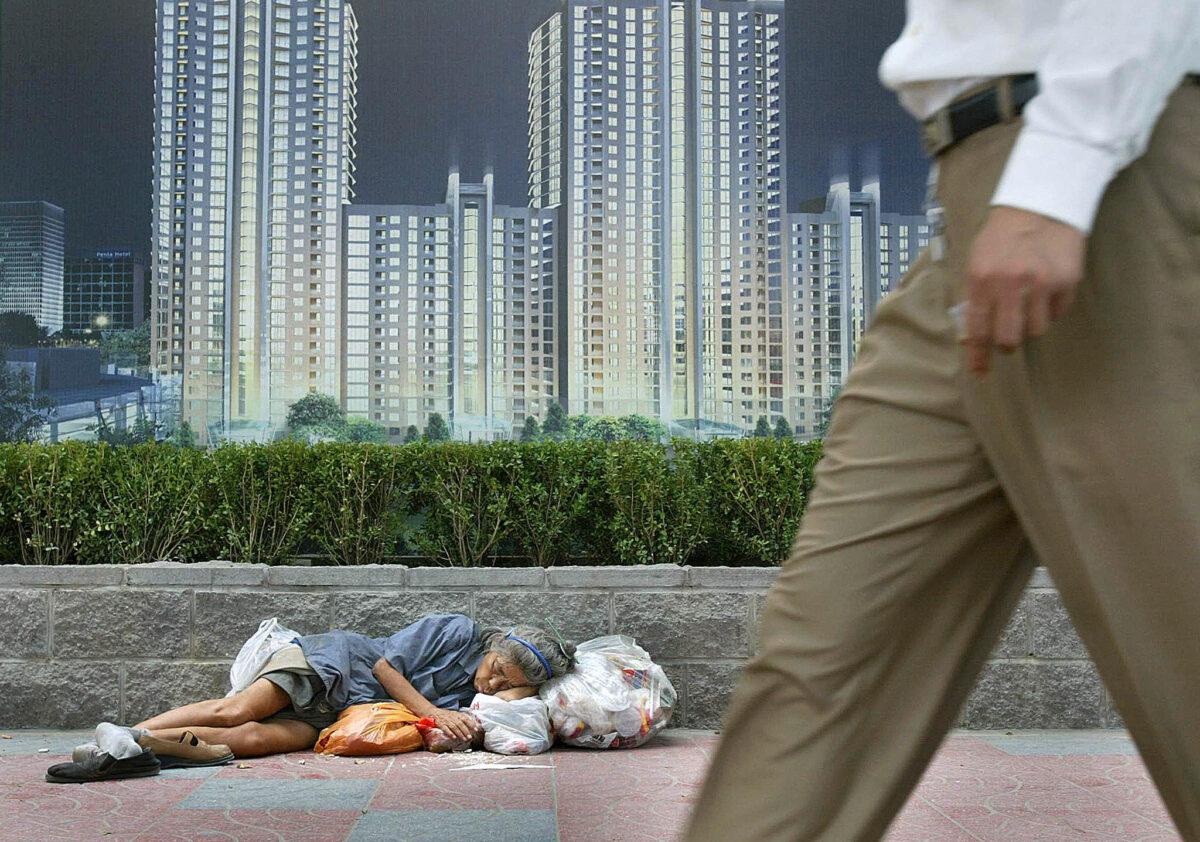
As China’s economic slowdown deepens, a growing number of unemployed rural migrant workers are being forced into homelessness in the cities. Now, a quiet change in official language is drawing scrutiny.
China’s rubber-stamp congress introduced revisions to its draft Social Assistance Law, including a seemingly minor but symbolic shift: replacing the term “homeless beggars” with “dispersed persons,” according to an April 27 report by Chinese regime newspaper The People’s Daily. The regime stated that its goal is to streamline workflows and improve services for the people.
For critics, the change is not trivial.
Linguistic Shift Amid Economic Pressure
In the past year, videos circulating on Chinese social media have shown rural migrant workers sleeping in train stations, under bridges, and on sidewalks after failing to find work in major cities.Against that backdrop, the terminology change has sparked backlash.
Wu Shaoping, a U.S.-based Chinese human rights lawyer, told The Epoch Times that the move fits a long-standing pattern.


“The CCP has always relied on wordplay and propaganda,” he said. “Renaming ‘beggars’ as ‘dispersed persons’ is an attempt to conceal the reality that more people in China are falling into poverty as the economy deteriorates.”
Under the CCP’s official narrative, extreme poverty has been eradicated, and the country has achieved a “moderately prosperous society.” Critics say that the rebranding undermines those claims.
Jie Lijian, chairman of the China Democracy Party International Alliance, told The Epoch Times that the change signals the collapse of those narratives.

The CCP has a long history of labeling and managing migrant populations.
In the 1980s, rural migrants flooding into cities were referred to as “blind drifters,” a term implying uncontrolled and undesirable movement. A 1982 regulation formalized the label “homeless beggars,” allowing the regime to detain and repatriate such individuals.
Jie said people are aware of these conditions and, under CCP internet censorship, use joking language to satirize the authorities.
Hidden Numbers, Questions About Accountability
Official data offers only a partial picture.China’s Ministry of Civil Affairs reported via Chinese news platform The Paper that authorities assisted people in temporary distress more than 700,000 times in 2024 and about 625,000 times in 2025. It did not publish comprehensive statistics on the total homeless population.
A 2021 report on missing persons found that more than 1 million people went missing in 2020, with the number reaching 3.94 million in 2016, according to Chinese state media China Daily. Since then, nationwide data has largely disappeared from public view.
Wu said the lack of transparency raises serious concerns.
“What’s more frightening for the homeless than being renamed is physically disappearing,” he said.
Wu said replacing detention centers with assistance stations did not fundamentally change the system.
“It’s the same structure with a different name,” he said. “The personnel remain, and accountability has never been fully addressed.”
Concerns have extended beyond homelessness.
In March 2026, a resident of Guangzhou, China, submitted an online petition calling for a suspension and review of China’s organ transplant system. The initiative was swiftly suppressed by the CCP.
While direct links between such concerns and the homeless population remain unproven, Jie said vulnerable groups face heightened risks in opaque systems.
“In the past, some young people who had gone to assistance stations seeking help were instead detained inside and subjected to various forms of mistreatment,” he said.
Jie also alleged that corruption is involved in the system, with officials inflating the number of people receiving aid—turning one individual into 20 on paper—and then dividing the support funds among themselves.