The Chinese regime’s personnel purge surrounding next year’s leadership reshuffle is currently underway, as the ruling Communist Party’s (CCP) 21st National Congress—held every five years—is expected to convene in Beijing in 2027.
Insiders within the CCP’s system told The Epoch Times that the CCP’s internal purge in the second half of the year will intensify and expand to the financial system, public institutions, universities, enterprises with state equity, and retired financial officials.
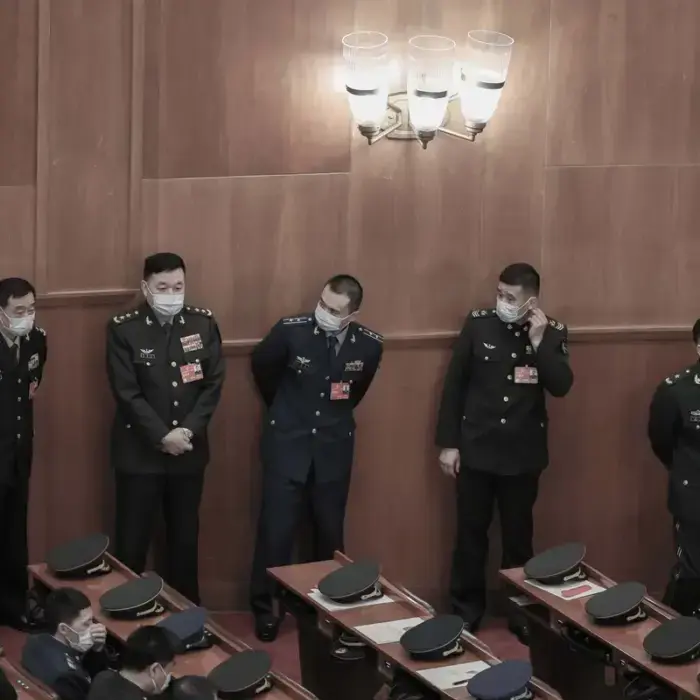
In an official notice issued on June 26, the qualifications of 14 high-ranking officials as deputies to the CCP’s National People’s Congress were terminated, as they were removed from their positions. Most of them are in the military and defense industry, according to state media Xinhua.
Wu Shiqi, an insider within the CCP’s system who used a pseudonym out of fear of reprisal from the Chinese regime, told The Epoch Times that in the first half of the year, the CCP also purged a group of high-ranking local officials who had already been investigated and flagged by the Party’s Central Commission for Discipline Inspection and the Organization Department.
“The target for the second half of the year is to dig deeper into officials whose assets are inconsistent with their reported income, as well as top to third-tier executives at enterprises and public institutions, university Party secretaries and presidents, and heads of scientific research projects,” Wu said.
“In the second half of the year, investigations will continue, targeting not only corrupt officials but also those whose political stances are deemed problematic,” he said.

Zhao Qiming, an insider in China’s financial sector who used a pseudonym out of fear of reprisal, told The Epoch Times that a key focus of the CCP’s investigations within the financial system for the second half of the year is the overseas assets held by officials and their family members.
Even presidents and vice presidents of local banks who have already left their posts remain subject to scrutiny, Zhao said.
“A meeting was held in June regarding self-inspection and self-correction for leading officials, requiring them to review their own conduct and rectify any errors. The meeting made it clear that the investigation in the second half of the year would cover individuals within the financial system and those associated with state-invested enterprises, including retired financial officials,” Zhao revealed.
The current procedure requires the related officials to first submit a self-assessment report declaring their own and their family’s assets, he said. “If their overseas properties are discovered that were not truthfully disclosed in the report, the matter will be treated as concealment of assets, and the assets in question may be subject to confiscation.”
Li, an insider in China’s financial sector who only gave his surname out of fear of reprisal, told The Epoch Times that the financial system in mainland China is not merely an economic sector but serves as the “purse” for the operation of power among the CCP’s top leadership.
“The financial system controls banks, stock markets, local government debt, and capital flows; it also determines whether local governments can continue to function,” Li said. “The purge of financial officials ahead of the CCP’s 21st National Congress is primarily about investigating personal networks and factions.”
“For the CCP’s top leadership, these factions once served to check and balance one another, but now, the rule is simply to investigate whoever fails to toe the line,” he said.
If there were absolutely no factions to balance each other out beneath the seven members of the CCP Central Committee’s Politburo Standing Committee–the top leadership of the CCP—the Party would face even greater problems, Li said.
“If factions disappear, everyone might outwardly pledge loyalty to you while ultimately being disloyal; instead, subordinates might band together to pursue their own agenda—or even unite to challenge the Standing Committee itself,” he said.