This copy is for your personal, non-commercial use only. Distribution and use of this material are governed by our Subscriber Agreement and by copyright law. For non-personal use or to order multiple copies, please contact The Epoch Times Reprints.
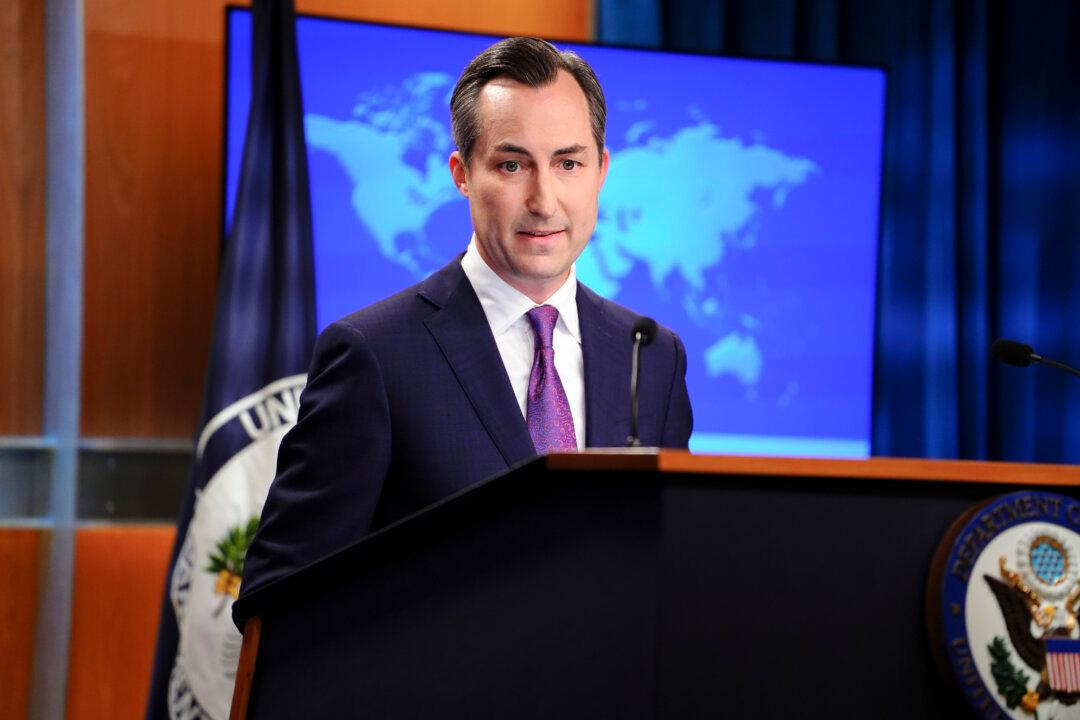
Secretary of State Antony Blinken testifies before the House Committee On Foreign Affairs on Capitol Hill in Washington on March 10, 2021. Ting Shen-Pool/Getty Images
U.S. Secretary of State Antony Blinken said on March 10 he intends to lay out in “very frank terms” the United States’ “deep objections” to the Beijing regime’s behavior in a meeting with top Chinese Communist Party (CCP) officials next week.
He added that the United States won’t make any concessions to China to get its cooperation on implementing the Paris climate agreement.
Blinken and national security adviser Jake Sullivan will meet with the top CCP official in charge of foreign affairs, Yang Jiechi, and China’s Foreign Minister Wang Yi in Anchorage, Alaska, on March 18—the first high-level in-person meeting between the two countries since President Joe Biden took office.
Blinken, at a House Committee on Foreign Affairs hearing on March 9, said the meeting is an “important opportunity forustolayout in veryfrankterms,manyconcernsthatwehavewithBeijing’saction.”
Reiterating previous remarks, Blinken described China as the United States’ “most consequential relationship,” saying the regime “uniquelyhasanabilitymilitarilydiplomatically,economically,tounderminetheinternational rules-based system.”
“Sowe’regoingtobeverymakingverycleartoourcounterpartsinChina,thedeepconcernobjectionsthatwehavetosomeofthethingsthatthey’redoing, andtoseeiftheywilladdressthoseconcerns,” he said.
Blinken also said he would “explore whether thereareavenuesforcooperation.“ When later asked by a congressman whether the secretary was ”contemplating concessions“ to the CCP in exchange for cooperation on the Paris climate deal or other matters, Blinken responded, ”No concessions whatsoever to the Communist Chinese Party.”
He said that the meeting won’t be a “strategic dialogue” and there were no plans at this stage for follow-up engagements, adding that any future talks would be “based on the proposition that we’reseeingtangibleprogressandtangibleoutcomes on the issues of concern to us.”
Responses to Genocide in Xinjiang
The secretary faced multiple questions on how the Biden administration will respond to the CCP’s repression against Uyghurs in Xinjiang, which the Trump administration designated a genocide; Blinken has said he agreed with this declaration. The secretary confirmed that he would raise the CCP’s abuses in Xinjiang in the meeting next week.
Blinken said the United States would respond first by “speaking out forcefully” on the issue and would work to build a “coalitionof like-minded countrieswhosharethesedeepconcernsabouthumanrightsabusesinChina.”
In addition, the United States would be calling for the regime to open up Xinjiang to investigators from the United Nations, he said.
There are also a number of practical actions “that we can and should do,” Blinken said. They include sanctions and visa restrictions on those responsible for the rights violations, barring exports of U.S. technology that aids in the repression, and banning imports of goods made from forced labor from Xinjiang.
The Trump administration imposed sanctions on several CCP officials over their roles in overseeing the persecution in the region and banned all cotton and tomato products from Xinjiang, citing the use of forced labor.
Cathy He is the politics editor at the Washington D.C. bureau. She was previously an editor for U.S.-China and a reporter covering U.S.-China relations.