

The researchers collected search results on two topics that are critical to Beijing’s agenda: Xinjiang and the COVID-19 pandemic, from five different search engines: Google Search, Google News, Microsoft’s Bing Search, Bing News, and YouTube. The data was collected daily from Nov. 1, 2021, to Feb. 28, 2022.
Chinese State Media Content Not Constrained by Newsworthiness
According to the report, Chinese state media can produce content about strategic topics beyond the constraints of newsworthiness.There is a consistent stream of state-backed narratives that flow into the web. They are mostly independent of paywalls or subscriptions, making them easily available. This continuous push of Beijing-backed narratives also takes advantage of the algorithms in most search engines that prioritize “freshness.”
Beijing’s Narratives Consistently Appeared on First Page of Search Results
Chinese state media content frequently appeared in top search results for both neutral and loaded terms related to Xinjiang. If one searches for the keywords “Xinjiang terrorism” or “Xinjiang debunked” on the above platforms, the researchers found that Chinese state media contents appear every day on the first-page search results, with the exception of YouTube search, where two days out of the 120 days, it appeared on the second page of the search results.For neutral terms, such as “kashgar,” “Urumqi” or “Xinjiang,” Chinese state media content still appeared almost every day on news searches and YouTube searches. Kashgar and Urumqi are cities in Xinjiang.
State-Affiliated Influencers Increase Beijing’s Reach
Beijing uses influencers on YouTube to counter critical reporting from other news outlets. The report said that these influencers share similar characteristics. They are Westerners but have lived in China. They claim to be independent “China experts.” Their connections to Beijing are often veiled.
A 2021 research by the Australian Strategic Policy Institute (ASPI) found that influencer content relied on two approaches to challenging established coverage of Xinjiang. They highlight local customs and culture to promote a positive and vibrant image of life in the region. They call out “Western injustices and biases” to counter allegations of forced labor and detention centers.
Reposting by Other Media Increase Beijing’s Presence
The report also found a surprisingly large number of seemingly independent news outlets repost CCP media reports routinely. This type of reposting would increase the total number the CCP media in search results by nearly 10 percent.The top ten sources that repost Beijing’s content are Finland’s helsinkitimes.fi, UAE’s bignewsnetwork.com, USA’s msn.com, Pakistan’s dailytimes.com.pk and bolnews.com, Chad’s alwihdainfo.com, India’s indianexpress.com, Ukraine’s ukranews.com, Bangladesh’s tbsnews.net, and Zambia’s iol.co.za.
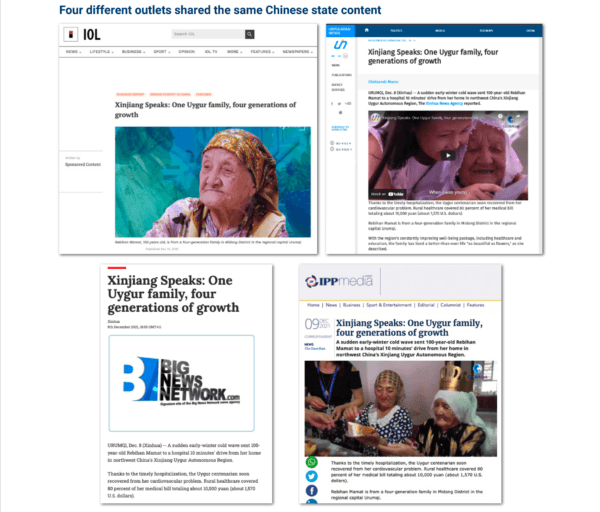
The report shows the screen captures of four outlets publishing the same story about Xinjiang with exactly the same title “Xinjiang Speaks: One Uygur family, four generations of growth.” Out of these four outlets, Zambia’s IOL put “Sponsored Content” on the Byline. UAE’s bignewsnetwork.com has “Xinhua” right underneath the title. Ukranews.com has “Xinhua News Agency reported” in the first paragraph. Another African media ippmedia.com does not give any clue where the article was from.
Finally, the report says that the tech companies are implementing policies to curb the influence of state-backed media. In the early months of 2022, search engines enacted measures to limit the reach of Russian state media.
But little has been done regarding the Chinese state media.


