


Team Columbia’s move was not planned before the race; it was an example of on-the-fly strategizing by experienced riders. Columbia rider George Hincapie explained, “We were expecting to get a little help from the other teams but nobody wanted to race. This made us a bit angry, so we decided if we saw a moment, we were going to go.”
Lance Armstrong showed the value of experience by jumping on the back of the late-race break, while Alberto Contador got left behind. This raises once again the question, “Who is the leader of Team Astana?”
And further: “If Team Astana decides to support Armstrong, can he win an eighth Tour?”
A Stage for Sprinters
Stage Three, 196.5 km from Marseille to La Grande-Motte, was a long, mostly flat stage with a very long flat finish across the plains of the Camargue; perfect for another sprint finish. The first 110 km climbed up over a few good hills, including two Category Four climbs, short but steep, but nothing that would challenge a rider. The final 80 km were completely flat.
This was not a stage suited to breakaways; once the peloton hit the plains, it could run down any attackers.
This didn’t stop an attack by Maxime Bouet of Ag2R right off the line. Samuel Demoulin of Cofidis joined him; they were quickly joined by Koen de Kort of Skil-Shimano, and Perez Morneo of Euskatel. The break opened up a thirteen-minute gap, until Saxo Bank decided to push the peloton to close the gap a bit.
The breakaway rider had to know that their only chance was to open a gigantic lead; only by riding 100% and working perfectly as a team could they hope to survive.
Dumoulin Tries to Duplicate Last Year’s Stage Three
Dumoulin won Stage Three in last year’s Tour by pushing a breakaway beyond range of the peloton, but last year’s third stage had only a 20 km flat finish, and headwinds slowed the peloton. Could Dumoulin repeat his feat?
Sadly, Dumoulin was driving the pace; the other riders in the break weren’t sharing the work evenly. To have a chance, they all needed to drive.
The day was hot (90 degrees F) and the team’s were weighing charging hard after the breakaway, and conserving energy for Stage Four a team time trial where the first five finishers for each team would be timed. Stage Three, either. Saxo Bank had to set the peloton’s pace; the other teams were not willing to do the work to help the yellow jersey. The teams couldn’t spend all their energy and sacrifice the team time trial; of course, they couldn’t concede Stage Three, either.
At the half-way point, Saxo Bank again picked up the peloton’s pace, as the gap opened to 12:35. With only one short, steep climb left, it wasn’t clear if the breakaway had enough of a gap to hold on.
Flying on the Plains
After the final climb, Liquigas, Francaise des Jeux, and Team Columbia sent riders to the head of the peloton, to help Saxo Bank, and the gap started tumbling. At the 120-km mark, the breakaway was only six minutes ahead.
Once the riders hit the plain, they hit the wind, which was blowing stiffly across the course.
At 55 kilometers left, Team Lampre rider Marzio Bruseghin got caught in a multi-rider crash, caused by the wind—apparently a gust pushed on rider into another. All the riders were able to continue.
With 150-km mark, Team Columbia picked up the pace again, as the wind picked up also. The breakaway was 4:19 ahead, looking unlikely to succeed.
Columbia Splits the Field
With thirty km to go, Columbia made a breakaway of its own, splitting the peloton. This was a challenge not just for the stage, but also an attack on the yellow jersey. Fabian Cancellara and Lance Armstrong were in the attack, but Cancellara had no support. Armstrong had Yaroslav Popovych and Haimar Zubeldia to support him. A couple of Milram, Skil-Shimano and Cofidis riders were also in the break. Twenty-seven riders in all made the split.
Columbia made a great strategic move; when the road turned, the leading Columbia riders exploded. The wind was still head-on for the rest of the peloton, but the leaders were in a cross wind, and could accelerate. Columbia got all nine riders into the break, making them the most powerful force in the break.
The four-man breakaway was ridden down by the Columbia pack. The four managed to hang on to the leading riders, so the four at least gained something from their effort.
Liquigas and Silence-Lotto tried to organize the peloton, but Saxo Bank stopped trying to drive the chase, as the yellow jersey was safely in the break. With ten km to go, it was clear the leading riders would not be caught.
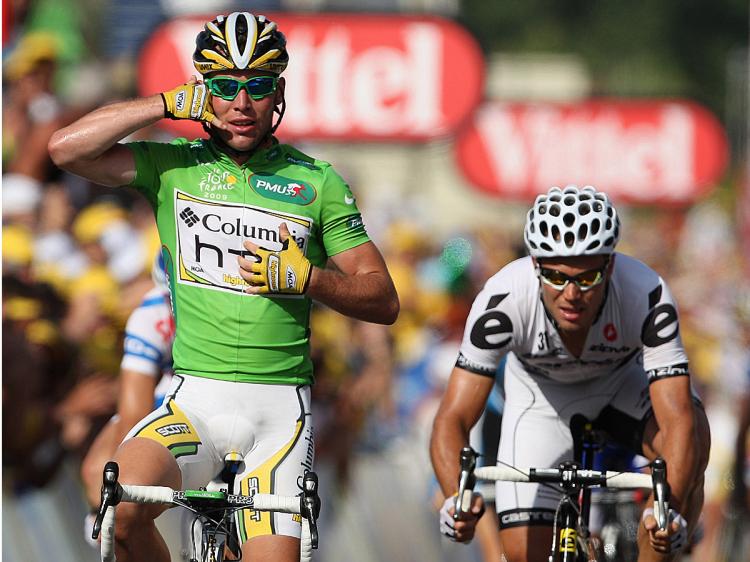
The final sprint emerged from chaos as many teams tried to take control. Cyril Lemoine of Skil-Shimano made the first break, but Mark Renshaw managed to fight his way to the front and led for Cavendish, mighty Thor Hushovd hooked onto Cav’s wheel.
When the Manx Missile launched, not even the God of Thunder could match him. Hushovd pulled even with Cavendish for an instant, but Cavendish made a second surge and beat Hushovd to the line by a bike length.
Lemoine finished third, and Samuel Dumoulin, in an amazing display of endurance, finished fourth after leading the break from the starting line.


