Cassini Snaps Saturn’s Rings and Lunar Quintet (Photo)

September 22, 2011 Updated: October 1, 2015

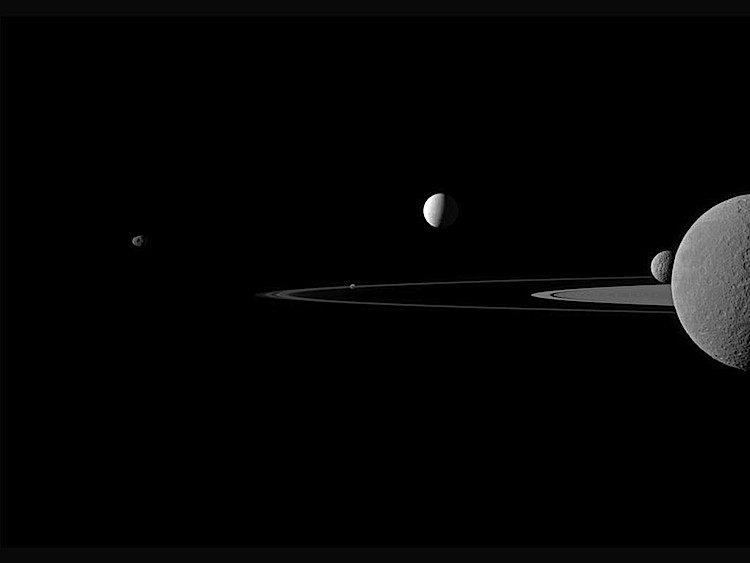
A quintet of Saturn's moons come together in the Cassini spacecraft's field of view for this portrait. (NASA/JPL-Caltech/Space Science Institute )
NASA’s Cassini spacecraft continues to unlock Saturn’s secrets with this latest image of five of its 19 known satellites, and corroboration of the moon Enceladus’ profound effect on its host planet by the European Space Agency’s Herschel Space Observatory.

From the left is Janus with a diameter of 111 miles (179 kilometers), followed by Pandora (50 miles or 81 kilometers wide), which is circling between Saturn’s A ring and the thin F ring toward the middle of the portrait.

Next is luminous Enceladus which is 313 miles (504 kilometers) across, and is located in the middle of the photo.

Rhea, Saturn’s second largest moon, has a diameter of 949 miles (1,528 kilometers), and is cut in half on the right edge of the image. Mimas, a smaller moon at 246 miles (396 kilometers) wide, lies in the background.

This view was captured on July 29, using the craft’s narrow-angle camera in visible green light, around 1.1 million miles (1.8 million kilometers) from Enceladus.

New infrared data from Herschel has confirmed the incredible rate of water vapor eruption from the "tiger stripes" at Enceladus’ South Pole, which are feeding the torus around Saturn.

Previous measurements by Cassini’s Ultraviolet Imaging Spectrograph (UVIS) instrument showed that about 440 pounds (200 kilograms) of water vapor shoot out from the moon every second.

"We can see the water leaving Enceladus and we can detect the end product—atomic oxygen—in the Saturn system," said Cassini UVIS science team member Candy Hansen, of the Planetary Science Institute, Arizona, in a press release.

"It’s very nice with Herschel to track where it goes in the meantime."

Although a small number of the torus water molecules enter Saturn’s atmosphere, the majority break up into hydrogen and oxygen atoms.

"When water hangs out in the torus, it is subject to the processes that dissociate water molecules, first to hydrogen and hydroxide, and then the hydroxide dissociates into hydrogen and atomic oxygen," said Tim Cassidy at the University of Colorado in the release.

"Cassini discovered atomic oxygen on its approach to Saturn, before it went into orbit insertion. At the time, no one knew where it was coming from," Hansen said.

"The profound effect this little moon Enceladus has on Saturn and its environment is astonishing."