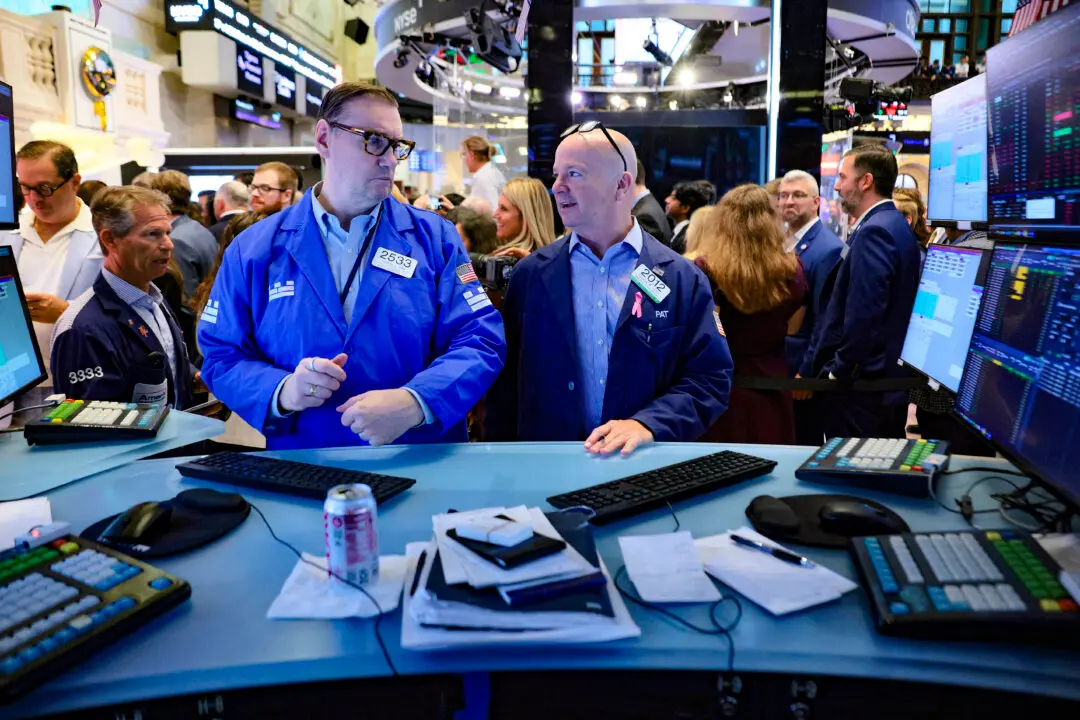
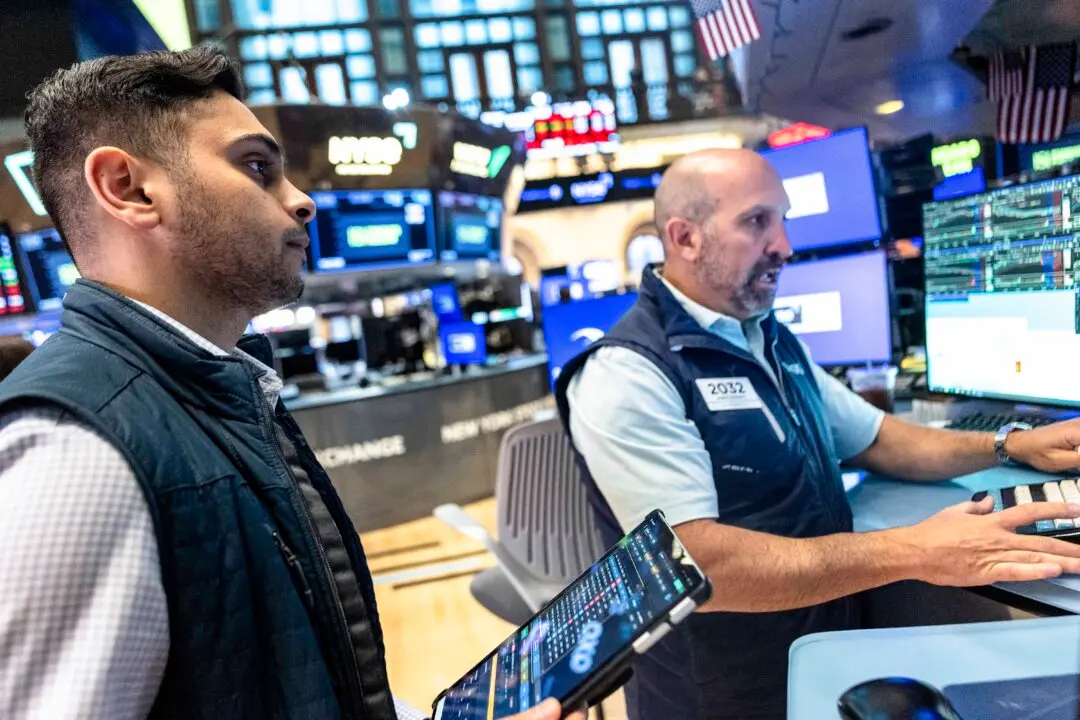
Wall Street ended the week at record highs, as a surprisingly weak jobs report gave investors another reason to bet against a near-term Federal Reserve rate hike.
The catalyst came on Friday morning, when the July labor market report showed the United States unexpectedly lost 23,000 nonfarm jobs, on top of a downwardly revised 20,000 gain in June—far from the 80,000 increase economists had forecast.
“With a loss of 23K jobs in July, and downward revisions to both of the prior two months, the upward momentum of job growth from the spring has slowed markedly,” ZipRecruiter Labor Economist Nicole Bachaud told The Epoch Times.
“Price volatility may be contributing to increased hesitation from employers. With job opportunities remaining scarce, more workers are exiting the labor market entirely.”
For investors, a weak jobs report is not necessarily bad news—a soft labor market reduces fears of a near-term rate hike, which could support demand for bonds.

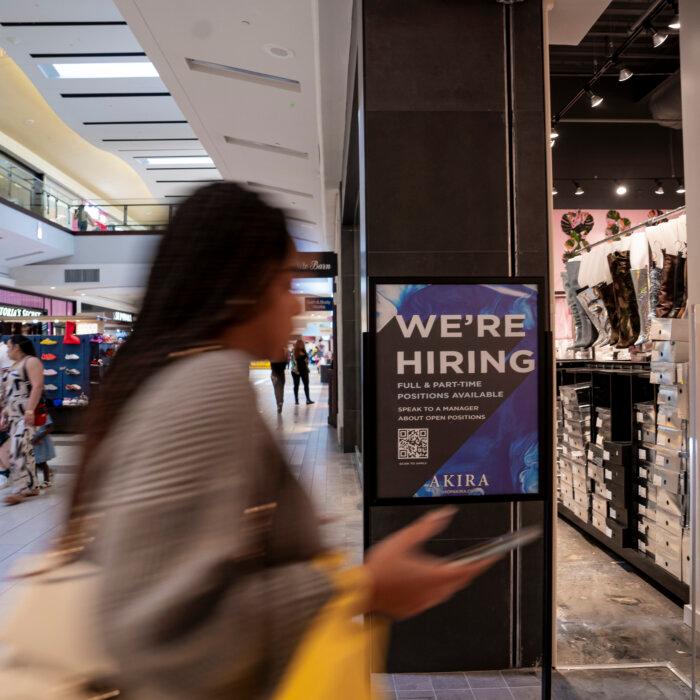
Bond yields fell, with the 10-year Treasury note dropping 7 basis points to 4.6 percent. The relief spread quickly to equities, with the Nasdaq climbing 1.20 percent and the Russell 2000 up 1.10 percent. The S&P 500 and the Dow trailed, adding 0.62 percent and 0.28 percent, respectively.
But the picture is more complicated, according to Brent Wilsey, chief investment officer at San Diego-based Wilsey Asset Management. He said the weak jobs number creates a challenge for the Federal Reserve, as inflation remains elevated and sticky.
“Friday’s negative jobs number raises the importance of next Wednesday’s [consumer price index] for July, which may see an uptick, since oil prices spiked during the second half of July, given the reescalation of tensions in Iran. This may very well be one of the more noisy CPI reports in recent memory,” he told The Epoch Times.
Wilsey pointed to a different set of forces behind the market’s push to record territory: investors paying down debt and looking for more evidence of strong corporate earnings as they reassess their portfolios midway through the year.
“Those two factors provided a nice catalyst for stocks after a choppy June and July. The usual summer volatility seems to have come early this year,” he said.
The jobs report capped a week that was already leaning bullish from the beginning, driven by a retreat in both oil prices and bond yields as fears of a Middle East escalation eased.
Brent crude oil traded as low as $80 a barrel on Tuesday on hopes of a new truce in the region, while the 10-year Treasury yield slid to 4.65 percent after touching its highest level since January 2025 the previous Friday.
Lower yields gave an outsized lift to rate-sensitive sectors. Tech and small caps led the charge, with the Nasdaq up as much as 2.8 percent on the week’s strongest days and the iShares Russell 2000 ETF (IWM) gaining 1.72 percent.
Boeing added to the positive market sentiment after regulators granted the aircraft maker certification for the 737 Max 7, sending the Dow past the 700-point mark in a single session to a fresh record high. A merger headline out of pharmaceuticals—Bristol Myers Squibb and AstraZeneca—added to the upbeat mood.
“The labor market in June was cooling and could continue this path as inflation remains a wild card,” Bachaud told The Epoch Times.
“Openings are drifting lower, and the softness in leisure and retail points to consumers pulling back before employers do. But hires ticking up even as postings slow is the kind of detail that keeps this from reading as a market losing steam.”
She said whether hiring holds up through the summer depends largely on whether inflation stabilizes and consumer spending remains solid.
Meanwhile, strong results from Palantir, Snap, and Caterpillar fed optimism about the earnings season, and a rally in Disney shares helped push the Dow to a third straight record close on Wednesday.
But the enthusiasm wasn’t universal. AMD beat estimates but not by enough to satisfy investors who had priced in more, and a shake-up at Alphabet’s DeepMind unit weighed on sentiment.
The stock markets finished the day mixed.
Disappointing earnings from SanDisk, Western Digital, and AppLovin triggered a bout of profit-taking on Thursday, pulling the Nasdaq and the S&P 500. The Dow also fell on a sell-off in Boeing shares.
That pause reflected a broader unease heading into Friday’s jobs data, according to analysts.
“Friday’s jobs report is of greater importance for markets given how fast this stock market has rallied over the past week, and ultimately we will need to see a number that is not too hot and not too cold for the market to keep grinding higher,” Clark Bellin, president and chief investment officer of Lincoln, Nebraska-based Bellwether Wealth, told The Epoch Times.
As it turned out, the number came in weak—enough to send yields lower and stocks to fresh record highs.