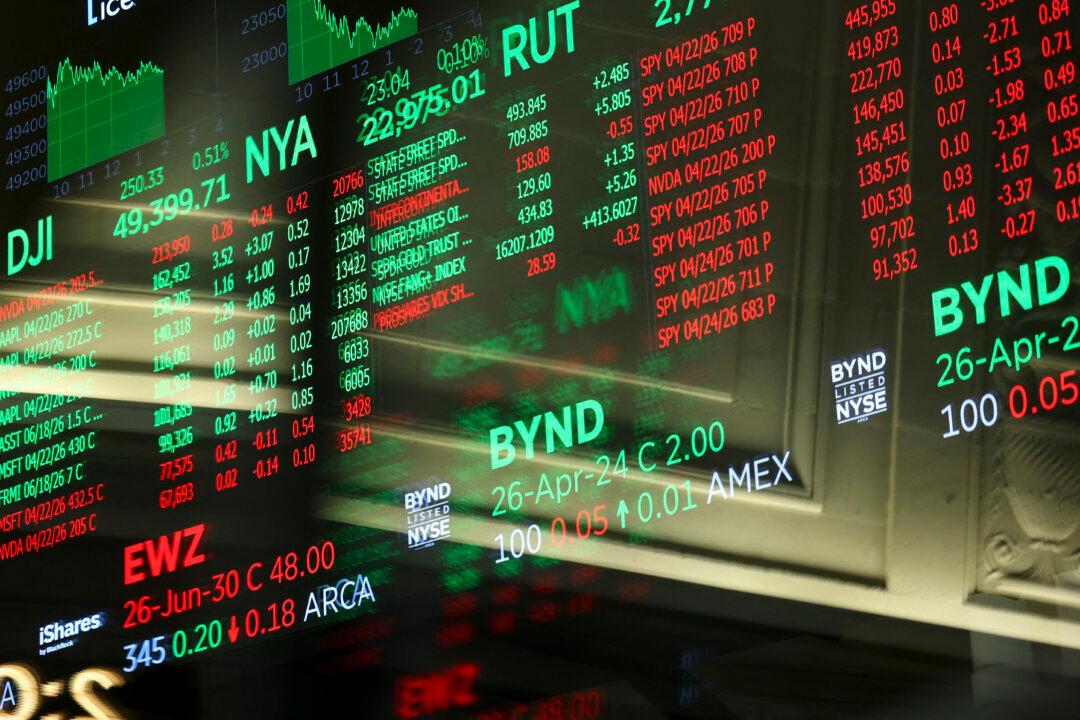
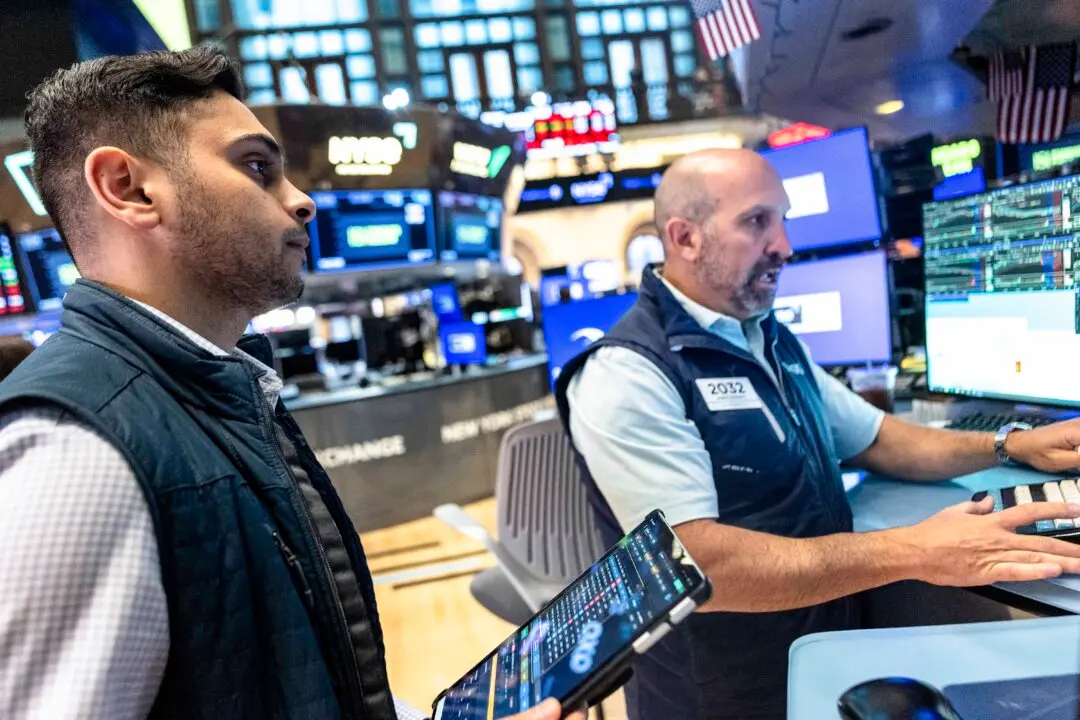
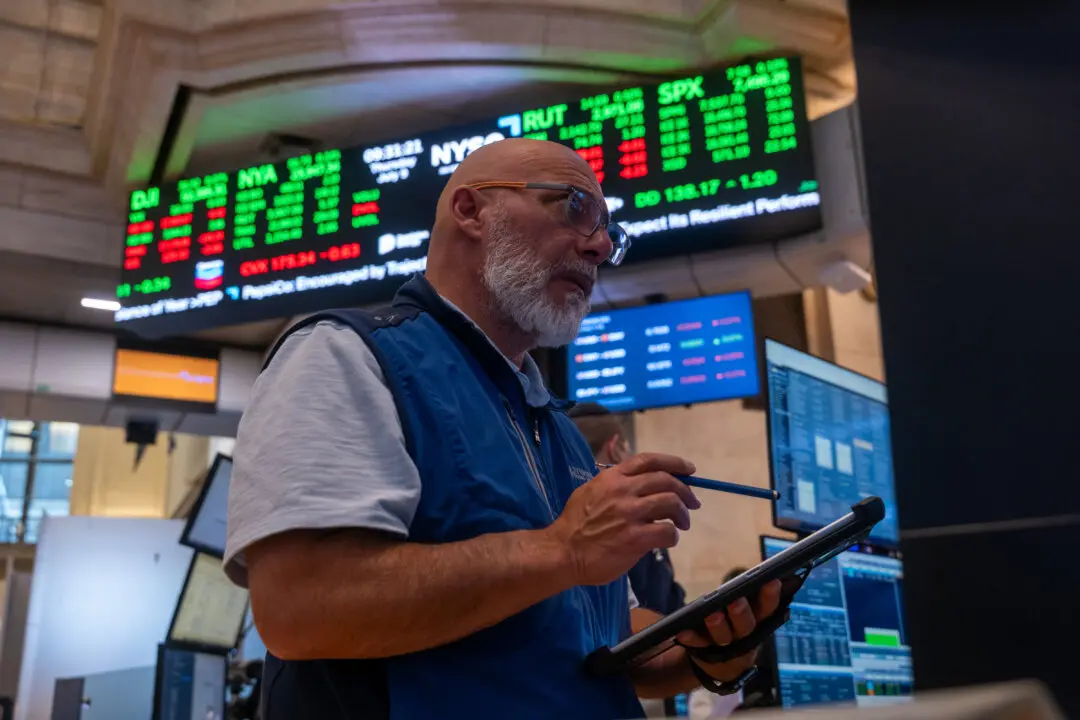
The Dow Jones Industrial Average closed above 50,000 for the first time on record during another roller-coaster week, driven by gains in large industrial and financial stocks, as investors grappled with uncertainty over the impact of artificial intelligence on technology companies and a resulting market rotation.
Supporting that rotation was evidence of a cooling labor market, which revived expectations for future Federal Reserve interest rate cuts and benefited interest rate—sensitive sectors that carry significant weight in the Dow.
For the week, the Dow Jones Industrial Average rose 2.5 percent to 50,115, with most of the gains recorded during the Feb. 6 session. The S&P 500 finished the week nearly unchanged at 6,932, recovering from midweek losses. The tech-heavy Nasdaq Composite ended 1.84 percent lower, also erasing earlier gains, while the Russell 2000 advanced 2.17 percent.
Market volatility remained elevated. The Chicago Board Options Exchange Volatility Index climbed above 22 in early trading on Feb. 5, fell below 20 by midday, then rose again to 21.70 by the close, finishing the week 1.82 percent higher.
Stocks began trading on Feb. 2, the first session of the new month, on a weak note amid continued selling in the metals market and investor caution ahead of a busy week of labor market data. That weakness was short-lived, however, as buyers returned to the market.
Contributing to the rebound were encouraging signals from the manufacturing sector. The S&P Global U.S. Manufacturing PMI edged up to 52.4 in January from December 2025’s five-month low of 51.8, indicating a firmer pace of expansion.


Meanwhile, ISM Manufacturing New Orders jumped to 57.10 points in January from 47.40 points in December 2025.
By the close, all major indexes finished higher, led by the Dow, which gained by 1.1 percent on strong performances from Caterpillar and Walmart. The S&P 500 and Nasdaq posted gains of 0.60 percent and 0.50 percent, respectively.
The Nasdaq, home to many software firms, fell by 1.43 percent for the day. The S&P 500 declined by 0.84 percent, while the Dow slipped by 0.34 percent. The Russell 2000 posted a small gain, suggesting investors were rotating out of big tech into smaller-cap stocks rather than exiting equities altogether.
That rotation continued on Feb. 4, though funds flowing out of large technology stocks moved into pharmaceuticals, financials, and homebuilders rather than small caps. The Nasdaq dropped by 1.34 percent, while the Dow gained by 0.71 percent. The S&P 500 and the Russell 2000 declined by 0.30 percent and 0.59 percent, respectively.
Supporting this shift was the release of the ADP payroll report, which showed private-sector employers added 22,000 jobs in January, following a downwardly revised 37,000 in December 2025 and below expectations for a 48,000 increase.
The weak ADP reading reinforced signs of a cooling labor market, renewing hopes for more accommodative monetary policy and lifting interest rate-sensitive sectors such as financials.
“Wednesday’s ADP report revealed that the U.S. job market started 2026 the same way it ended 2025: sluggish,” Melissa Cohn, regional vice president of William Raveis Mortgage and a 43-year mortgage industry veteran, told The Epoch Times.
If there is a silver lining, Cohn said, it is the increased likelihood of future rate cuts, which could benefit homebuyers by lowering mortgage rates.
“If the job market remains in low gear, then that could open the door for the Fed to cut rates earlier in the year than expected,” she said.
Bret Kenwell, U.S. investment analyst at eToro, said the ADP report alone is unlikely to influence Fed policy.
“But if the January jobs report shows a similar dynamic, it should at a minimum help keep the Fed from adopting an overly restrictive stance as the first quarter progresses,” he said.
Additional reports released on Feb. 5—including the Challenger job cuts report, the December Job Openings and Labor Turnover Survey, and the Initial Claims report—confirmed the same labor market trend, bolstering expectations for eventual rate cuts.
Still, those hopes were not enough to prevent a broad sell-off on the day, led by technology stocks, following the release of an upgraded AI model, Claude Opus 4.6, on Feb. 5, which heightened investor concerns. Announcements of large AI capital spending budgets by major technology firms added to the pressure.
In the past two weeks, Meta, Microsoft, Alphabet, and Amazon have announced billions in capital expenditures (CapEx) for AI-related projects, raising investor concerns that these projects will leave little free cash flow for the companies to return to shareholders.
After two days of sharp declines, equities rebounded strongly on Feb. 6 as investors bought shares of sectors seen as less exposed to AI-related disruption, as well as semiconductor stocks expected to benefit from AI-driven capital expenditures.
Buying accelerated through midday, helping all major indexes finish solidly higher and erasing most midweek losses, with the Dow closing above the historic 50,000 mark.
Clark Bellin, president and chief investment officer at Bellwether Wealth, said investors should remain selective but opportunistic.
“2026 should still be a positive year, with plenty of opportunities to buy stocks at a discount,” he told The Epoch Times.