The Institute for Supply Management’s October index of services—a monthly survey of the sector’s prevailing economic direction—rose to 52.4 from 50 in September.
Anything above 50 indicates expansion.
Heading into the report, the market consensus suggested a reading of 50.8.
A rebound in business activity and new orders drove the better-than-expected number.
Employment was stuck in contraction for the fifth consecutive month. But the sub-index rose to a five-month high and came in better than market estimates.

Additionally, price pressures rose to a three-year high, suggesting that the services sector is facing higher costs due to rising U.S. import duties.
Companies’ inventories remained little changed, and many firms in the services sector indicated that their supplies were too high compared with business activity. This could have been the result of businesses rushing ahead of President Donald Trump’s global tariffs and buying foreign goods.
Eleven industries registered growth, driven by accommodation and food services, retail trade, and wholesale trade. Six sectors posted a contraction.
Services activity rose to a three-month high amid an acceleration in new order volumes and a steady level of new business growth.
Despite the better-than-expected reading being fueled by financial services and tech, a deeper dive reflected improving demand from consumers, according to Chris Williamson, chief business economist at S&P Global.
“October’s final PMI data add to signs that the US economy has entered the fourth quarter with strong momentum,” Williamson said in the report. “Growth in the vast services economy has picked up speed to accompany an improved performance in the manufacturing sector.”
Business activity, he noted, is supportive of gross domestic product’s expansion at an annualized pace of approximately 2.5 percent.
Prices and Labor
Survey respondents continued to cite tariff-related effects on prices paid, according to Steve Miller, head of the Institute for Supply Management’s Business Survey Committee.To date, prices for items sensitive to the current administration’s levies have been mixed.

The September annual headline inflation rate edged up to a lower-than-expected 3 percent—the highest level since January—from 2.9 percent in August. Core inflation, which strips out the volatile energy and food sectors, slowed to 3 percent from 3.1 percent in the previous month.
It is unclear when the next batch of consumer price index or producer price index reports will be published.
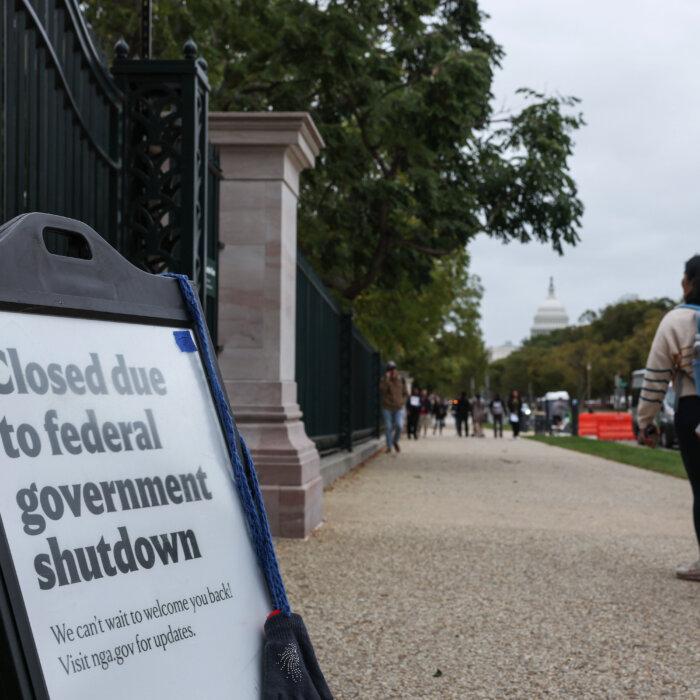
The October survey respondents also pointed to the five-week-old government shutdown as having an impact on current business conditions.
“There was no indication of widespread layoffs or reductions in force, but the federal government shutdown was mentioned several times as impacting business activity and generating concerns for future layoffs,” the report said.
Recent measurements suggest the U.S. labor market could be starting to rebound.
Despite that the Bureau of Labor Statistics has not released employment data, private-sector alternatives indicate that the job market is firming, according to Eric Teal, chief investment officer for Comerica Wealth Management.
“As the immigration policies take effect, we expect that the job market will improve for entry-level workers and service industries; however, this might bring with it wage and inflationary pressures that bear close monitoring,” Teal said in a note emailed to The Epoch Times.
ADP data indicated that annual pay growth was flat at 4.5 percent for job-stayers and 6.7 percent for job-changers.