Last month’s figure was also little changed from the same time a year ago.
Economists, based on a consensus estimate, had expected a deficit reading of $88.6 billion. A modest increase was widely anticipated after companies accelerated their purchases from abroad ahead of sweeping U.S. tariffs announced on April 2 taking effect.
Goods imports were flat from April to May, totaling nearly $276 billion. Automotive vehicles accounted for virtually all imports last month, increasing 11.7 percent. U.S. purchases of foreign-made consumer and capital goods tumbled 6.2 percent and 2.1 percent, respectively.
Exports fell 5.2 percent to $179.235 billion, driven by a 13.6 percent decline in shipments of capital goods and a 5.2 percent decrease in exports of foods, feeds, and beverages.

Last month, the U.S. goods trade deficit declined sharply from the record high registered in March, plummeting 46 percent and posting the smallest monthly trade gap since December 2023.
Advance retail inventories edged up by 0.3 percent to $806.6 billion, while advance wholesale inventories dropped by 0.3 percent to $905.4 billion.
Separate Bureau of Economic Analysis data highlight that the U.S. current account deficit—a gauge of the flood of goods, services, and investments into and out of the economy—rose by more than 44 percent to $450.2 billion.
The adjustment was driven by downward revisions to consumer spending (0.5 percent from 1.2 percent) and exports (0.4 percent from 2.4 percent). Additionally, first-quarter imports were adjusted lower to 37.9 percent from 42.6 percent.
In today’s economic climate, imports are likely to play a significant role in forthcoming GDP reports. Imports are subtracted from gross domestic product calculations because they measure the value of goods and services produced in the United States.
Despite the first quarterly contraction since early 2022, the U.S. economy is poised to rebound in the second quarter.
Deadline Day
The president’s July 9 deadline for reciprocal tariffs is approaching, and the White House has indicated for weeks that trade agreements could be forthcoming.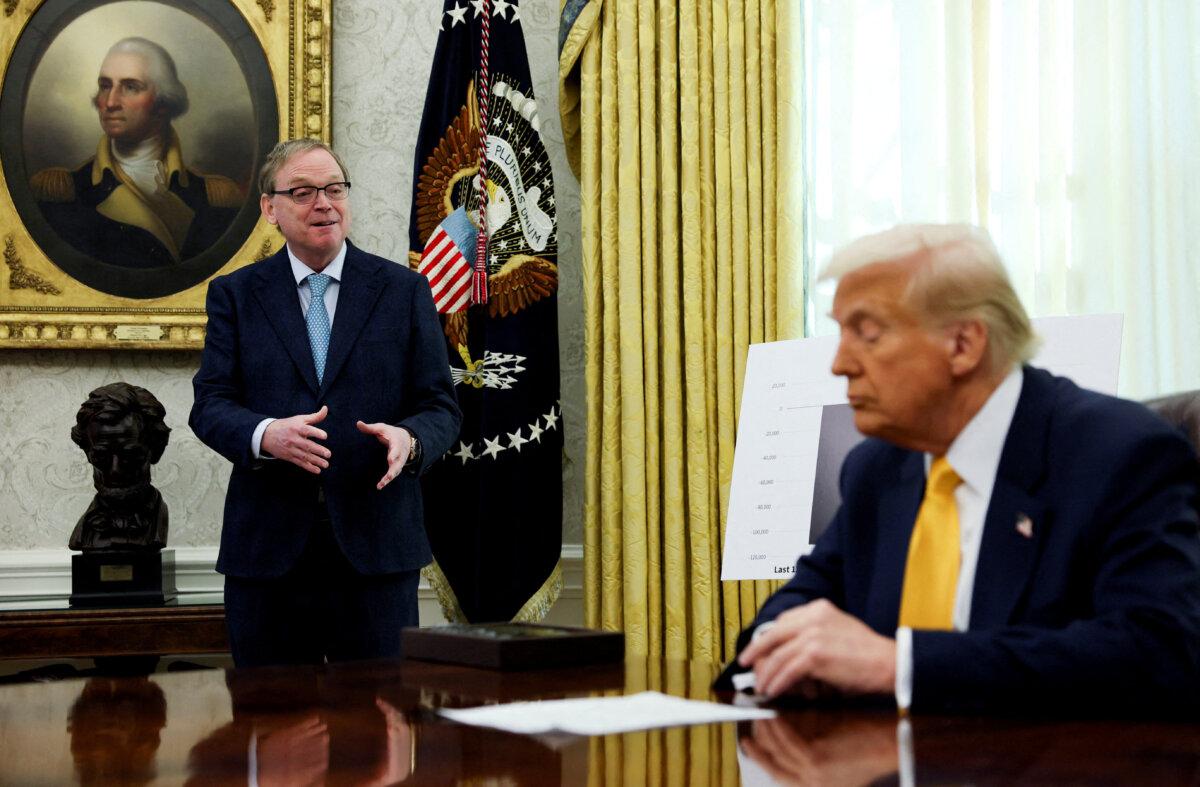
“I think that what we’re focusing on this week—obviously, there’s been quite a bit going on—but I had to call on a reconciliation package question with [Commerce Secretary] Howard Lutnick yesterday. He picked up right away, and he was in the middle of trade negotiations,” Hassett said.
Hassett noted that numerous trade agreements could be announced around the Fourth of July.
“And so there’s still a lot of moving parts, but the parts are moving in a good direction,” he added.
So far, the United States has reached a deal with the United Kingdom and agreed to a temporary arrangement that would lower tariffs on China to 55 percent.
Consumer Confidence
While trade uncertainty might have peaked in April, concerns surrounding the economy’s future persist.“Consumer confidence weakened in June, erasing almost half of May’s sharp gains,” Stephanie Guichard, a senior economist of global indicators at The Conference Board, said in the report.
The write-in survey responses suggested that tariffs continue to be on the top of consumers’ minds, “and were frequently associated with concerns about their negative impacts on the economy and prices,” she said.
The University of Michigan’s final estimate for the June Consumer Sentiment Index will be released on June 27. It is expected to highlight a rebound from the previous month.