In the first four full months under the Trump administration, February to May, three saw net foreign acquisitions of about $250 billion per month.
This is a big change from the February to May period under the Biden administration in 2024, when the monthly net foreign acquisitions were below $100 billion, except in March 2024, when it hit $104 billion.
Both foreign and U.S. residents increased their holdings in long-term U.S. securities in May, with net purchases jumping by $318.5 billion and $59.1 billion, respectively—an indication of an expected long-term stability in the U.S. economy.
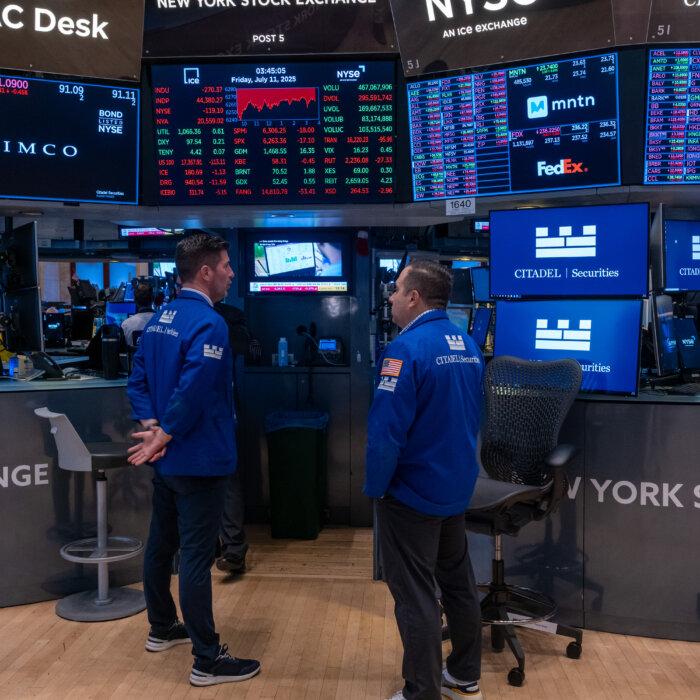
The higher level of net foreign acquisitions over the past months came amid the Trump administration’s push to boost U.S. investments and manufacturing.
The initiative focuses on attracting investments through measures such as cutting down regulatory burdens, speeding up permitting, and increasing access to national resources.
“An Investment Accelerator is needed to cut through red tape and ensure that businesses can quickly deploy capital and create jobs without navigating a maze of bureaucratic hurdles,” the White House stated at the time.
“By streamlining processes, the Accelerator will attract both foreign and domestic investment, reinforcing America’s position as the premier destination for large-scale investment.”
Major international companies have announced multibillion-dollar investments in the United States in recent months.
The CHIPS Act was passed in 2022 and allocated $53 billion in federal incentives for boosting the country’s semiconductor sector.
Lutnick highlighted TSMC raising its investment by $100 billion.
“We’re getting more value for the same dollars,” he said. “Are we renegotiating? Absolutely, for the benefit of the American taxpayer, for sure.”
“Today’s commitments guarantee that the future will be designed and built right here in Pittsburgh, in Pennsylvania, and I must say, in America,” he said.
Speaking at the event, Sen. Dave McCormick (R-Pa.) highlighted the need for bipartisan cooperation to push America forward.
“In our different parties, we have plenty of differences, but on this, we agree,” he said. “We agree that we need to be at the crossroads of the energy revolution, the AI revolution, and to have a leadership position. We need to show a unified front at the local level, at the state level, at the national level.”