The national labor market has remained resilient over the past year, serving as a constant in an otherwise uncertain economic climate.
Employers and workers have navigated numerous developments since Labor Day 2024—from the 2024 presidential election to President Donald Trump’s global tariffs.
US Labor Market–Then and Now
Wall Street was in a state of panic heading into the Labor Day long weekend in 2024, as an uptick in the unemployment rate triggered the Sahm Rule.The Sahm Rule is a recession indicator developed by Claudia Sahm, an economist formerly at the Federal Reserve. When the three-month moving average of the jobless rate rises by 0.5 percentage points from its low over the preceding 12 months, it signals that the United States could be in the early stages of a recession.
In the July 2024 jobs report, the unemployment rate rose to 4.3 percent, the highest since October 2021, effectively activating the Sahm Rule.
Months later, economists viewed it as a false alarm because the economy continued expanding, the labor market still created jobs, and the unemployment rate stabilized at around 4 percent.
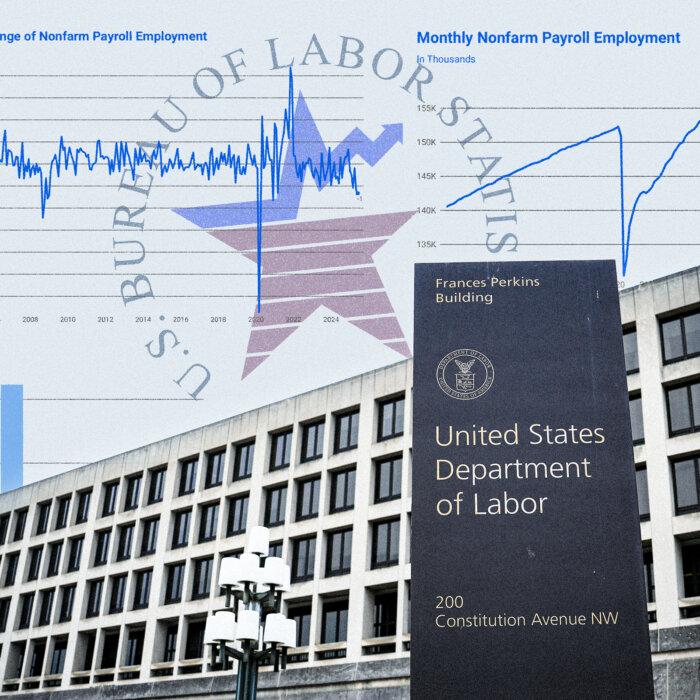
Today, while recession fears have dissipated immensely since the April peak of tariff-driven uncertainty, employment conditions could be deteriorating.
The adjustments also reduced the three-month moving average to a paltry 35,000. By comparison, for the same period in 2024, the three-month moving average was 170,000.
While job growth may be slowing, other metrics are also in play.
The labor force participation rate—the percentage of individuals employed or actively seeking work—declined to 62.2 percent from 62.7 percent.
Average weekly hours have ranged between 34.1 and 34.3.
Other trends that have persisted over the past year are low layoffs, steady resignations, and slower hiring levels. Economic observers have attributed this freeze to employers monitoring the broader economy to determine whether it is heading into a downturn or will emerge unscathed from changes to trade policy.
“Economic activity data show the economy is expanding at a moderate pace, while the jobs data are losing momentum,” Bill Adams, chief economist for Comerica Bank, said in a note emailed to The Epoch Times.
Notable Trends
Several trends have emerged in the U.S. labor market this year.Government Payrolls
As part of the current administration’s efforts to shrink the size of the U.S. government, the direction of federal payrolls is now heading downward.
American Workers
Another significant development in the job market this year has been the narrowing employment gap between employed U.S.- and foreign-born workers.Blue Collar Wage Boom
This past spring, the Treasury Department released data showing real blue-collar wages posting their most significant gain in almost 60 years.Inflation-adjusted hourly wages grew by 1.7 percent in the first five months of 2025 for production and non-supervisory workers.
Looking Ahead
Recent indicators suggest that small-business owners have become more optimistic than they were in the spring.“While uncertainty is still high, the next six months will hopefully offer business owners more clarity, especially as owners see the results of Congress making the 20 percent Small Business Deduction permanent and the final shape of trade policy,” Bill Dunkelberg, chief economist for the National Federation of Independent Business, said in a statement.
Findings from the bimonthly survey also show that 55 percent of respondents stated that hiring has not become any easier.
“At RedBalloon, we’re definitely seeing momentum in the talent market,” Andrew Crapuchettes, CEO of RedBalloon, said in a statement, adding that he sees the economy “emerging from a time of labor market turmoil into a sustained march forward.”
By the fourth quarter of 2025, the unemployment rate is forecast to edge up to 4.4 percent from the current 4.2 percent. Payroll growth is predicted to average 70,700.
Ultimately, according to Jeffrey Roach, chief economist for LPL Financial, the labor market’s strength or weakness will influence growth prospects.
“We still expect Q3 GDP to be close to zero, but the outlook for 2026 GDP growth could improve if the labor market holds and credit availability improves,” Roach said in a note emailed to The Epoch Times.