U.S. automakers reported mixed June sales in an increasingly electrified market, with Ford, General Motors (GM), and Toyota rolling out dozens of new electric vehicle (EV) models and hybrids to give consumers more affordable options—and to close the gap with Tesla.
Ford posted a 14.2 percent jump in second-quarter sales to 612,095 vehicles, with market share climbing to an estimated 14.3 percent, up 1.8 percentage points from the first quarter, the company announced on July 1.
The legacy automaker has been investing heavily in what it calls “powertrain choices”—a lineup spanning gas, hybrid, electric, and diesel vehicles—aimed at making cars affordable to mass-market consumers, much as it did more than a decade ago. It is a direct challenge to both Tesla and Chinese EV makers.
For the first half of the year, Ford sold a record 156,509 EVs, up 14.7 percent, led by the Mustang Mach-E, F-150 Lightning, and E-Transit. Hybrid sales jumped to 117,521, driven by strong demand for the Maverick Hybrid and F-150 Hybrid. EVs accounted for 13.5 percent of Ford’s total second-quarter volume.
“We blew the doors off the overall industry with our second-quarter sales,” said Andrew Frick, president of Ford Blue and Model e, and interim head of Ford Pro. “Customers continue appreciating our broad powertrain choices—gas, hybrid, electric, and diesel—digital productivity tools that save time and money, and our Ford Motor Company: From America, For America commitment.”
GM told a different story. The automaker sold 714,896 vehicles in the second quarter, down 4 percent, weighed down by a shrinking EV market, discontinued models, and inventory constraints, the company reported on July 1.

Still, GM held onto its number-one U.S. sales position, driven by enduring demand for pickup trucks and SUVs. Cadillac delivered its best-ever second-quarter EV sales, supported by the OPTIQ and VISTIQ, and the V-Series posted its best quarter and best first half on record. GM also continued offering six Chevrolet and Buick models with starting MSRPs of around $30,000 or less—a pointed play for affordability.
“Our business is performing well, and customer demand is resilient, especially for our trucks and SUVs,” Duncan Aldred, GM’s president of North America, said. “The depth, breadth and appeal of our vehicle portfolio allows us to lead the market in sales, while maintaining discipline on inventory, pricing and incentives to deliver strong margins.”
Toyota’s results were the most impressive among the legacy automakers. Toyota Motor North America on July 1 reported June U.S. sales of 212,793 vehicles, a 10.1 percent annual increase, with EVs totaling 122,063 units—up 35 percent—and representing 57.4 percent of total sales volume. volume.
Toyota was a deliberate latecomer to the EV market, betting that mass consumers were not yet ready to abandon the gas pump. That hybrid-first strategy has paid off, with the RAV4 Hybrid posting an all-time sales record. Now, Toyota is moving quickly toward full electrification, with 33 EV options across the Toyota and Lexus brands.
“Strong demand and disciplined inventory management have fueled consistent gains versus a year ago, and accelerating interest in our electrified vehicles—with month-over-month growth throughout the quarter—reinforces that our multi-pathway approach is resonating,” said Andrew Gilleland, senior vice president of automotive operations at Toyota Motor North America.
He added that, with a range of vehicles starting under $35,000, Toyota is well-positioned to make EVs more accessible while delivering value across its lineup of electric, hybrid, and gasoline-powered vehicles.
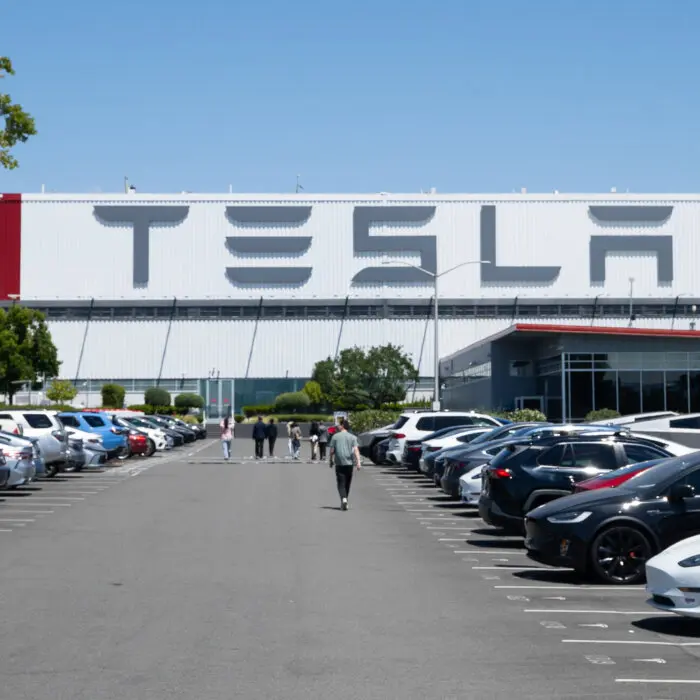
Tesla, meanwhile, on July 2 reported second-quarter deliveries of 480,126 vehicles, up 25 percent from a year earlier—a period in which the company struggled through a difficult Model Y transition, the elimination of EV tax credits, and political backlash against CEO Elon Musk.
Three Headwinds
Wall Street’s reaction to the sales reports was mostly negative. Ford and GM shares fell 1.87 percent and 2.02 percent, respectively, following the release of their sales data, while Toyota gained 0.8 percent.
The biggest surprise, however, was Tesla: despite reporting better-than-expected deliveries, its shares tumbled 7.49 percent in a sell-the-news reaction. Investors had expected more from the EV pioneer, which carries an astronomical valuation, with a forward price-to-earnings ratio of 217, compared to 8 for Ford, 6 for GM, and 10.6 for Toyota.
The mixed results land at a difficult moment for the industry. Personal consumption spending on new vehicles has been declining steadily since 2023.
Three headwinds define the current landscape. First, the expiration of EV subsidies, the introduction of tariffs, and regulatory rollbacks are reshaping both supply and demand. Second, consumers have been drifting away from battery-electric vehicles since 2024, gravitating toward hybrids and combustion-engine vehicles instead. Third, overall vehicle affordability remains a persistent issue.
According to Deloitte’s 2025 Global Automotive Consumer Study, conducted between October and December 2024, interest in all-battery EVs remained muted across most markets, while demand for internal combustion engine and hybrid vehicles grew.
The Department of Transportation data reinforce the trend: hybrid-electric vehicle sales jumped more than 75 percent from 2023 to 2025, while EV sales grew only modestly—a gap likely to widen following the loss of government EV subsidies.
The appeal of hybrid vehicles is straightforward. Compared with EVs, hybrid vehicle buyers benefit from an established fueling infrastructure, better fuel efficiency, stronger performance in extreme weather, and more predictable resale values, according to a Kelley Blue Book analysis.
Affordability
This growing market fragmentation—with legacy automakers offering consumers a spectrum of powertrain choices—poses a mounting challenge for Tesla, and an opportunity for Toyota, which leads in hybrids and is now an aggressive EV competitor, according to some analysts.
“Tesla still holds a lot of the EV attention in people’s heads, mostly because of Elon, but without major new mass-market models, that momentum will start to dwindle,” Rich Pleeth, CEO and co-founder of Finmile, told The Epoch Times. “Toyota, on the other hand, is taking a more pragmatic route, with hybrids, plug-in hybrids, and EVs that fit how customers live.”
Ashley NeSmith, founder of Ashley the Auto Advocate, said affordability is the biggest challenge in the auto sector.
“The companies that will win over the next few years are the ones that build the vehicles people actually want and price them at a level people can actually afford,” she told The Epoch Times.
According to Cox Automotive’s June 9 report, the average new-vehicle transaction price was $49,220 in May, down slightly from $49,456 in April but up 1.2 percent from May 2025, and well above the pre-pandemic full-year average of $38,363 in 2019.