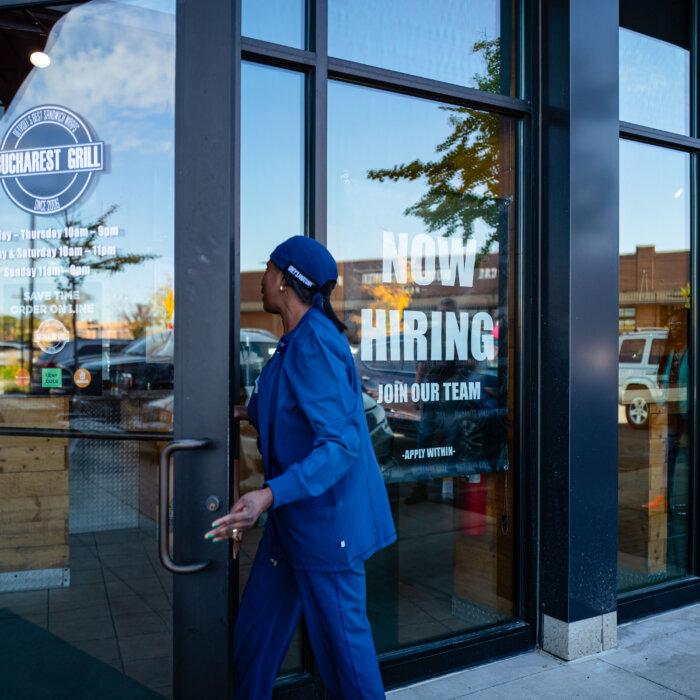
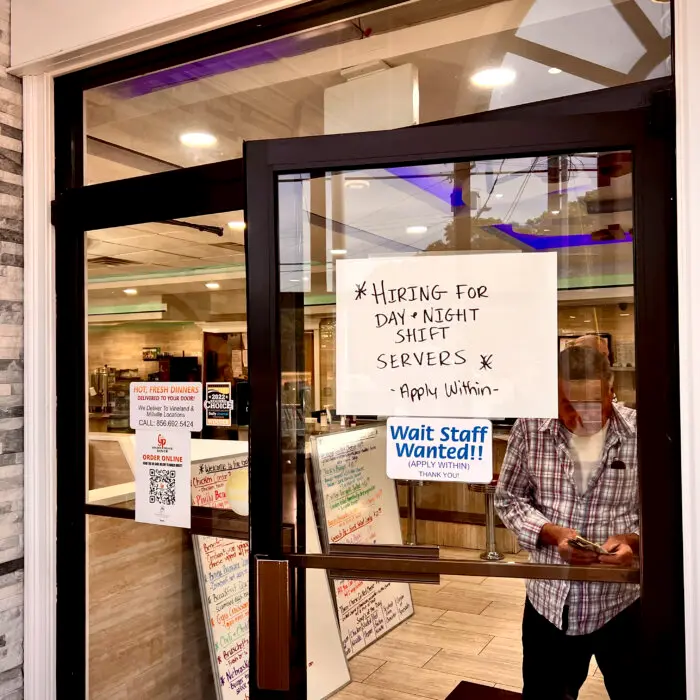
Hiring momentum cooled sharply in June as the economy added fewer jobs than expected.
Employers added 57,000 new jobs last month, from May’s 129,000 gain, according to new data from the Bureau of Labor Statistics released on July 2.
The consensus forecast had penciled in a gain of 110,000.
The unemployment rate unexpectedly slipped to 4.2 percent, from 4.3 percent, also coming in below economists’ estimates.
This was largely driven by a dip in the labor force participation rate, which fell 0.3 percentage points to 61.5 percent.
Changes to employment dynamics—less immigration and lower workforce participation—are widely expected to keep the jobless rate subdued amid a low breakeven rate.
Following the weather-driven two-month volatility to kick off the year, employment conditions had substantially improved heading into the summer. Layoffs remained low and labor demand kicked into high gear as companies shrugged off various headwinds.
Job growth was driven by professional and business services (36,000) and social assistance (25,000). Health care payrolls also climbed by 22,000.
Leisure and hospitality shed 61,000 positions, “reflecting weaker than usual seasonal hiring,” the bureau said. This partially reversed the sector’s employment gains in recent months, fueled by the World Cup.
The private sector accounted for almost all of June’s payroll growth, with government jobs increasing by just 8,000.
Revisions were also sizable, with April and May’s nonfarm payrolls adjusted lower by a combined 74,000.
Wages were little changed in June as average hourly earnings rose 0.3 percent month-over-month and ticked up to 3.5 percent year-over-year. Both readings were in line with consensus estimates.
Upward inflationary pressures over the last few months have eroded workers’ earnings. The federal agency reported that real (inflation-adjusted) average hourly and weekly earnings slid 0.1 percent and 0.2 percent, respectively, from April to May.
But cooling price pressures amid stabilizing global energy markets could slow the trend.
Average weekly hours, meanwhile, were also flat at 34.3. The number of people employed full-time declined by 514,000 full-time, while part-time jobs were little changed.
More people took on an additional position in June, with the total number of multiple jobholders climbing by more than 120,000 to 8.554 million.
Since the monthly jobs report was released one day earlier due to the Fourth of July long weekend, it coincided with the latest weekly unemployment claims.
Initial jobless claims—the number of Americans filing applications for unemployment benefits—fell by 1,000 to 215,000 for the week ending June 27, also coming in below the market forecast. Continuing jobless claims—the number of out-of-work individuals receiving benefits—was flat at 1.814 million.
Market Reaction
Investors cheered the jobs report missing estimates, as markets repriced their interest rate expectations.
The leading benchmark averages were up as much as 0.6 percent in pre-market trading after the employment numbers.
“While the headline may be negative—slowing job growth—there could be a silver lining to markets as it could force some of the more hawkish Fed governors to reconsider quickly raising rates to fight inflation,” Chris Zaccarelli, CIO for Northlight Asset Management, told The Epoch Times in an emailed note.
“Lately the narrative has been around inflation—which remains too high—but if the employment mandate is brought back into play, it can increase the odds of leaving rates on hold, which all things being equal, would be much better for the market.”
Futures market data show that traders pushed out their rate-hike forecast to December from September, according to CME FedWatch.
The 2-year Treasury yield—a reflection of Federal Reserve policy—erased almost 4 basis points to around 4.13 percent.
The U.S. Dollar Index—a measure of the greenback against a weighted basket of currencies—surprisingly tanked 0.7 percent on July 2. The dollar usually strengthens on forecasts of tighter monetary policy.
The dollar remains up more than 2 percent year-to-date.
Federal Reserve Chairman Kevin Warsh, speaking at a European Central Bank event in Portugal, stated that inflation is still “too high.”
“We’re all in the price stability business; that might not be our only business, but if there was a common thing I heard over the last couple of days, it was open-mindedness on these questions of AI, open-mindedness on productivity, but we’ve all looked around, and we’ve seen that prices are too high,” Warsh said.
The Fed will hold its next two-day policy meeting on July 28–29.