Shares of AI chipmaker Nvidia surged more than 5 percent in after-hours trading on May 28 after the tech titan reported better-than-expected earnings and revenues.
The company recorded revenues of $44.06 billion, higher than the market estimate of $43.31 billion. Earnings per share came in at 96 cents, slightly above the consensus forecast of 93 cents.
Demand for Nvidia’s crucial AI infrastructure and data center division, which comprises AI chips and related components, surged 73 percent year over year to $39.1 billion.
“Global demand for Nvidia’s AI infrastructure is incredibly strong,” said CEO Jensen Huang in a statement attached to the first-quarter earnings report.
“Countries around the world are recognizing AI as essential infrastructure, just like electricity and the internet, and Nvidia stands at the center of this profound transformation.”
Revenues of its gaming division, which includes chips for playing 3D games and provides a processor for the new Nintendo Switch 2 console, surged 42 percent from the previous year to $3.8 billion.
Net income advanced 26 percent from a year earlier to $18.8 billion.
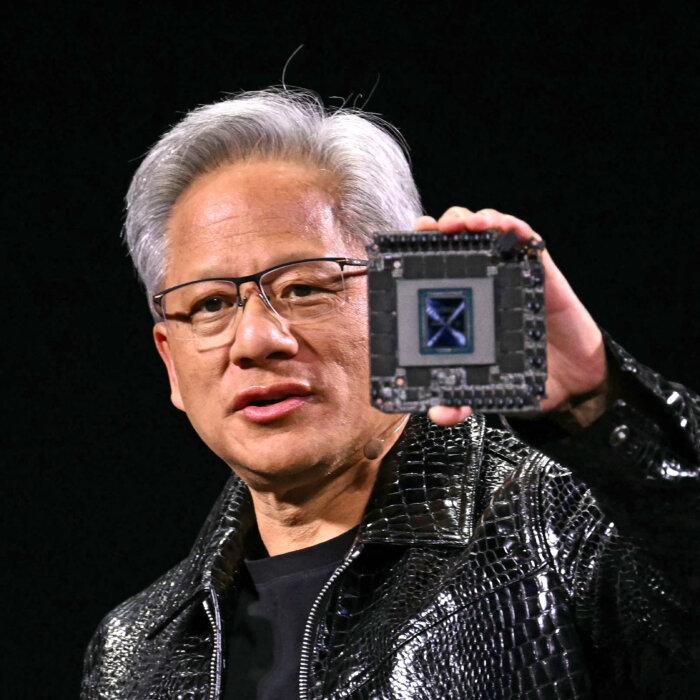
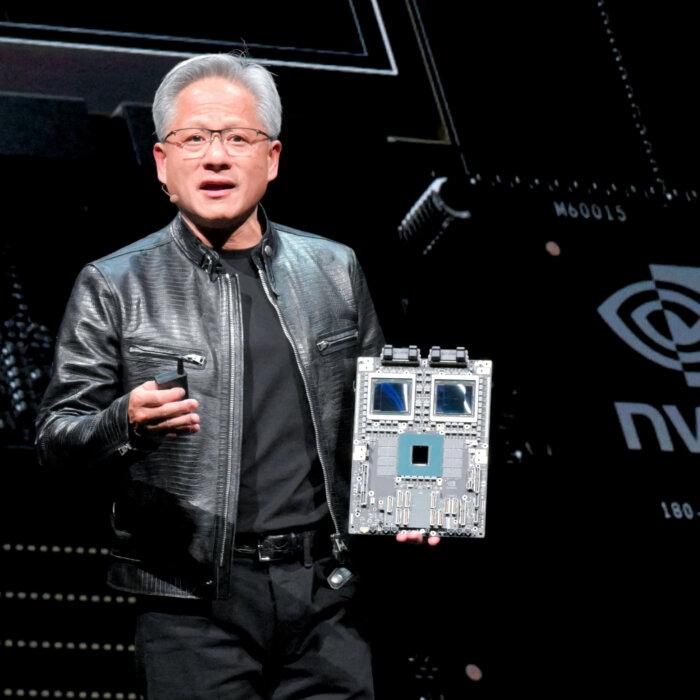
The company also announced that its Blackwell NVL72 AI supercomputer, which Nvidia describes as a “thinking machine designed for reasoning,” is in full-scale production across cloud service providers and system makers.
Nvidia anticipates $45 billion in sales in the current quarter and noted that its guidance would have been about $8 billion higher if not for the U.S. government’s export restrictions in chip shipments to China.
Challenges and Optimism
Investors had been waiting for confirmation on the impact of China’s restrictions—and the Trump administration’s easing of them.Last month, the White House penned a letter to Nvidia, informing the tech titan that it would require an export license for the company’s H20 chip.
This is another iteration of its Hopper processor, specifically designed for the Chinese market to comply with U.S. government restrictions.
The Bureau of Industry & Security also rolled out extra steps to bolster export controls on semiconductors.
Since the 2022 artificial intelligence boom, U.S. officials have feared that the Chinese regime could exploit AI chips from Nvidia and its industry rivals for economic and military purposes.
Huang, meanwhile, praised the Trump administration’s decision and the president’s “visionary” reindustrialization policies.
“The president would like American technology to win with Nvidia and American companies to sell chips all over the world and to generate revenues, tax revenues, invest and build in the United States,” Huang said in Sweden on May 24.
In April, Nvidia announced it would invest up to $500 billion over the next four years to construct AI infrastructure across the United States.
Despite the latest turbulence, market analysts are optimistic about Nvidia’s prospects, particularly after the 90-day U.S.-China tariff pause.

“In our view, Nvidia remains the premier Artificial Intelligence stock and the dominant leader in GPUs,” said Larry Tentarelli, the chief technical strategist at Blue Chip Daily Trend Report, in a note emailed to The Epoch Times.
Nvidia could add another component to the latest U.S. stock market rally, says Ipek Ozkardeskaya, a senior analyst at Swissquote Bank.
Big Tech Rebound
Flying high in April and shot down in May? It has been quite the opposite for Big Tech stocks this month.Despite the broader market meltdown in the aftermath of President Donald Trump’s April 2 global tariff announcement, the U.S. stock market has rebounded over the last several weeks, led by tech stocks, including Nvidia.
“Tech stocks have seen a fantastic turnaround since early April, shifting market sentiment significantly. This is a great backdrop for Nvidia,” said Joe Tigay, a portfolio manager at the Rational Equity Armor Fund, in a note emailed to The Epoch Times.
“While the broader market has been a rollercoaster, NVIDIA’s fundamental company performance has never faltered. They continue to innovate and execute.”
Over the past month, the tech-heavy Nasdaq Composite Index has rallied more than 10 percent. It has pared most of its losses this year and is down just 0.5 percent.
The so-called “Magnificent Seven” has mostly surged in May.
Shares of Tesla Motors have rocketed close to 27 percent.
Google’s parent Alphabet and Amazon have risen 7 percent and 10 percent, respectively.
Microsoft and Meta Platforms have soared 17 percent.
Apple has been the lone stock that has struggled to maintain momentum amid the president’s tariff threats.
Shares of Apple are down more than 4 percent.
Last week, Trump said he would impose a 25 percent tariff on the iPhone maker unless the company manufactured its signature product in the United States.
“I have long ago informed Tim Cook of Apple that I expect their iPhones that will be sold in the United States of America will be manufactured and built in the United States, not India, or anyplace else. If that is not the case, a Tariff of at least 25 percent must be paid by Apple to the United States,” Trump said in a May 23 Truth Social post.
National Economic Council director Kevin Hassett stated on May 27 that the White House does not seek to “harm Apple” with levies.
“In the end, we’ll see what happens, we’ll see what the update is, but we don’t want to harm Apple.”
Apple will release its next earnings report on July 23.