Tennessee will be the site of the United States’ first privately owned nuclear fuel recycling plant, converting tons of radioactive waste into usable fuel.
Oklo Inc., a nuclear technology company, announced on Sept. 4 that it will build a $1.68 billion advanced nuclear fuel recycling facility on a 247-acre site in Oak Ridge, Tennessee. The plant will recycle spent fuel from nuclear power plants and is projected to create more than 800 new jobs in the process.
Oklo is the fifth nuclear technology company to build in Tennessee with the state’s $70 million Nuclear Energy Fund, which supports nuclear power-related businesses and nuclear education programs in the state’s universities and research institutions.
“With assets like Oak Ridge National Laboratory, a rich history in the nuclear industry and leadership that stands ready to support Oklo’s next steps, we know Tennessee is the ideal location for this project and the company’s continued nuclear efforts,” Stuart McWhorter, commissioner of the state’s Department of Economic and Community Development, told The Epoch Times.
“[The creation of Tennessee’s Nuclear Energy Fund] shows our state is able and willing to help do whatever it takes to take America into the next steps of energy dominance. We know this is just the next step—not the final step—for our great state as it becomes a clean energy capital of the world, and we’re grateful to welcome Oklo to the Tennessee family.”
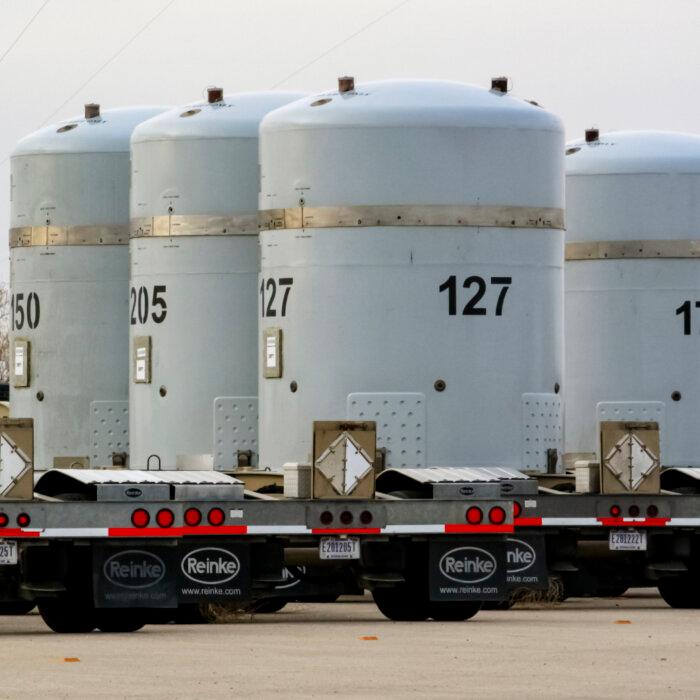
After about five years, the fuel no longer generates fission reactions but remains highly radioactive, at which point the materials are removed from the reactor and sealed in welded stainless steel canisters, typically on-site. According to Oklo, the energy that can be derived from this material equals about 1.3 trillion barrels of oil, five times the reserves of Saudi Arabia.
According to the terms of the 1982 Nuclear Waste Policy Act, the Energy Department was to be responsible for the safe disposal of nuclear waste, but has thus far not received funding to build a planned repository at Yucca Mountain in Nevada.
Domestic production of uranium peaked in 1980, according to the Energy Information Administration. Currently, the United States’ foreign suppliers of uranium are Russia (12 percent), Kazakhstan (25 percent), Uzbekistan (11 percent), Canada (27 percent), Australia (9 percent), and other foreign nations (16 percent).
Companies such as Oklo say that recycling is the solution to both the storage and the supply problem and that the process has been in profitable use in other countries for decades. Orano, one of the world’s largest commercial recycling companies, is based in France with a U.S. subsidiary. It has reprocessed more than 40,000 metric tons of used nuclear fuel worldwide since 1976.
Orano reprocesses spent fuel, which it collects from France, Japan, the Netherlands, Belgium, Switzerland, and Germany, to generate electricity in nuclear reactors, according to the company’s communications director, Curtis Roberts. The company estimates that 10 percent of France’s electricity comes from recycled nuclear fuel.
Oklo said it is currently in the process of acquiring licenses for the Tennessee recycling facility from the U.S. Nuclear Regulatory Commission. The facility in Tennessee is expected to begin producing fuel by the early 2030s, subject to regulatory approvals.
Oklo is also developing fast-fission power plants and is exploring opportunities with the Tennessee Valley Authority (TVA), an electricity utility, to recycle the TVA’s used fuel and to sell electricity from Oklo plants in the region to TVA.
“AI has triggered a Sputnik moment, accelerating the demand for dependable domestic power,” Schweiger said, citing reports that AI data centers would drive a 160 percent increase in power demand through 2030.
In addition to being the location for Oklo’s new recycling plant, Oak Ridge, Tennessee, became famous as a site of the Manhattan Project and the race to create a nuclear bomb during World War II.