Brent crude oil futures prices surged late on April 12 following the United States’ threat to block Iranian ports after negotiations to end the conflict failed, as Iran refused to agree to U.S. terms to give up its nuclear program.
Oil prices hit a high of $103.49 per barrel on April 12 after closing at $95.20 on April 10.
“Effective immediately, the United States Navy, the Finest in the World, will begin the process of blockading any and all Ships trying to enter, or leave, the Strait of Hormuz,” Trump said in an April 12 post on Truth Social.
The U.S. Central Command (CENTCOM) later clarified that the blockade, set to begin on April 13 at 10 a.m. ET, or 5:30 p.m. local time in Iran, will apply only to maritime traffic “entering and exiting Iranian ports.” U.S. forces will not impede freedom of navigation for vessels traveling the strait “to and from non-Iranian ports.”

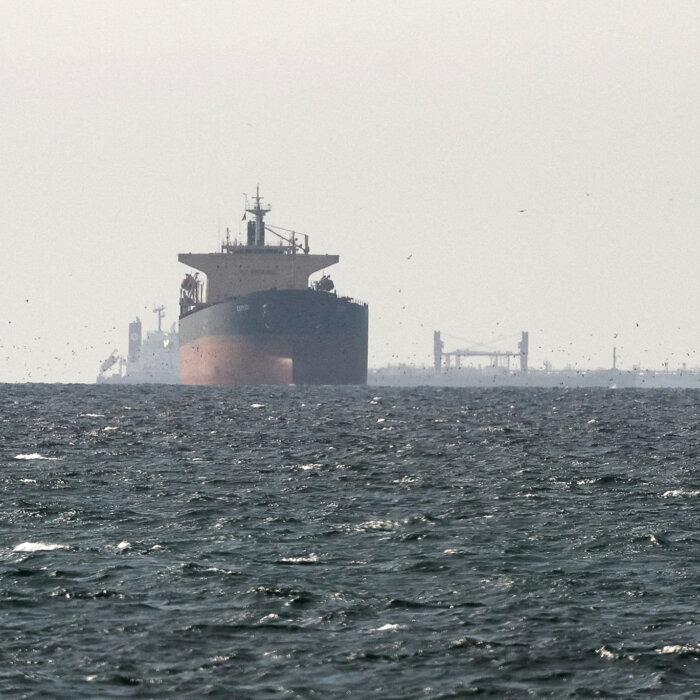
Iran allegedly charged some ships $2 million to pass through the strait last week, and five ships reportedly paid the fee.
US Clearing Iranian Mines
In another April 12 post on Truth Social, Trump criticized Iran for dropping mines in the Strait of Hormuz.“They say they put mines in the water, even though all of their Navy, and most of their ‘mine droppers,’ have been completely blown up,“ he wrote. ”They may have done so, but what ship owner would want to take the chance?”
Oil Market
About 25 percent of global seaborne oil trade transited the Strait of Hormuz in 2025, and options to bypass this critical passageway are limited, according to the International Energy Agency.Only the United Arab Emirates and Saudi Arabia have pipelines that could potentially reroute oil flows to bypass the strait, the agency said. Other oil-exporting nations such as Iraq, Iran, Bahrain, Qatar, and Kuwait are dependent on the strait to ship their energy exports.
As such, as long as transit through the Strait of Hormuz remains uncertain, oil prices will likely remain higher.
Jim Krane, Energy Research Fellow at Rice University, said the U.S. blockade might be effective as a long-term strategy to impose pain on the Iranian economy, but it isn’t a good short-term negotiating tactic when the oil market is already under strain.
“If the deficit to the oil market takes another jump, it is going to impose pain on every person on Earth that’s subject to market oil prices,” Krane said.
Claudio Galimberti, chief economist of Rystad Energy, said the blockade will raise prices but might move the needle on talks.
“It means the oil markets will be even tighter than before,” Galimberti said. “However, I think this is a negotiation tactic, which eventually resolves into a full opening of Hormuz. So, more pain now, but more gain later.”
But even if passage through the Strait of Hormuz were to normalize, it could still take some time before oil markets calm down.
“Output has already been reduced at oil and gas fields, while refinery operations have been curtailed or temporarily shut, suggesting that some supply disruptions may take weeks, or longer, to fully reverse,” ING Bank said in an April 10 post.
Trump said on April 11 on Truth Social that large numbers of empty oil tankers were “heading, right now, to the United States to load up with the best and ‘sweetest’ oil (and gas!) anywhere in the World.”
In the United States, the price of regular gasoline averaged $4.12 per gallon on April 12, up from $3.59 a month back, according to data from the American Automobile Association.
In California, Hawaii, and Washington, prices exceeded $5 per gallon.