Commentary
Home prices rise another percent according to Case-Shiller. The Fed does not even count that as inflation.
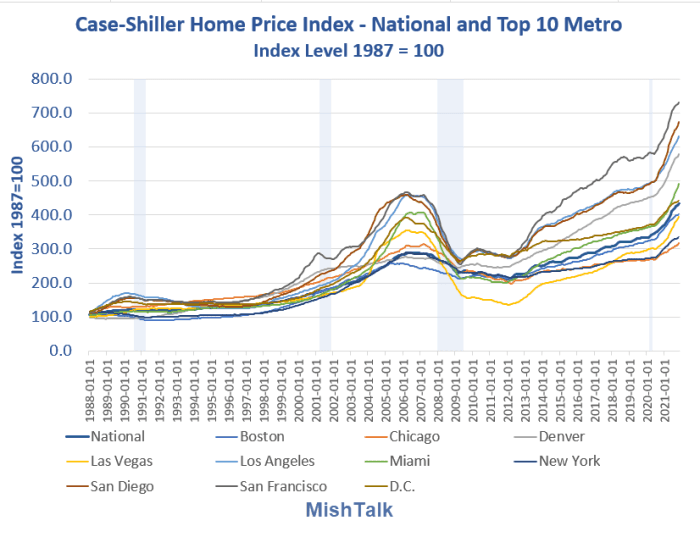
Case-Shiller National and Top-10 City Home Price Indexes—Data via St. Louis Fed. Chart by Mish
Home prices jumped again in November according to the latest Case-Shiller Home Price Report.
- 10-City: +0.93 percent
- 20-City: +0.99 percent
- National: +0.90 percent
CS National, Top 10 Metro, CPI, Owners’ Equivalent Rent (OER)
Case-Shiller National and Top-10 City Home Price Indexes—Data via St. Louis Fed. Chart by Mish
Chart Notes
- The above chart shows Case-Shiller home price index compared to inflation measures from the Bureau of Labor Statistics (BLS).
- OER is the mythical price the BLS calculates as if one would rent one’s own house from himself, unfurnished, without utilities.
- Home prices are not directly in the CPI.
- OER is the single largest factor with a weight in the CPI of 23.51 percent. Rent of primary residence is 7.58 percent of the CPI.
This dynamic has fueled more housing speculation. 17 percent of recent home purchases were made by people who already owned a house.
CS National, Top 10 Metro, OER, CPI Year-Over-Year Percent Change
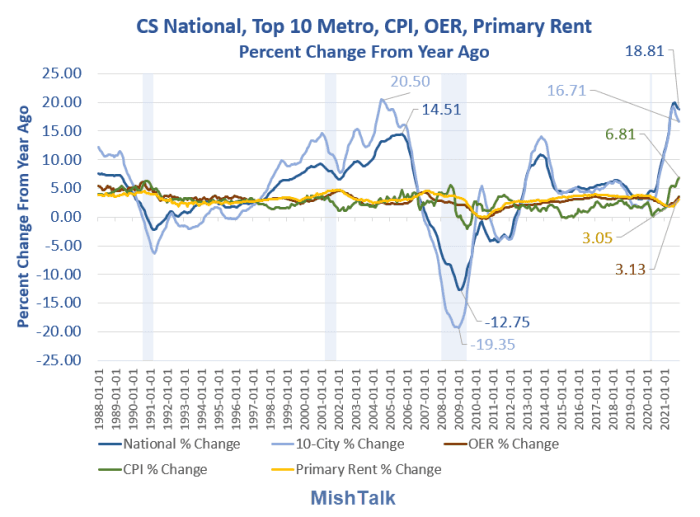
Case-Shiller Home Prices vs OER, CPI, Rent. Chart by Mish
As of November, national home prices are up 18.81 percent from a year ago. The CPI was up 6.81 percent and OER a mere 3.13 percent.
Three Measures of Inflation
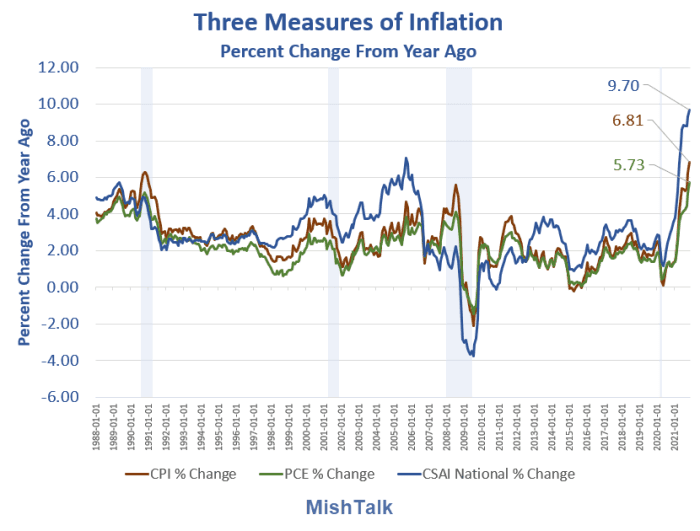
CPI and PCE Measures from the BLS, CSAI Calculation by Mish. Chart by Mish
Chart Notes
- CPI is the Consumer Price Index
- PCE stands for Personal Consumption Expenditures.
- CSAI is a Mish calculation derived by substituting actual home prices in the CPI instead of OER.
Accounting for those paid expenses, PCE overweights health care whereas the CPI overweights housing.
Neither the CPI nor PCE directly includes home prices.
The BLS' rationale is that home prices are a capital good, not a consumer item.
My rationale is so what? The Fed needs to focus on inflation, not just alleged consumer inflation.
Fed Twiddles Thumbs
With its myopic focus on consumer prices instead of all prices, the Fed blew yet another asset bubble.Prices of all sorts have been skyrocketing. Ask anyone looking to buy a home what it feels like.
An asset bubble has been brewing for years with Fed Chair Jerome Powell twiddling his thumbs. More accurately, Powell wanted higher inflation to make up for the alleged lack of prior inflation.
The Fed could not spot huge inflation underway because it ignored housing and other asset bubbles.
Stock Market Plunge Likely
Add it all up and the liquidity drain by the Fed is highly likely to cause another stock market crash or a long, slow drain like what happened in Japan.For further discussion and charts, please see “Stocks Hammered with the Nasdaq Plunging Again as Liquidity Dries Up.”
From MishTalk.com