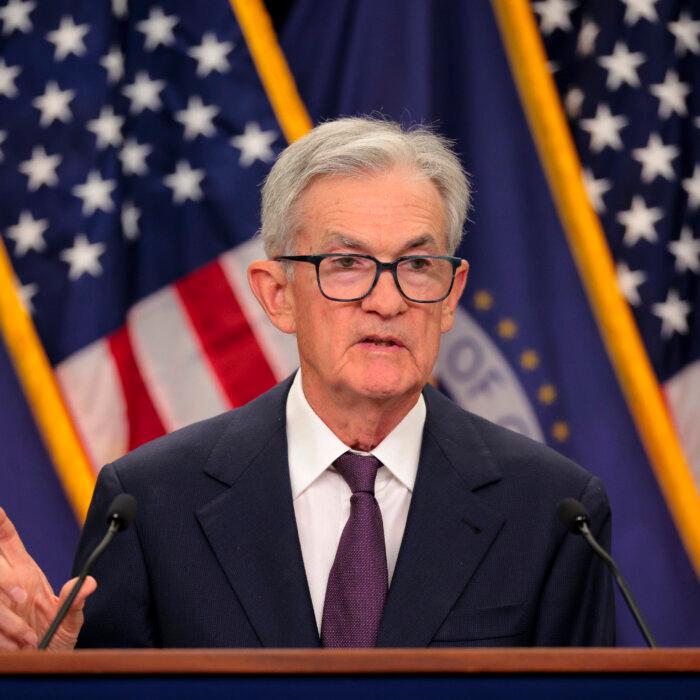
Monetary policymakers voted 11—1 on Sept. 17 to lower the key policy rate to a target range of 4 percent to 4.25 percent after holding rates steady since January. Newly confirmed Fed board member Stephen Miran was the lone no vote, preferring a half-point cut.
Stock Market
Wall Street widely expected the cut. However, investors did not forecast the Fed presenting a more conservative outlook for the next 15 months.Updates to the Summary of Economic Projections—a periodic survey of officials’ expectations for policy and the broader economy—show the Fed penciling in two more quarter-point rate cuts this year. Additionally, policymakers anticipate a single rate cut next year, followed by another reduction in 2027.
Ultimately, the Fed expects the benchmark rate will settle at around 3 percent by the end of 2027. By comparison, before the announcement, the futures market had anticipated the central bank to lower interest rates to 2 percent by late 2026.
U.S. stocks barely moved following the announcement.
The blue-chip Dow Jones Industrial Average finished the day with its gains intact, rising 260 points, or 0.57 percent, to 46,018. The tech-heavy Nasdaq Composite Index and the broader S&P 500 ended the session down 0.33 percent and 0.1 percent, respectively.
Gina Bolvin, president of Bolvin Wealth Management Group, said this was a “measured step” by the Fed.
“For investors, this means modest rate relief, not fireworks. Rate-sensitive sectors like housing and consumer discretionary may benefit, but caution remains key,” Bolvin said in a note emailed to The Epoch Times.
Still, historically, rate cuts have been positive for financial markets when the unemployment rate is low and GDP growth is positive, said David Miller, CIO at Catalyst Funds.
“In this environment, it’s giving a very clear green light that it’s a good time to invest in equities and it’s a good time to invest in fixed income, historically, when you get this type of rate cutting in a strong economy,” Miller said in a note emailed to The Epoch Times.
Mortgage Rates
Recent homeowners and prospective homebuyers could find savings in the mortgage market.The Federal Reserve’s decision-making partly influences yields for U.S. Treasury securities, primarily the benchmark 10-year, which has declined by approximately 30 basis points over the past month to around 4 percent.
Mortgage rates typically track the 10-year, meaning if the central bank continues to cut interest rates, more relief could be coming for households seeking to obtain the American dream of homeownership.
A challenge for mortgage interest rates is the institution’s ongoing balance sheet reduction strategy, said Robert Dietz, chief economist at the National Association of Home Builders.

The Fed has been reducing the size of its balance sheet—which comprises mortgage-backed securities and U.S. Treasury securities—over the past three years, from almost $9 trillion in March 2022 to around $6.6 trillion this month. Although the Fed has not signaled a change to the current program, a hypothetical slowing would reduce mortgage rates by about 25 basis points.
“I think we’re cutting the size of our balance sheet quite largely. As you know, we’re still in abundance reserve condition, and we’ve said that we’ll stop somewhat above an amp reserve level, and that’s what we are,” Powell told reporters.
As for the latest policy decision, it could have a material and direct impact on future housing supply, he noted.
Credit Cards
Credit card interest rates are variable and directly linked to the federal funds rate.Auto Loans
Interest rates attached to auto loans are determined by various factors, such as the type of automobile or the borrower’s credit score. However, auto loan lenders base their rates on the Fed’s benchmark rate.The five-year Treasury yield can partially influence auto loan rates as it serves as a proxy for mid-term borrowing costs.
Savings Yields
Savers should expect lower returns on their savings over time.When the U.S. central bank reduces the federal funds rate, financial institutions earn less on their lending activities, be it business loans or mortgages. To maintain their profit margins, banks will trim the interest they pay on client deposits.
While online entities and credit unions may continue offering better rates than the big banks, their rates will eventually come down.