Distillates are a category of refined petroleum products consisting of heating oil, diesel fuel, jet fuel, and kerosene.
This year, the United States has experienced sharp storage drawdowns, driven by a reduction in the supply of renewable diesel and biodiesel amid slowing output and lower net imports, the EIA said.
Additionally, there has been strong international demand, particularly from major European hubs such as the United Kingdom and the Netherlands. In the first half of 2025, U.S. distillate exports averaged 1.2 million barrels per day—7 percent above the five-year average.
U.S. production has also declined due to the closure of refineries, specifically two locations in California that maintained a capacity of approximately 284,000 per day
“The loss of refining capacity will likely reduce U.S. production of petroleum products, including distillate fuel oil, reducing the output available to restock distillate inventories,” the report stated.


As a result, distillate inventories fell by 17 percent—or 22 million barrels—in the first half of 2025. This is higher than the average decrease of 10 percent over the last four years.
Prices were little changed after the report.
Heating oil futures dipped 0.06 percent to $2.344 per gallon on the New York Mercantile Exchange, one day after registering a more than 2 percent gain.
Distillate fuel production was little changed, totaling 29,000 barrels.
‘Right Now We Are Bleeding’
A new survey by the Federal Reserve Bank of Dallas, released on Sept. 24, showed that oil and gas activity in Texas, Louisiana, and New Mexico declined in the third quarter.Oilfield services firms experienced a modest deterioration across multiple industry indicators, including equipment utilization and operating margins. Demand for employees was flat.
Many survey participants referenced tariffs as negatively impacting their businesses.
“Tariffs continue to increase the cost of production. We are suffering from a combination of increased cost due to tariffs and downward pricing pressure from end users,” said one individual at an oil and gas support services firm.
One person belonging to an exploration and production company noted that the current administration’s levies on steel and aluminum “are increasing our cost of business.”
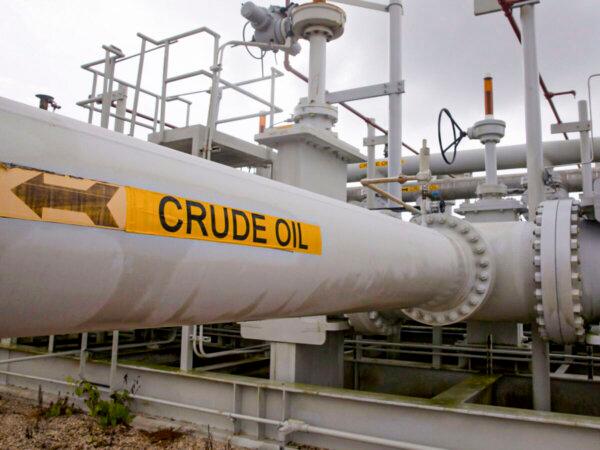
Looking ahead, Dallas Fed survey respondents anticipate the average price for a barrel of West Texas Intermediate (WTI) crude oil will be $63 by the end of the year. They expect U.S. oil prices to be $69 a barrel in two years and $77 per barrel in five years.
Survey participants also forecast natural gas prices will average $3.30 per million British thermal units by year’s end.
Ultimately, the United States requires a “vibrant oilfield services sector,” especially when the country accelerates production, said one respondent. “Right now we are bleeding.”
WTI crude futures advanced $1.58, or 2.49 percent, to finish the Sept. 24 trading session at a seven-week high of $64.99 per barrel. Natural gas futures picked up $0.01 to settle at $2.86 per million British thermal units.
Oil prices have found support following a surprise drop in weekly crude supplies, which fell by 607,000 barrels last week compared with the market forecast of an 800,000-barrel storage injection.
Geopolitical tensions in Eastern Europe also bolstered oil prices after Ukraine struck two crude pumping stations in Russia. Ukraine’s ongoing drone strikes have also damaged Russia’s refining capacity, says Phil Flynn, energy strategist at The PRICE Futures Group.