It’s the worst of times for young Americans looking to buy a home.
Already wracked by years of economic chaos, rapid inflation, and dwindling early-career job prospects, Americans in the millennial and Generation Z cohorts are now facing an affordability crisis when it comes to homes.
While prices are rising for most everything in the United States, the price of both a new home and rent has skyrocketed since 2020—both are up by 25 percent or more.
Affordability Crisis
In the past five years, the cost of housing has exploded in the United States.

Economists typically gauge affordability by comparing median household income with the median cost of a home, according to Robert Dietz, chief economist at the National Association of Home Builders.
“We’re near a decade low measure of affordability,” Dietz said.
American families now need about 25 percent of their monthly income to make a payment on their mortgage, Nadia Evangelou, senior economist and director of real estate research at the National Association of Realtors, told The Epoch Times. That’s up from 16 percent in 2019.
The term crisis is appropriately used when describing the situation, Anirban Basu, chief economist at Associated Builders and Contractors, told The Epoch Times.
Housing Shortage
The primary cause of the affordability crisis is the lack of available housing units. The economists who spoke with The Epoch Times said that a number of long- and short-term trends are contributing to that issue.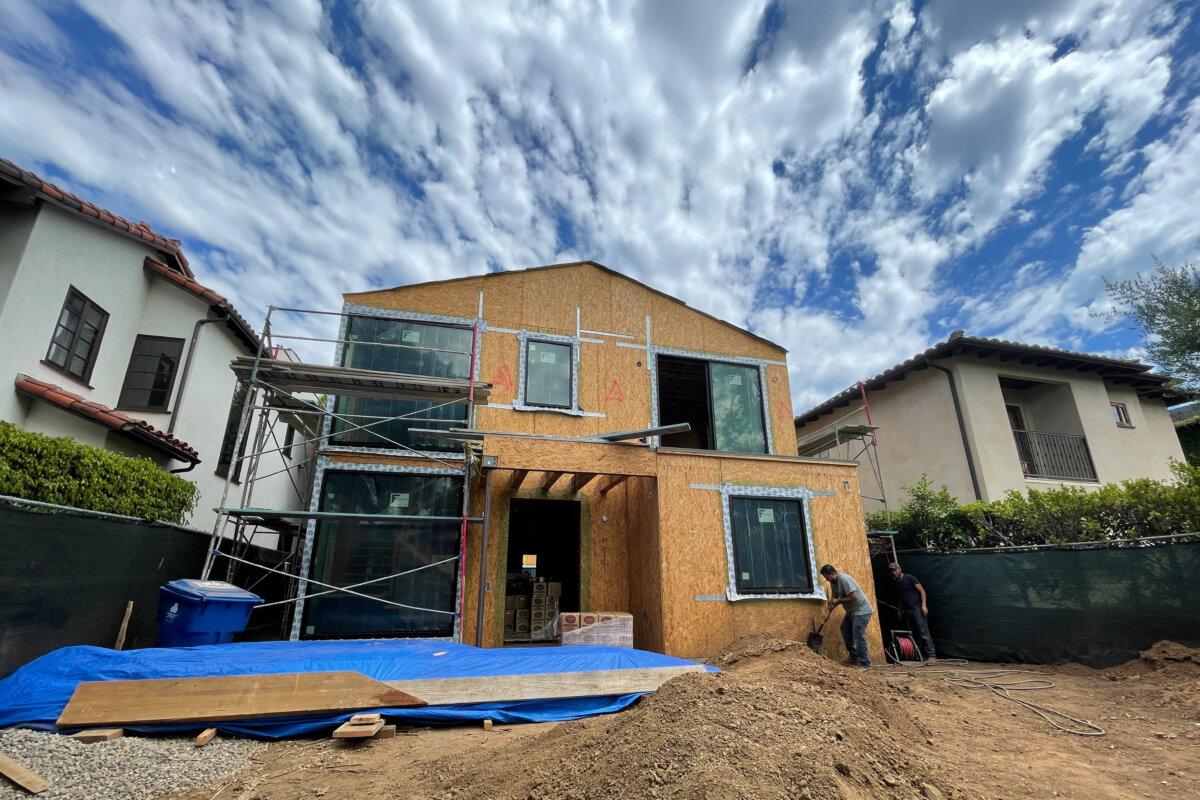
In the simplest terms, Evangelou said, single-family housing in most markets is so expensive right now because there are too many buyers competing for too few houses. When demand exceeds supply, houses get more expensive.
Mortgage Crisis Fallout
The seeds of the current housing shortage were planted nearly 20 years ago, when the U.S. housing market crashed as part of the Great Recession.After the housing market crashed in 2007, Dietz said, financing the construction of a new home became much more difficult. About 60 percent of single-family homebuilding companies are small businesses, which rely on loans themselves to finance the construction of a house. As a result, Basu said, the number of new homes built has lagged behind demand every year for nearly 20 years.
Adding to those challenges, Dietz said more than 1.5 million skilled laborers involved in the building trades have left the workforce in the past two decades. The relative shortage of workers has pushed up labor costs.
Single- and multi-family homebuilders are also disincentivized from building smaller, more affordable homes. Dietz said homebuilders are more likely to get financing on a big, luxury project because it’s likely to make money. Basu said builders tend to make a greater profit on custom-built and luxury housing.
Multi-family housing developers invested heavily in building apartment complexes with luxury finishings and amenities aimed squarely at young professionals in cities with strong job markets, such as Austin, Nashville, and Tampa, Basu said. Developers chose this path because it is profitable for them, while developing low-cost housing is not.
Now, certain markets are overbuilt with luxury apartment housing that cannot get rented, Basu said.
The Lock-In Effect
In the short term, Dietz and Basu pointed to the relatively high interest rate, largely influenced by the Federal Open Market Committee, which determines the benchmark interest and sets the field for mortgage and other loan rates.After the 2007–2009 recession, the Federal Funds Effective Rate dropped to less than 1 percent and remained low until 2015. Eventually, it rose back to about 2.4 percent in 2019. However, the COVID-19 pandemic pushed the rate back below 1 percent, where it stayed until a series of rate hikes that lasted from February 2022 to August 2023 brought the rate up to 5.33 percent.
In the past year, the Fed has steadily dropped the rate. Most recently, the Fed set it at 4.22 percent.
The economists called this a mortgage lock-in effect. Essentially, Americans who secured a long-term loan on a single-family home with an interest rate lower than 6 percent aren’t eager to abandon that deal and take on a new mortgage with a higher interest rate.
Disproportionately, Americans younger than 44 years of age are feeling the worst of the squeeze, Basu said.
Overregulation
Basu and Dietz argued that there is a simple solution to solving the crisis: build more housing. By the laws of economics, the market—incentivized by high prices and consistently strong demand—should be working overtime to boost supply. However, state and local laws in many communities are making it harder for developers to build.Dietz pointed to changing regulations about the size of building lots and the minimum distance between dwellings. When housing lots are comparatively large and the legal requirements call for a significant amount of space between each house and from the street to the front door, builders are pushed to put up bigger, more expensive houses. Zoning laws increasingly prevent certain tracts of land from being used to build any kind of housing.

The permitting process is also a burden, according to Dietz. Both liberal and conservative economists are in agreement that local governments are too slow to grant permits, charge too much in fees, and zone inefficiently, he said. When combined, these “artificial” forces make it significantly harder to build more affordable housing, he said.
Basu also said many of the most preferred communities with low crime rates and desirable public school systems have changed their zoning rules to prevent the development of lower-cost single- and multi-family housing.
There is a consistent, strong force of citizens refusing to build more housing because of concerns of school overcrowding, and they tend to vote for politicians who run on what Basu called a “no-growth platform.”
Outlook
Given dropping interest rates, the affordability crisis will likely ease in 2026 and beyond. However, improvement will be painfully slow.The economists agreed that the steadily dropping federal funds rate—and therefore mortgage rate—will likely make housing development more financially feasible. Basu said the Federal Reserve “is eager to cut rates” because it is well aware that the housing market is in poor shape.
Both Dietz and Evangelou said the pace of homebuilding is already increasing and that housing inventory will likely increase in 2026 as 30-year mortgage rates remain at about 6 percent.
Ultimately, reaching a solution to the affordability crisis will be a painfully slow process. To really get at the heart of the problem, more cheap housing needs to be built.
“Rates can move down quickly,” Evangelou said. “But building millions of new homes takes years.”