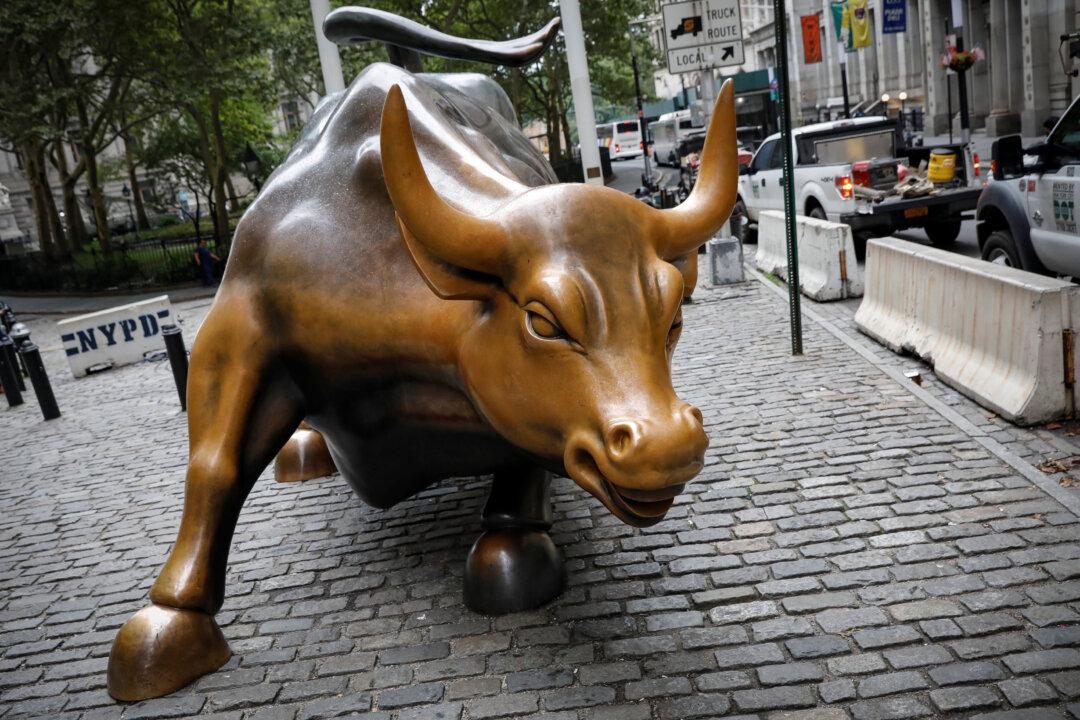
U.S. stocks were deep in the red during the Nov. 18 trading session as investor enthusiasm over artificial intelligence (AI) faded.
The blue-chip Dow Jones Industrial Average fell by more than 600 points, or nearly 1.3 percent.
Despite the decline, the index remains up 8 percent this year.
Since closing above 48,000 for the first time a week ago, the benchmark of 30 stocks has tumbled by about 4 percent.
The tech-heavy Nasdaq Composite Index fell by almost 400 points, or 1.7 percent. The broader S&P 500 erased close to 100 points, or 1.2 percent.
Both indexes are still up 15 percent and 12 percent year-to-date, respectively.


Wall Street is swimming in red ink as members of the so-called Magnificent Seven came under pressure.
Shares of AI chipmaking juggernaut Nvidia declined about 2 percent, while Amazon and Microsoft dropped more than 3 percent.
Traders shrugged off news of a major AI partnership announcement.
Since the beginning of the AI boom three years ago, these types of agreements have triggered massive rallies on the broader stock market.
Now that investor ebullience over AI could be slowing, concerns surrounding elevated tech evaluations and ambitious spending plans are mounting.
Current conditions make it feel like a “mini bear market in some stocks,” says Ken Mahoney, president of Mahoney Asset Management.
“We also are starting to get questions arising about the sustainability of the spending from Open AI, and how that has boosted a lot of the stocks they are doing deals with,” Mahoney said in a note emailed to The Epoch Times.
Economic Woes
Bob Lang, chief options analyst at Explosive Options, says investors might be signaling worries about the U.S. economy in the year ahead.“It seems the stock market is starting to get concerned about growth in 2026 and perhaps a recession later in the year,” Lang said in a note emailed to The Epoch Times.
Recent forecasts indicate that the record-breaking government shutdown could shave off some of the gross domestic product in the fourth quarter and heading into 2026.

“We estimate the shutdown could shave roughly 0.5pp off of GDP growth in the quarter, but most of it will likely be recovered in the beginning of 2026.”
Despite short-term momentum indicators flashing red, the long-term trend remains solid, says Adam Turnquist, chief technical strategist for LPL Financial.
Bitcoin Falls Below $90,000—Briefly
Cryptocurrency markets continued their downward trajectory on Tuesday, with bitcoin wiping out all of its 2025 gains.Bitcoin briefly slipped below $90,000 for the first time since late April. The price of the top cryptocurrency is down 2 percent this year.
Shortly after, bitcoin recovered and erased its losses, ticking up almost 1 percent.
Ethereum, the second-largest digital token, also recovered by rising nearly 7 percent to above $3,100. The crypto, however, is down 7 percent this year.
Market watchers are not entirely sure why bitcoin has been sinking.
Like artificial intelligence, crypto momentum may be dissipating, says Ipek Ozkardeskaya, senior analyst at Swissquote Bank.
“What’s clear is that momentum remains Bitcoin’s bigger trend—pointing at deeper losses. How deep? My Fibonacci retracement on the 2023–2025 rally suggests it could sink to around $82,000–83,000 without breaking the past two years’ bullish trend,” Ozkardeskaya said in a note emailed to The Epoch Times.
Other Market Developments
The U.S. dollar’s upward trend, which began after reaching a bottom this past summer, has stalled.A gauge of the greenback against a weighted basket of currencies, the U.S. Dollar Index, was little changed on Nov. 18.
The index is still down about 8 percent this year.
U.S. Treasury yields were mainly in the red.
The benchmark 10-year dipped below 4.12 percent. The 2-year yield declined to 3.57 percent, while the 30-year was flat at 4.74 percent.
The metals market was firmly down, with gold prices falling 0.6 percent to around $4,050 per ounce.
Silver prices also fell 0.8 percent to around $50.30 per ounce.
Energy commodities struggled as well. U.S. crude oil prices were little changed at around $60 per barrel, while natural gas fell more than 2 percent to $4.26 per million British thermal units (Btu).