Shares of chipmaker Nvidia slipped in after-hours trading after the company reported better-than-expected 2026 second-quarter earnings and revenue results.
The tech behemoth reported record quarterly revenue of $46.74 billion, a 56 percent increase in the quarter and surpassing the Wall Street consensus forecast of $46.06 billion.
Earnings per share—a measure of how much profit a business generates for each share of its stock—came in at $1.05 versus the market estimate of $1.01.
This represents an increase from 67 cents per share a year ago.
Data center sales fell short of forecasts as Nvidia reported $41.1 billion, slightly below the $41.29 billion projection. They accounted for 88 percent of total sales in the previous quarter.
Gaming and networking revenue came in better than expected, totaling $4.3 billion and $7.25 billion, respectively.
The company approved an additional $60 billion in stock buybacks.
This market function consists of businesses repurchasing their own shares from the stock market to reduce the number of outstanding shares, which typically bolsters the stock’s value and enhances financial ratios.
Looking ahead, third-quarter revenues are projected to range from $52.9 billion to $55.1 billion, compared to investors’ expectations of $53.46 billion.
In its outlook, Nvidia did not assume any H20 shipments to China.
The H20 is a specialized artificial intelligence (AI) graphics processing unit made for the Chinese market, downgraded from its high-end chips to comply with U.S. export regulations.
Nvidia shares tumbled about 2 percent following the closing bell. The stock closed the Aug. 27 trading session little changed at $181.60.
This year, Nvidia’s stock has risen more than 31 percent.Wall Street Remains Enamored
Investors continue to be bullish on the tech juggernaut.“Saying this is the most important stock in the world is an understatement,” Jay Woods, chief global strategist at Freedom Capital Market, said in a note emailed to The Epoch Times.
“Earnings trends continue to accelerate quarter by quarter. The bar keeps getting higher, and the chipmaker keeps exceeding it. The growth projections continue to expand exponentially, and there’s been no slowdown in sight.”
This month, several analysts bolstered their target price and raised their rating to “Outperform.”

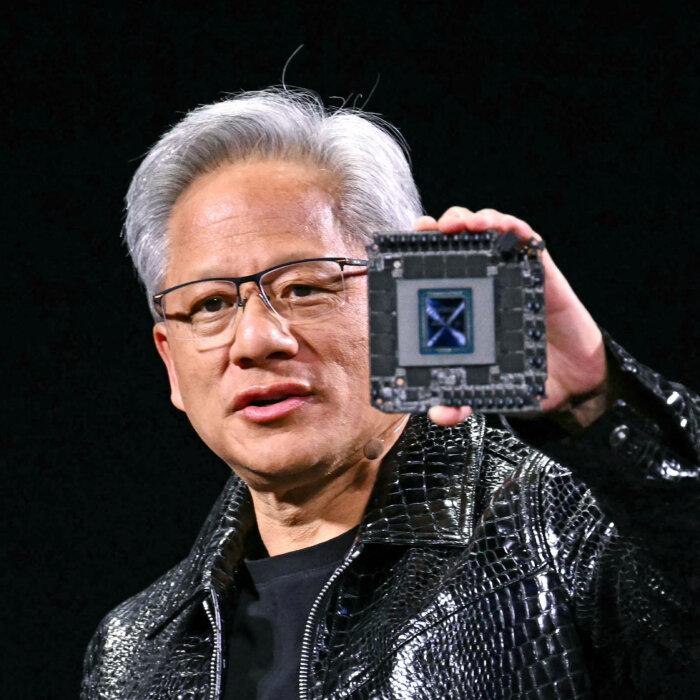
Woods expects more price target upgrades this year.
Research from Giuseppe Sette, president and co-founder of Reflexivity, shared with The Epoch Times, highlighted several factors that position the company for further growth.
Nvidia is a “clear AI infrastructure leader,” Sette writes, citing its Blackwell chip design that is creating a new microarchitecture for high-performance computing, large language models, and generative AI.

The company is also manufacturing China-specific Blackwell chips to meet U.S. export standards.
AI Bubble Talk
Since OpenAI CEO Sam Altman reportedly told a group of reporters that AI is in a bubble, analysts have been examining the situation to determine if there is any veracity behind this sentiment.“There have been comparisons made to the current tech weighting of 34.5 percent to the dot com bubble in early 2000,” Nancy Tengler, CEO and CIO at Laffer Tengler Investments, said in a note emailed to The Epoch Times.
“The current weighting is near the record-highs achieved in 2000.”
In the late 1990s and early 2000s, the stock market was entrenched in a bubble, fueled by intense investor speculation and enthusiasm for internet-based companies.
The ebullience in startups with “.com” in their name ended when the bubble burst in March 2000. Trillions of dollars in market value were wiped out, resulting in an economic downturn.
With today’s stock market highly concentrated in the so-called Magnificent Seven stocks—Alphabet, Amazon, Apple, Meta, Microsoft, Nvidia, and Tesla—concerns are rising about another bubble brewing.
Still, Tengler says, market concentration is not a new phenomenon on Wall Street.
“In the 1970s and 1980s, energy concentration was significant as a percentage of the total at 25-30 percent and 15-20 percent, respectively. In the early decades of the 1900s, industrials and materials comprised the vast majority of the DJIA [Dow Jones Industrial Average],” she said.
Ultimately, overweighted stocks and industries reflect the drivers of economic growth.
“Technology is driving this 4th Industrial Revolution—a 35 percent overweight (add another 10 percent to include AMZN, META, and GOOGL) seems reasonable,” Tengler added.
While AI will significantly affect productivity and consumers’ daily lives, it is unclear if tech companies in the broader S&P 500 are the best places to invest in the AI theme, says Torsten Slok, chief economist at Apollo Wealth Management.
The P/E ratio is one determining factor, he noted.
It is a measure of how much investors are willing to pay for $1 of a company’s earnings and a gauge of whether a stock is overvalued, undervalued, or reasonably priced.
A P/E ratio of 20 to 25 is average. Anything below signals the stock is undervalued, and a number higher suggests the company is overvalued.
“The P/E ratio for Tesla is almost 200, and the P/E ratio for Nvidia is around 60. Many software companies are likely to go out of business because of ChatGPT,” Slok said.
“The bottom line is that it is not clear that the tech stocks in the S&P 500 are the best choices when investing in the AI theme,” Slok continued.
“The situation today is surprisingly similar to the IT bubble in the 1990s.”