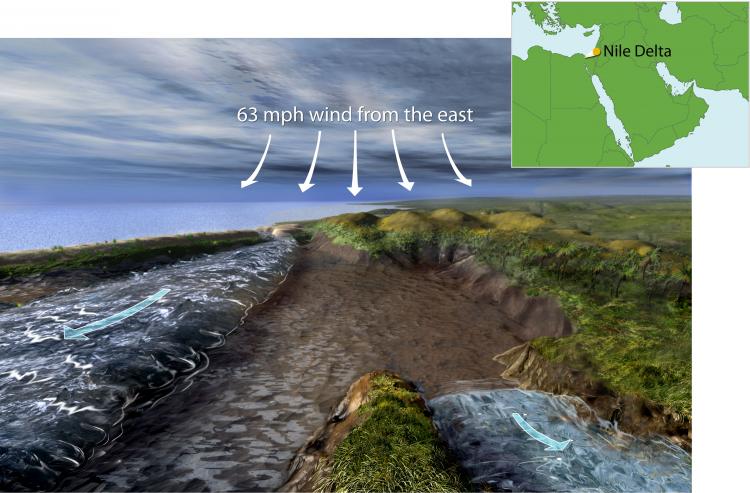
The biblical story of the miraculous parting of the Red Sea for Moses and the Israelites to escape from the Pharaoh could have been possible, according to new computer simulations.
As part of a larger study looking at the impact of wind on water depth, researchers from the National Center for Atmospheric Research (NCAR) and the University of Colorado at Boulder discovered that a strong east wind, blowing overnight, could have pushed back water at a bend where an ancient river is thought to have merged with a lagoon on the coast of the Mediterranean Sea.
“The simulations match fairly closely with the account in Exodus,” said the study’s lead author, Carl Drews of NCAR, in a press release.
“The parting of the waters can be understood through fluid dynamics. The wind moves the water in a way that’s in accordance with physical laws, creating a safe passage with water on two sides and then abruptly allowing the water to rush back in.”
The researchers based their computer models on a reconstruction of the probable location and depths of the Nile delta waterways at the time the biblical event is said to have happened some 3,000 years ago.
Article continued below the videos
[youtube]XZqIZqDh1ns[/youtube]
Computer modeling animation (University Corporation for Atmosphere Research (UCAR). Animation by Tim Scheitlin and Ryan McVeigh, NCAR)
[youtube]itox6Zn_1G0[/youtube]
NCAR researchers Carl Drews discusses the results of the study (University Corporation for Atmosphere Research (UCAR). Animation by Tim Scheitlin and Ryan McVeigh, NCAR)
Previous explanations of the miracle have included a tsunami, but a tsunami would not have caused a gradual overnight retreat of the water or be associated with wind. Other researchers have looked at “wind setdowns”—the opposite of storm surges, where strong, persistent winds can lower water levels.
“Wind setdown occurs when wind blows across a body of water and part of the water level drops, and so it exposes dry area. That’s a well-known phenomenon,” said Drews in a video.
“The tricky bit is to get water on both sides of the crossing. The biblical account describes that there was a wall of water on their left and a wall of water on their right, and the previous researchers have tried to duplicate this kind of thing.”
A previous study by Russian researchers found hurricane-force winds (74 miles per hour) could have exposed an underwater reef near the Suez Canal. But from their research, Drews and co-author Weiqing Han, who published their study in the online journal PLoS ONE, were not convinced the reef would be completely exposed, or that people could cross in such strong winds.
In the new study, Drews and Han pinpointed a location 75 miles north of the Suez Canal by studying old topographic maps of the Nile delta. The historic water flow and depth of the waterway were estimated from archeological records, satellite measurements, and modern maps.
From their computer models, they found that winds of 63 miles an hour, lasting for 12 hours, could push back waters about 6 feet deep. This would have exposed a roughly 2-mile-long by 3-mile-wide mudflat passage for about 4 hours.
When the wind stopped, the waters would come rushing back in, just as described when the Pharaoh’s army tried to pursue the fleeing Israelites.
“People have always been fascinated by this Exodus story, wondering if it comes from historical facts,” Drews said. “What this study shows is that the description of the waters parting indeed has a basis in physical laws.”
To read the research paper, please visit http://tiny.cc/0ktt3
The Epoch Times publishes in 35 countries and in 19 languages. Subscribe to our e-newsletter.