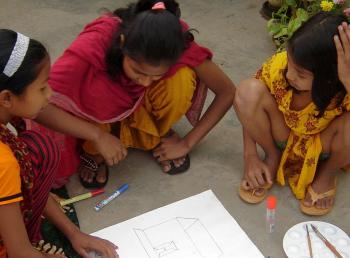
Before the coming of the New Year, three young girls—Sweety, Farza, and Yasmin—hurry to prepare “Best Wishes” postcards for their friends around the world. It’s one of the dozens of activities they do at their favorite place to get in touch with nature: the Farmers’ Research Institute, a complex inhabited by 130 plant species situated in the heart of Dhaka, the capital of Bangladesh.
The complex, part of the educational project “Learning from Nature,” is host to dozens of varieties of fruits, flowers, trees, herbs, and decorative and medicinal plants. It was initiated by the Bangla grass-roots organization Krisoker Sor (Farmers’ Voice), run by Zakir Hossain, M.D., a graduate of Ecological Agriculture at Wageningen University in the Netherlands.
Hossain has been involved with the place since 2001, and now oversees the educational blossoming of around 500 children, including third-, fourth- and fifth-graders, preschoolers, and children who have dropped out. The project aims to engender in children a stronger kinship with nature and the environment.
And this goes along with a commensurate development in their personalities, talents, ability to think and reflect, and even physical fitness. It also gives the eager pupils a strong sense of place.
“The struggle is to build a new paradigm, which is ecologically sound and safer for children in stepping into the future,” Hossain said, who is always ready to extrapolate from his pet project to global concerns.
For the last six months Sweety, Farza, and Yasmin have been inductee botanists: watering plants, pruning, documenting, and seeding them. Now the three are preparing New Year cards using plant leaves, and sending them to their far-flung friends.
These acquaintances include the East Sujankathi Primary School, which is in Bangladesh, Hillhead Primary School in the U.K., Wat Pramanathat School in Thailand, Brookside Elementary School in Canada, and Winthrop Avenue Primary School in the United States.
“Exchanging New Year cards is becoming popular even among the children,” Hossain explained. The epistolary friendships give all involved a global perspective.
The complex, part of the educational project “Learning from Nature,” is host to dozens of varieties of fruits, flowers, trees, herbs, and decorative and medicinal plants. It was initiated by the Bangla grass-roots organization Krisoker Sor (Farmers’ Voice), run by Zakir Hossain, M.D., a graduate of Ecological Agriculture at Wageningen University in the Netherlands.
Hossain has been involved with the place since 2001, and now oversees the educational blossoming of around 500 children, including third-, fourth- and fifth-graders, preschoolers, and children who have dropped out. The project aims to engender in children a stronger kinship with nature and the environment.
And this goes along with a commensurate development in their personalities, talents, ability to think and reflect, and even physical fitness. It also gives the eager pupils a strong sense of place.
“The struggle is to build a new paradigm, which is ecologically sound and safer for children in stepping into the future,” Hossain said, who is always ready to extrapolate from his pet project to global concerns.
For the last six months Sweety, Farza, and Yasmin have been inductee botanists: watering plants, pruning, documenting, and seeding them. Now the three are preparing New Year cards using plant leaves, and sending them to their far-flung friends.
These acquaintances include the East Sujankathi Primary School, which is in Bangladesh, Hillhead Primary School in the U.K., Wat Pramanathat School in Thailand, Brookside Elementary School in Canada, and Winthrop Avenue Primary School in the United States.
“Exchanging New Year cards is becoming popular even among the children,” Hossain explained. The epistolary friendships give all involved a global perspective.