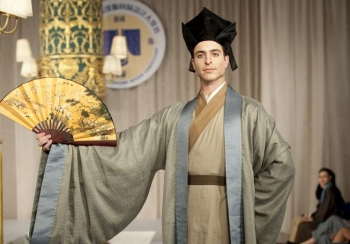
NEW YORK—As designer Cheng Minghua stepped on the stage to receive her award, flanked by a lithe male model wearing the gold-winning outfit—her gold-winning outfit—one could easily tell that Cheng was in shock. The silent Cheng, petite and dressed modestly in a slate-gray suit, could barely muster a grin as she accepted her trophy, looking as if she were in a dream.
She hadn’t thought she'd win, she confided later. In fact, she didn’t think of the competition at all as she prepared to enter this year’s NTDTV Global Han Couture Design Competition.
“My thought was very simple,” she said. “This competition is about the revival of traditional Chinese dress (also called Han dress), and the ancients’ clothing was about virtue. They were simple and pure-minded like children, and so the clothes they wore looked natural on them.”
Her entries were few in number: just three ensembles, all menswear. One outfit was in Tang style and two in the style of the Ming Dynasty. One Ming outfit was for a nobleman, the other for a scholar, and the Tang outfit was done in the style of an ordinary man.
Seeing her creations is a striking experience, not because the work is novel in style somehow, but because it seems to unlock your hidden memory of simpler times. Using earth tones—dust brown, steel gray, indigo, and ivory—and very organic hemp/cotton blends, Cheng’s designs shone with inner strength, not outward ostentation.
The Beijing native resides in San Francisco, where, she laments, “fabric stores are few.” She visited all the ones she knew a few times, never leaving the Bay Area.