


Players will have had just a three day spell with the next match in the 2010-2011 Ashes Series starting on Friday Dec 3 in Adelaide. Recovery is paramount, as is tweaking the player selection despite it being a draw.
Australia may ring a few changes for the second in the five Test series, while England with impetus behind them are unlikely to make any—they were generally seen to have taken a moral victory by both the media and the Pom’s and Aussie fans.
Gabba Test
England started slowly in the first innings scoring just 260 before the tenth wicket fell mid-way through the last session of the day. Australia’s Peter Siddle—who took 5 wickets, including a rare hat-trick—proved worthy of his controversial selection.
Similarly, Michael Hussey silenced critics with 195. He and Brad Haddin (136) had saved the innings for the Australians who were in trouble at 5/143.
Australia was looking the goods at a venue where England hadn’t won in 24 years. They set up a considerable lead of 221 runs with England beginning their second innings at bat late on Day 3.
However, there were no first innings heroics like Siddle’s as Australia were ineffectual with the ball, while England were superb.
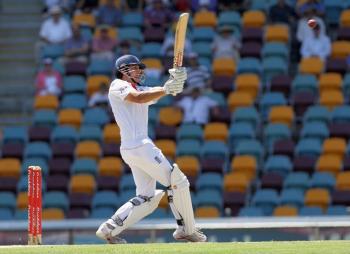
Alastair Cook’s record breaking 235 not-out, Jonathon Trott’s 135 not-out and captain Andrew Strauss’s 110, on the Gabba’s uncharacteristic lifeless and flat wicket, were memorable knocks.
England’s had a second innings score of 517 for 1 wicket, before retiring late on Day 5, giving Australia an ungettable target of 297 in the final session of the match.
The match petered out as Australia scored 107 runs before the captains agreed to a draw with an hour of play remaining.
For England, this was seen as a psychological victory where they only need to draw the series to retain the Ashes.
Adelaide Test
While momentum is with England, Trott, however, played down the hype surrounding the style in which they fought back from an ordinary first innings saying that they were there to win, not draw.
“Obviously we went to Brisbane to win the game and we weren’t able to do that,” he told reporters in Adelaide on Wednesday.
“So I wouldn’t say there is any advantage on either side, it’s still nil-nil and we come to Adelaide with a determination and real energy to hopefully go one-nil up in the series.
“And that is all we are thinking about.”
“We’ll be looking to hopefully get the same sort of impetus [as in the second innings] in the way we play and definitely carry it on towards Adelaide, but cricket is a funny game and a tough game,” South African-born Trott said.
Although both will take the “nil-all, series is there for the taking” philosophy into Adelaide, based on form Australia has the most worries.
Attack Selection
While their batting was just passable, it was in their bowling attack that the Aussies had the greatest flaws in. Selectors have certainly identified this.


