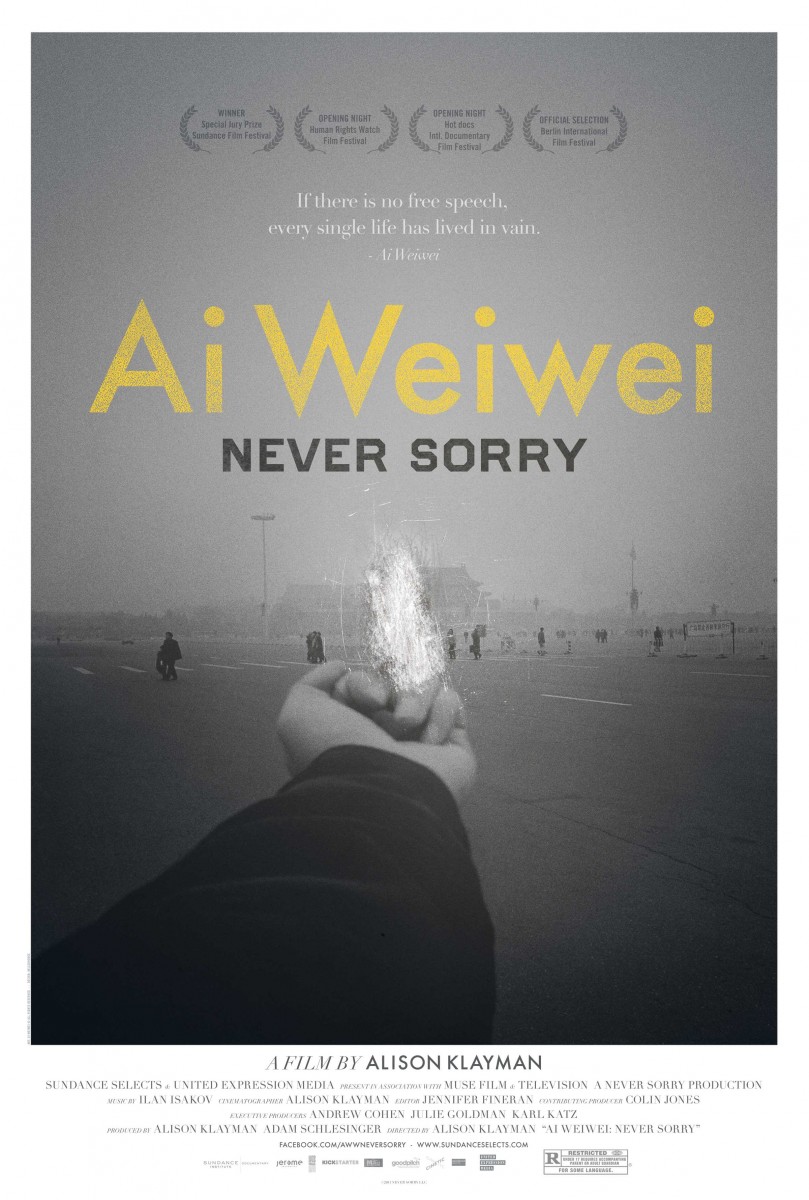
BEVERLY HILLS, Calif.—Fresh off a plane from New York on July 20, Alison Klayman sat across from me in a stark ballroom of The Beverly Hills Hotel to discuss her new, highly acclaimed documentary, “Ai Weiwei: Never Sorry.”
Ai Weiwei, a controversial, complex Chinese artist is probably China’s most famous artist at the moment and also its most outspoken critic. Ai uses any and every medium possible to express and communicate. His blogging and twittering has stirred the ire of the Chinese Communist Party (CCP).
At the same time, his posts have fostered a following of fans and peers willing to risk their own safety by associating with the controversial artist and activist.
Klayman’s “Never Sorry” invites us to peer into Ai’s world through intimate moments with his mother and son, at public art openings, when confronting the abuses of the Communist Party, and while he engages in making his own documentary projects.
First time director who trained as a journalist, young, down-to-earth Alison Klayman admits to being uncomfortable sitting on the other end of an interview.
Klayman met Ai Weiwei while she was living in Beijing. Her roommate was a curator of an exhibit of Ai’s photos, during the time that Ai lived in New York, and she wanted a video to be part of the exhibition. Thus, Klayman entered the scene with camera in tow.
A documentary on a documentary
Klayman explained that the short film she made for the exhibit covered many more topics than were needed for the New York exhibition’s video. “We were talking about blogging, censorship, what [Ai] faced, and what he thought about contemporary China—also his upcoming Earthquake project.”

The Earthquake project was an investigation that exposed the cover up by the CCP of the over 5,300 children killed in the 2008 Sichuan earthquake. Ai’s documentary divulged the problem of poorly constructed school buildings, which led to so many deaths.
Klayman wanted to use this extra footage and to follow up with Ai’s work. She also recognized the artist’s charismatic nature and felt others would be as fascinated by him as she was.
Klayman also knew her role should not be to merely rehash what Ai has done, an accomplished documentary filmmaker in his own right. She wanted to bring out something new about him and to capture the impact that Ai’s documentaries have had on young Chinese fans and viewers who watch them.
The film portrays numerous instances when the public came out to show solidarity with their beloved artist.
“There is definitely more than one hero in this film. Everyone you see shares the same values as Ai Weiwei,” Klayman said. “These people are very brave because of the risks they face in China, individuals and citizens who do not have an international support base [like Ai Weiwei]. That’s why it’s all the more heroic.”
“It shows remarkable individual courage, it’s not singular. It’s not just about Ai Weiwei,” Klayman explained.
The impact of censorship
Through her work with Ai, Klayman has learned how social media works behind the firewall.
Klayman went to Beijing in 2006, following her graduation in journalism from Brown University. She immediately became aware of the censorship that exists there after experiencing the limited access to Internet sites. “It’s something you are hit in the face with right away,” she said.

Over time, one of Klayman’s biggest realizations was that much censorship in China comes from self-censorship.
“The reality is, in mainstream press, the journalists have been living in this situation for so many years, they understand their society and context, and they know an article will never get printed, so they don’t write it,” she said.
“I think that is the strength of censorship—where it’s already gotten to you inside,” Klayman explained.
This self-censorship is at the heart of Ai’s message, according to Klayman.
Censorship has already occurred “if you think you won’t be heard, or you can’t have an impact, or you’re scared,” she said.
“The first step has to come from the individual—courage—where you feel free in your mind, and you feel you have to say something,” she said.
Klayman acknowledges that her work will face censorship in China, too. “There is no hope this film will get official distribution in China, but there is a strong appetite for it. Everyday on twitter, people are looking for it.”
Ai speaks for many Chinese
The response of Chinese abroad who have seen the film at special screenings, Klayman reports, is that “they are surprised that it is in not an anti-China film, and Ai Weiwei is not an anti-China figure.”
Klayman explains that Ai’s art hearkens back to before the CCP instigated the Cultural Revolution (1966-76) and deliberately destroyed traditional arts in China.
Weiwei’s art really deals with tradtional art of China. “He works with traditional crafts and techniques and has a great respect and understanding of the long traditions,” Klayman said. “It’s a real shame it has all been lost.”
Ai Weiwei represents a large diverse population in the mainland, according to Klayman. Patriotism, she believes, involves asking questions and “not letting your country off the hook. Patriotism means wanting the best and not accepting status quo.”
“I could not have picked a better place to go for telling stories of global concern; everyone around the world has so many hopes and fears connected to China. What we really need now is as clear of an understanding of the country as possible. I want to continue to be part of that,” she said.
The Epoch Times publishes in 35 countries and in 19 languages. Subscribe to our e-newsletter.