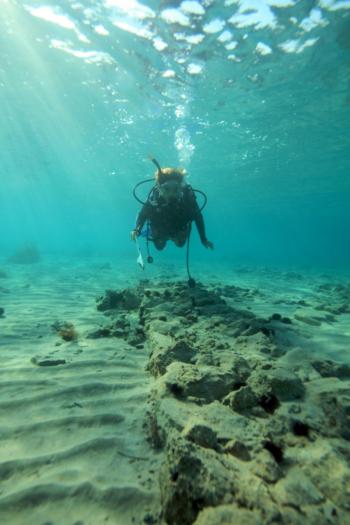
Archaeologists surveying the ruins of an ancient settlement submerged off the coast of Greece now think it could be 5,000 years old—making it by far the world’s oldest underwater town recognized to date.
The fieldwork carried out this summer was the first of a five-year collaboration between Greek and U.K. researchers to investigate the site of Pavlopetri, which has not been studied since its discovery and mapping by a British archaeologist in 1967–68.
Dr. Jon Henderson, an archaeologist from the University of Nottingham, is jointly leading the research with Mr. Elias Spondylis from the Ephorate of Underwater Antiquities of the Hellenic Ministry of Culture in Greece. Dr. Henderson is the first archaeologist in 40 years to have an official permit granted by the Greek government to work on the site.
“It was tremendously exciting. I had read about the site when I was young and I couldn’t believe that not only was I diving on it now but that I had the chance to work on it. We then came across around 9,000 square meters of new buildings that had recently been uncovered due to movements in the sand, which was a real thrill,” Dr. Henderson said.
Pavlopetri lies in about 3 to 4 meters (10 to 13 feet) of water just off the sandy coast of southern Laconia. It is remarkably complete. Domestic buildings, streets, courtyards, possible religious buildings, tombs, and graves have all been mapped using the latest in 3-D digital surveying equipment.
Pavlopetri was previously thought to date from the Mycenaean period (around 1680-1180 B.C.)—the historical setting for much of the Ancient Greek literature and myths. Newly found late Neolithic pottery suggests the site may have been occupied since at least 2800 B.C. By studying this major maritime settlement, the researchers hope to understand more about the workings of Bronze Age Greek society.
Dr. Chrysanthi Gallou, a specialist in Aegean prehistory at the University of Nottingham, is responsible for studying the many finds.