The new rate increase is on top of the 14 percent increase enacted last year and 11 percent the year before. The increase, scheduled from July 1, would bring the cost of water to 25 percent more than the 2007 cost.
The problem with the rate hike, Weprin said, is that residents don’t know where their money is going. Weprin, who chairs the Council Finance Committee, says that the additional funds are going into the City’s general fund, and not to water system maintenance, as residents rightly expect.
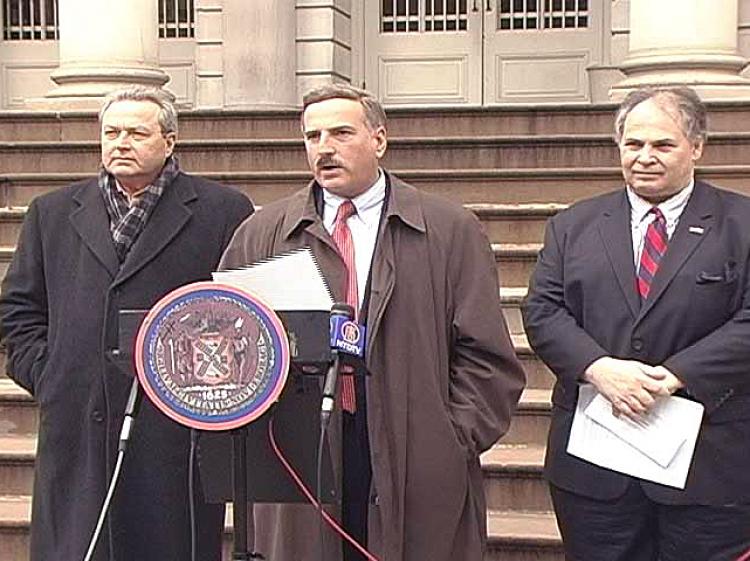
“It’s a back door property tax, it’s outrageous, and we should recognize it as such,” he said at a press conference at City Hall Wednesday.
The Water Board’s job is to determine the water rate, collect payments, and encourage water conservation. The Board is obliged to “establish rates and charges in each year at a level that will provide sufficient revenues to cover the cost of providing water and wastewater services,” according to its mission statement.
The Water Board pays the City to lease the water and sewer infrastructure. However, since 2005, the payments exceeded the cost of rent. The amount, currently almost $123 million, has been spilling over to the City’s general fund, according to Weprin.
Conservation and Price
A consumer’s water consumption can be broken down to two parts: the inelastic, or necessary water use, and the elastic, or optional water use. Market studies suggest that higher water prices force users to conserve water where possible, such as doing away with lawns and longer-than-necessary showers.
Of course, when the drop in demand is necessitated by an increase in price, it is the lower income users that are hit hardest. Researchers at the School of Forestry and Environmental Studies at Yale University and the JFK School of Government at Harvard suggest in a 2007 white paper titled “Managing Water Demand” that because raising water prices for the purpose of conservation is so politically sensitive, the more popular way to achieve conservation is through technological and legislative means. This usually means government subsidies for water-saving retrofits and requirements for water-use reduction.
Suggestions for the Water Board
Pending state legislation would require the Water Board to wait at least 30 days after the adoption of the city budget before setting its annual fees, rates, rents, or other charges for the use of the sewage system or water system.
Currently, the Board raises rates based on forecasts in April of each year. “As a result, the board tends to adopt, in effect, artificially high rates that would raise sufficient funds to cover the budget submitted by the city’s department of Environmental Protection,” reads the legislation. (Bill A03250)
Corey Bearak, president of the Queens Civic Congress, touts this bill as a way to improve the rate setting system. His Congress and the Croton Watershed Clean Water Coalition wrote recommendations to enhancing the accountability of the Water Board.
Among the suggestions are to cease the use of water payments in funding non-water related projects and disclose capital costs for infrastructure maintenance.
Public hearings for the proposed rate hike are scheduled for April 27-30 and the City Council will hear the matter at 10 a.m., April 28, at 250 Broadway, 16th floor. The petition can be found at council member Weprin’s Web site, www.council.nyc.gov/dc23/html/members.shtml.