
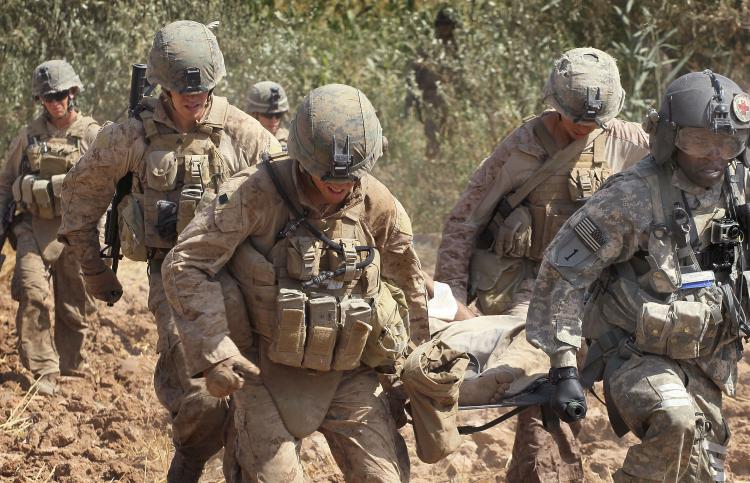
The Iraq Veterans Against the War claims thousands of troops are being sent to war while suffering from post-traumatic stress disorder (PTSD), traumatic brain injury (TBI), or military sexual trauma (MST).
In a move to stop the redeployment of troops suffering from trauma, Iraq Veterans Against the War (IVAW) launched its first strategic campaign, Operation Recovery: Stop the Deployment of Traumatized Troops.
The veterans hope to help troops who are already suffering from traumatic experiences to avoid getting pushed over the edge by being forced back into a war zone, according to Joe Callan, IVAW Western Regional Field Organizer, who served in the Marines for 11 years.
“We don’t want them to have to go back,” Mr. Callan said. “There are many soldiers who do want to go back in, and there are many soldiers who don’t want to deploy, that have to deploy even with these traumas.”
Currently, troops with PTSD and psychiatric conditions may or may not be deployed, depending on their situation, according to Maria Tolleson, media-relations officer of the U.S. Army Office of the Surgeon General.
Before deployment, soldiers undergo a face-to-face screening process that identifies those at risk. “Providers make a recommendation to commanders about deployability of soldiers; commanders use their best judgment based on mission requirements, etc. and make the final decision, taking into consideration medical recommendations,” Tolleson said.
Soldiers who are identified as having PTSD or behavioral or mental health issues that may become worse by deployment are then given another assessment by a behavioral health expert, according to Tolleson.
Regulations about deployment for troops suffering from PTSD or similar issues are outlined in the Health Affairs Policy issued in November 2006 on Deployment Limiting Psychiatric Conditions. Soldiers who are determined to be non-deployable are given a profile on their limitations, but “if their psychiatric situation is stable, they may be deployed and followed up by a behavioral health provider in theater,” Tolleson said.
“There is a waiver process that must be utilized for soldiers considered non-deployable with psychiatric conditions,” Tolleson said, adding that “commanders may NOT deploy a soldier whose waiver was denied.”
“Our goal is that the troops who are fit to deploy do deploy, and those that are not fit to deploy get the type of treatment they need so they can deploy,” Tolleson said.
Caring for Veterans
A complete withdrawal of the 50,000 remaining U.S. troops in Iraq is scheduled for 2011, and a troop drawdown in Afghanistan is planned for July 2011.
More than 2 million U.S. service members have been deployed to war zones in either Iraq or Afghanistan, and more than 40 percent (831,169) of them served two or more deployments, according to data collected by Veterans for Common Sense.
The VA has had 143,530 PTSD patients who were veterans of Iraq and Afghanistan, according to March 13, 2010, data collected by Veterans for Common Sense.
Although the main objective of the IVAW Operation Recovery campaign is to stop the redeployment of troops suffering trauma, it has other concerns that may be on the way to resolution.
The IVAW campaign description states, “The VA doesn’t have the resources to serve all those in need; too often service members are conveniently denied care or access to quality mental health screenings.”
The Obama administration recently changed the standards that troops need to meet in order to receive PTSD treatment and other mental health care.
Previously, troops needed to provide documented proof of an incident (stressor) that would cause them to have PTSD. During his July 10, 2010, weekly address, President Barack Obama announced that the VA will no longer require troops to prove a stressor in order to get treatment.
An additional $16 billion in funding was also announced for the VA, raising its budget to $114 billion, which is the highest it’s been since the years following the end of the Vietnam War.
In an Aug. 23 speech, Vice President Joe Biden said the administration had launched “one of the largest, most comprehensive programs in American history to support our returning veterans and their families long after their military service is over.”
Changing Culture
Mr. Callan was with a light-armor and reconnaissance battalion during his three tours in Iraq. Nearly a third of his platoon were wounded during his second deployment in 2004 and 2005. They were in “a ton of firefights,” and they were hit with at least 18 IEDs.
After the fray, two soldiers went to go see the psychiatrist, referred to as “the wizard” among the troops. One of them was released on a behavioral disorder, while the second got off as a conscientious objector. “They both got out, but they had to fight really hard to get to go see the psych,” Mr. Callan said.
According to Mr. Callan, things may have changed quite a bit since then because in 2005, the mentality surrounding PTSD was that “if you have PTSD, you’re weak, or you couldn’t hack it,” whereas “now it’s more like anybody can get it.” “It’s not so much that you can’t hack it. These things are awful, and you’re having a normal reaction to some really awful things.”
“It’s much more recognized now,” he said.
In a move to stop the redeployment of troops suffering from trauma, Iraq Veterans Against the War (IVAW) launched its first strategic campaign, Operation Recovery: Stop the Deployment of Traumatized Troops.
The veterans hope to help troops who are already suffering from traumatic experiences to avoid getting pushed over the edge by being forced back into a war zone, according to Joe Callan, IVAW Western Regional Field Organizer, who served in the Marines for 11 years.
“We don’t want them to have to go back,” Mr. Callan said. “There are many soldiers who do want to go back in, and there are many soldiers who don’t want to deploy, that have to deploy even with these traumas.”
Currently, troops with PTSD and psychiatric conditions may or may not be deployed, depending on their situation, according to Maria Tolleson, media-relations officer of the U.S. Army Office of the Surgeon General.
Before deployment, soldiers undergo a face-to-face screening process that identifies those at risk. “Providers make a recommendation to commanders about deployability of soldiers; commanders use their best judgment based on mission requirements, etc. and make the final decision, taking into consideration medical recommendations,” Tolleson said.
Soldiers who are identified as having PTSD or behavioral or mental health issues that may become worse by deployment are then given another assessment by a behavioral health expert, according to Tolleson.
Regulations about deployment for troops suffering from PTSD or similar issues are outlined in the Health Affairs Policy issued in November 2006 on Deployment Limiting Psychiatric Conditions. Soldiers who are determined to be non-deployable are given a profile on their limitations, but “if their psychiatric situation is stable, they may be deployed and followed up by a behavioral health provider in theater,” Tolleson said.
“There is a waiver process that must be utilized for soldiers considered non-deployable with psychiatric conditions,” Tolleson said, adding that “commanders may NOT deploy a soldier whose waiver was denied.”
“Our goal is that the troops who are fit to deploy do deploy, and those that are not fit to deploy get the type of treatment they need so they can deploy,” Tolleson said.
Caring for Veterans
A complete withdrawal of the 50,000 remaining U.S. troops in Iraq is scheduled for 2011, and a troop drawdown in Afghanistan is planned for July 2011.
More than 2 million U.S. service members have been deployed to war zones in either Iraq or Afghanistan, and more than 40 percent (831,169) of them served two or more deployments, according to data collected by Veterans for Common Sense.
The VA has had 143,530 PTSD patients who were veterans of Iraq and Afghanistan, according to March 13, 2010, data collected by Veterans for Common Sense.
Although the main objective of the IVAW Operation Recovery campaign is to stop the redeployment of troops suffering trauma, it has other concerns that may be on the way to resolution.
The IVAW campaign description states, “The VA doesn’t have the resources to serve all those in need; too often service members are conveniently denied care or access to quality mental health screenings.”
The Obama administration recently changed the standards that troops need to meet in order to receive PTSD treatment and other mental health care.
Previously, troops needed to provide documented proof of an incident (stressor) that would cause them to have PTSD. During his July 10, 2010, weekly address, President Barack Obama announced that the VA will no longer require troops to prove a stressor in order to get treatment.
An additional $16 billion in funding was also announced for the VA, raising its budget to $114 billion, which is the highest it’s been since the years following the end of the Vietnam War.
In an Aug. 23 speech, Vice President Joe Biden said the administration had launched “one of the largest, most comprehensive programs in American history to support our returning veterans and their families long after their military service is over.”
Changing Culture
Mr. Callan was with a light-armor and reconnaissance battalion during his three tours in Iraq. Nearly a third of his platoon were wounded during his second deployment in 2004 and 2005. They were in “a ton of firefights,” and they were hit with at least 18 IEDs.
After the fray, two soldiers went to go see the psychiatrist, referred to as “the wizard” among the troops. One of them was released on a behavioral disorder, while the second got off as a conscientious objector. “They both got out, but they had to fight really hard to get to go see the psych,” Mr. Callan said.
According to Mr. Callan, things may have changed quite a bit since then because in 2005, the mentality surrounding PTSD was that “if you have PTSD, you’re weak, or you couldn’t hack it,” whereas “now it’s more like anybody can get it.” “It’s not so much that you can’t hack it. These things are awful, and you’re having a normal reaction to some really awful things.”
“It’s much more recognized now,” he said.