[ Video Courtesy of NTDTV ]
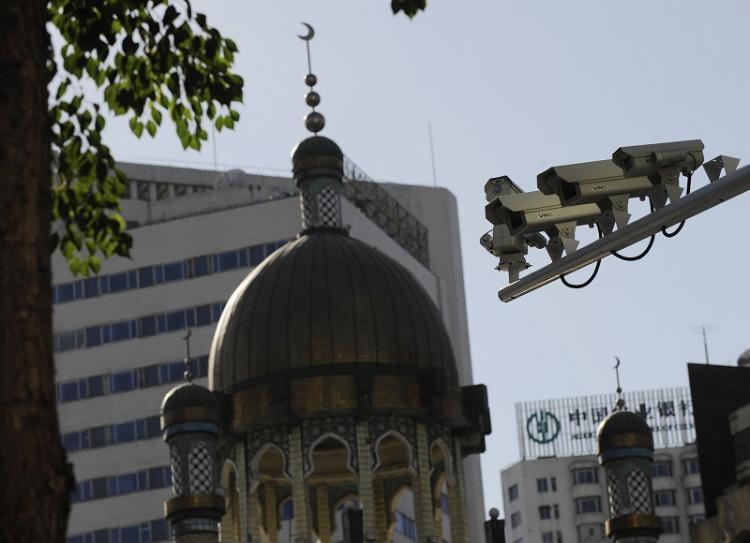
In anticipation of the one-year anniversary of the July 5 protests in Xinjiang’s capital Urumqi, the city is heavily guarded against all possible eventualities. Chinese security authorities have installed more than 40,000 surveillance cameras in public locations throughout the city.
Some Chinese media, including Urumqi media, iyaxin.com, reported on July 2 that a comprehensive video monitoring system has been implemented in Urumqi with the installation of more than 40,000 surveillance cameras inside the city’s 3,400 buses, at 200 bus stations, 4,400 roads and streets, 270 schools and daycare centers, as well as 100 large supermarkets, providing surveillance around the clock.
These figures are as of July 1, and installations are still in progress according to the person in charge of the Urumqi Information Office.
According to Associated Press, about 5,000 new police officers were hired in Xinjiang during the past year.
Dilshat Rishit, a spokesperson for the World Uyghur Congress (WUC), told The Epoch Times in an exclusive interview that the city of Urumqi felt like a huge open-air prison for Uyghurs, that the situation is worse than prior to the July 5, 2009 incident, and described it as “explosive.”
An article on another Urumqi media site, wlmqwb.com, describes the cameras as being high-definition, riot-proof and fireproof, and capable of 360 degrees rotation with fixed focus. It also says that for key surveillance areas, a combination of spherical video camera and fixed focus lens is used, which is additionally equipped with infrared night vision so that images are clear even at night.
Urumqi residents reported that special police and armed police are patrolling streets and communities, and have taken control of the entire city.
An Urumqi resident, Ms. Han, told Sound of Hope (SOH) Radio Network that bags are being checked on buses and in grocery stores, and even in parks, where tables are set up solely for this purpose. [Authorities] “are extremely watchful, because it’s getting close to the one-year anniversary,” Han said.
Resident Mr. Su told SOH his recollections of the July 5, 2009 incident: “The actual number of casualties was definitely higher than the official death toll of 197 [announced by authorities]. At least 3,000 to 4,000 people were killed, and most were innocent [bystanders]. The July 5 incident has rekindled conflicts between Uyghurs and Han Chinese. After July 6 and July 7, most of the people killed were Uyghurs. The communist party does not want certain things to be revealed to the international community.”
Amnesty disputes regime’s casualty figures