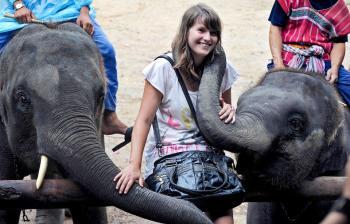
BANGKOK—A century ago there were over 100,000 domestic elephants working in Thailand. Today, only 2 percent of that number is left—2,000 elephants—laboring solely in the country’s tourism industry.
Dr. Richard Lair, an adviser at Thai Elephant Conservation Center in Lampang, said that prior to World War II, elephants were found all across Thailand.
“And pretty much since then, the wild population [currently standing at 1,500] has been limited in its range by habitat encroachment and domestic elephants [numbered at 2,000] have also been affected by deforestation. It has become harder to find land to feed them and then also there’s been no useful work for them to do,” Dr. Lair said.
Elephants were used for logging in Thailand until 1989 and before that, they were the major form of transportation.
“They are great in mud, they can move through swamps that no other animal can move through. Despite their size, they are incredibly surefooted and can handle mountain trails,” he said.
The turning point, he said, came during the 1930s when a railroad connected Bangkok to the country’s second largest city of Chang Mai—previously a long journey by river, then elephant.
With elephants no longer being allowed to work in logging, the tourist industry became the only legal option for mahouts, elephant handlers, and for Dr. Lair this is problematic.
“What happens if tourism fails? Or goes way down, which could happen, if the world was suddenly thrown into a 1930s-style depression? That would be a real nightmare. … I believe the price of elephants would plummet, and that number of elephants would plummet.”
As an example, he said the 2003 SARS crisis kept many potential tourists at home and the cash value of an elephant during this period dropped by half.
Continued on the next page...
While Dr. Lair said that elephants have been domesticated in Asia for about 4,000 years, he believes they ultimately belong in the wild.
Dr. Richard Lair, an adviser at Thai Elephant Conservation Center in Lampang, said that prior to World War II, elephants were found all across Thailand.
“And pretty much since then, the wild population [currently standing at 1,500] has been limited in its range by habitat encroachment and domestic elephants [numbered at 2,000] have also been affected by deforestation. It has become harder to find land to feed them and then also there’s been no useful work for them to do,” Dr. Lair said.
Elephants were used for logging in Thailand until 1989 and before that, they were the major form of transportation.
“They are great in mud, they can move through swamps that no other animal can move through. Despite their size, they are incredibly surefooted and can handle mountain trails,” he said.
The turning point, he said, came during the 1930s when a railroad connected Bangkok to the country’s second largest city of Chang Mai—previously a long journey by river, then elephant.
With elephants no longer being allowed to work in logging, the tourist industry became the only legal option for mahouts, elephant handlers, and for Dr. Lair this is problematic.
“What happens if tourism fails? Or goes way down, which could happen, if the world was suddenly thrown into a 1930s-style depression? That would be a real nightmare. … I believe the price of elephants would plummet, and that number of elephants would plummet.”
As an example, he said the 2003 SARS crisis kept many potential tourists at home and the cash value of an elephant during this period dropped by half.
Continued on the next page...
Not to Be Kept in Captivity
While Dr. Lair said that elephants have been domesticated in Asia for about 4,000 years, he believes they ultimately belong in the wild.