But it wasn’t until December 2025 that President Donald Trump told military planners to give him the option, in case the fundamentalist Shia regime refused to end its uranium enrichment program.
The move came after a meeting with Israeli Prime Minister Benjamin Netanyahu in Washington. With that request, the countdown to Operation Epic Fury kicked off.
Joint Chiefs of Staff Chair Gen. Dan Caine told reporters during a March 2 press conference that, with the president’s December request, the Pentagon began “setting the force and setting the theater.”
After U.S. negotiators left Geneva on Feb. 26 without concessions from Iranian Foreign Minister Abbas Araghchi, the die was cast.
Related Story

The next day, the president called the Pentagon from Air Force One as it was en route to Corpus Christi, Texas, where he was scheduled to campaign for Republican primary candidates.
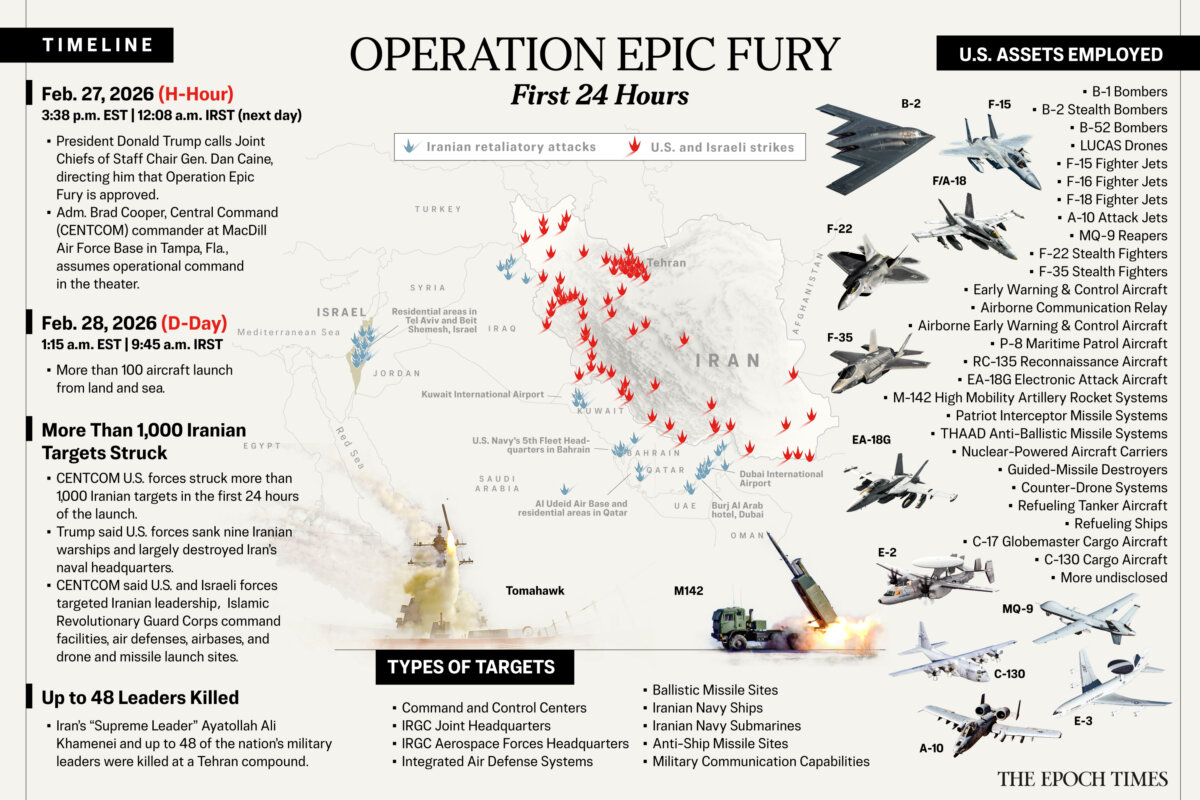
Caine recalled the exact moment he got the call: “H hour,” a military term for the time at which an operation begins, was 3:38 p.m. (EST) on Feb. 27, when the Pentagon “received the final go order from President Trump.”
“The president directed, and I quote: ‘Operation Epic Fury is approved. No aborts. Good luck,’” Caine said.
With that one call, he said: “Across the globe, [U.S. military] operation centers came alive,” and Adm. Brad Cooper, Central Command commander at MacDill Air Force Base in Tampa, Florida, assumed operational command in the theater.
When Trump issued the “go order” at 3:38 p.m. on Feb. 27, it was just after midnight on Feb. 28 in Tehran.
In the nearly 10 hours between H hour and the actual launch of the attack, Caine said, “in the region, every element of the joint force made their final preparations.”
“Air defense batteries readied themselves, checking their systems to respond to Iranian attacks,” he said. “Pilots and crews rehearsed their strike packages for the final time. Air crews began loading their final weapons, and two carrier strike groups began to move towards their launching point.”
“As dawn crept up across the Central Command [area of operations], skies surged to life,” Caine said.
“More than 100 aircraft launched from land and sea—fighters, tankers, airborne early warning, electronic attack, bombers from the states, and unmanned platforms—forming a single synchronized wave.”
That wave arrived over Iran at 1:15 a.m. (EST), 9:45 a.m. in Tehran.
That timeline was accelerated by “a trigger event conducted by the Israeli Defense Forces, enabled by the U.S. intelligence community.”
That moved the standard night attack to a mid-morning opening salvo that killed Iranian leader Ali Khamenei and up to 48 of the nation’s military leaders at a Tehran compound.
More than 1,000 targets were struck in the first 24 hours of the aerial, missile, and drone assault.
“The full strength of America’s armed forces came together in a unified purpose against a capable and determined adversary,” Caine said.
—John Haughey; Stacy Robinson
BOOKMARKS
The Senate failed to advance a measure on Wednesday that would block the president’s ability to wage war against Iran without congressional approval. Lawmakers are divided about how the United States should proceed, and you can find out what they’re saying by reading Jackson Richman’s latest report.
Four more states have moved to restrict what foods can be purchased with food stamps. Kansas, Nevada, Ohio, and Wyoming all sought waivers banning things like candy or carbonated soda, and Agriculture Secretary Brooke Rollins granted those requests on Wednesday.
The Department of Health and Human Services said this week that states cannot remove children from parents because of disputes over gender identity. “A state’s decision to break up a family cannot be based solely on a parent’s objection to radical gender ideology, or irreversible sex-rejecting medical interventions,” Administration for Children and Families leader Alex Adams said.
More Democrats showed up to vote in the Texas and North Carolina Senate primaries than Republicans, according to preliminary voting data. Check out Chase Smith’s analysis to find out which party spent more, and where.
The U.S. Supreme Court on March 4 ruled unanimously that New Jersey’s public transit system may be sued for accidents that take place outside of its home state. The justices found that New Jersey Transit is not an arm of the state and must face lawsuits filed in Pennsylvania and New York.
—Stacy Robinson