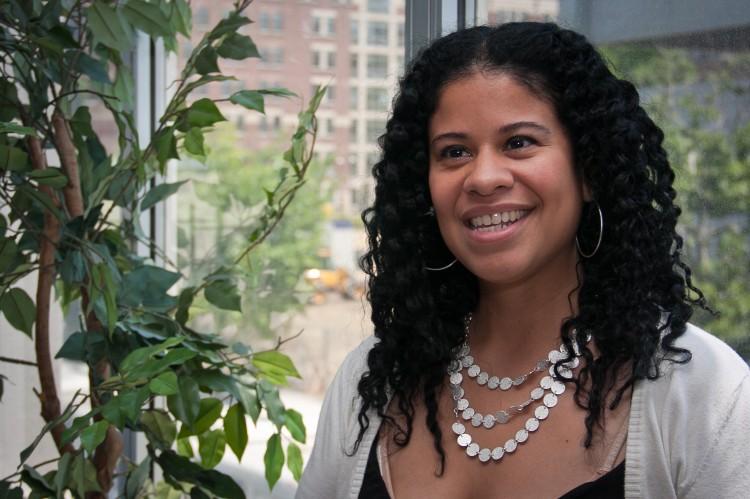
NEW YORK—Beatriz Coronel recalls looking through the window with her 10-year-old brother as her mother was taken away on a stretcher. She remembers watching paramedics pump her mother’s stomach after she attempted suicide.
“That’s an image I will never forget,” Coronel said almost 30 years later. It was at that time, 9 years old, that she began to wonder about human behavior, and how environment and culture influence people.
Coronel, 38, was born and raised in the projects. On her whole floor, her family was the only one that had a man in a household, the rest were single mothers.
Her neighborhood was paradoxically located one street away from Lincoln Center.
“How can one street be divided into two different worlds?” Coronel said. “Just seeing the difference of where you live can completely affect who you become. At that point, I understood I had to do something to give back to my community.”
Coronel’s experience as a young child shaped her life markedly and she became part of the support system she wished her mother could have found.
After getting a masters degree in psychology at the City College of New York, she got a job as program director of Life is Precious (LIP), a nonprofit suicide prevention program for Hispanic teens.
The program was established in 2008, and runs in the Bronx and Brooklyn.
LIP offers art therapy and academic support, in addition to individual and group counseling for young Latina females who have either attempted or considered suicide.
The organization was prompted by a 2006 Center for Disease Control and Prevention report, which found that the Latino teen population has the highest attempted suicide rate in the country. Recent numbers released from the center’s 2011 report show that the numbers have only decreased slightly.
Coronel said the challenges Latina women faced decades ago are still here today.
Cinderella in Ecuador
Coronel’s mother’s story was the inspiration behind her joining Life is Precious.
Her mother, Ana, was tricked into coming to the United States at age 17.
“My grandmother told her they were going for a daily errand run, ended up taking her to the consulate, forced her to get a visa, and they approved her,” Coronel said. Ana lived with her aunt, and began working to support her mother and eight siblings in Ecuador.
Thrown into a foreign country overnight, Ana was isolated. But her life in Ecuador was just as grim—her family lived in poverty and could only afford one meal a day. And her mother frequently physically and mentally abused her.
“I see her as the strongest person I know because, while she was going through all this abuse, she was still raising a family,” Coronel said. “My mom was like a Cinderella before the glass slippers.”
After working as a home attendant, Ana eventually saved enough to bring her mother and seven of her siblings to the United States. “Thanks to her, as one person that struggled so much, she changed so many people’s lives,” Coronel said.
But when Ana got older, things took a turn for the worse. There were no Spanish-speaking therapists, and Ana had been too alone for too long. Her violent relationship with her husband caused her to attempt suicide.
“Even now it’s hard to find a therapist who can understand her language, and, more importantly, her culture,” Coronel said.
Luckily, Ana was able to turn things around on her own.
“Having to take care of a household has taught her very valuable lessons at a young age,” Coronel said. “She is still giving, always willing to help someone, always donating to a cause. That actually gave her a lot of strength.”
With that strength, Ana dedicated herself to being a positive influence on her children.
Although young Latina girls have been facing loneliness and onerous responsibilities for decades, the portals to seek help are still hard to find.
For this reason, LIP is a unique organization in New York.
Small Non-Profit Tries to End the Cycle
With only three case managers, four art therapists, and two sites, working at Life is Precious can be grueling.
But for Coronel, it has been worth the run.
“For me, it’s seeing how these girls’ lives change,” she said.
Although Coronel has been working at LIP for three years, she was still moved to tears by the most recent girl who joined the program.
“As a professional we are not supposed to be emotional, so we can show them everything is going to be fine,” Coronel said. “But her story made me very teary-eyed, I had to turn away.”
The girl and her sibling were left to take care of their grandmother after being abandoned by their mother and a father with 5 other kids.
The grandmother, 61, could not financially support them.
For two years, the girl has been going to school during the day and living in a homeless shelter overnight.
“She described school as dark and lonely, feels like a prison. Then she goes home to a shelter, has to be inside by 9, no visitors—her whole life is like a jail,” Coronel said.
Coronel said the amount of anger the girl held inside was agonizing.
LIP provides creative art therapy, such as dancing, drawing, and jewelry making, where girls can learn coping skills in the process. “For kids who can’t articulate what they’re going through verbally, such as this girl, art is going to be a major mental release,” Coronel said.
LIP focuses on strengthening the familial connection, hosting a “family day” every Saturday. The organization has a Dominoes Club for fathers, and a Tertulia (social) Club for mothers.
Once a year, LIP takes a Mother’s Day trip to Central Park.
“We had this one mother and daughter who didn’t want to come, they don’t get along. When they got there they had this face that said, ‘Why are we here?’ But by the time they left, they left holding hands,” she said.
“To me, that’s symbolic of here’s a family that came disconnected and left completely connected with each other,” Coronel said. “That’s a reward for me.”
The Epoch Times publishes in 35 countries and in 19 languages. Subscribe to our e-newsletter.