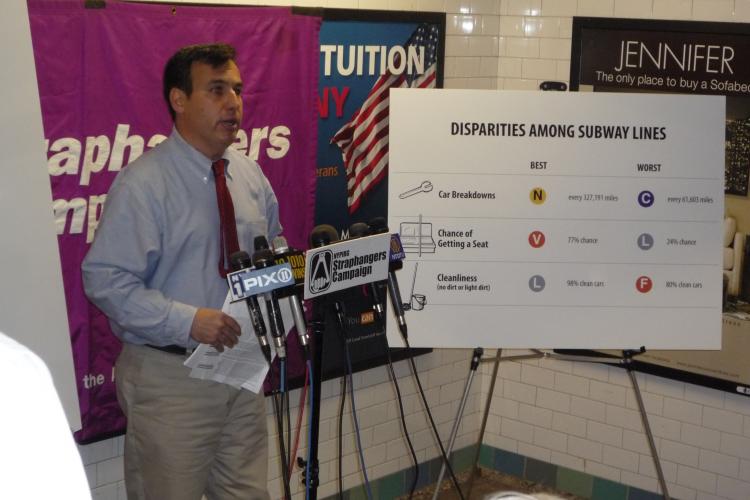
NEW YORK—The annual State of the Subways Report Card came out today—kudos to the 7 and L lines, which made it to the top of the ratings this year.
The report card is the Straphanger Campaign’s yearly assessment of 22 subway lines based on six criteria: frequency of service, regularity of train arrivals, breakdowns, seat availability, cleanliness, and adequacy of in-car announcements.
System surveys in this report were conducted in 2008 by surveying the arriving times of trains and comparing them to the times scheduled by the MTA, comparing passenger count during peak hours to the number of seats available, surveying passengers about cleanliness, and in-car announcements.
The 7 and L lines are the best of the bunch this year in part because of their special management and the nature of their routes, according to Gene Russianoff, the senior attorney for the Straphangers Campaign.
These routes are run by the General Line Managers, a group that has been given greater autonomy from the MTA and thus has to be more accountable to riders. “It’s a human in the hotspot,” Russianoff said. “They’re responsible for the station, cleanliness, and the frequency of breakdowns.” The Line Managers concept is part of an experiment by the MTA begun last fall. It currently encompasses the numbered lines and will be extended again to lettered lines this fall, according to Russianoff.
Another reason the 7 and L lines did well is the fact that their routes do not merge with other lines—the 7 shuttles between Times Square and Main St. Flushing and the L shuttles between 8 Ave./14th St. and Canarsie, Brooklyn. “They have the ability not to get hung up on the problems on other lines,” Russianoff said. Though the L did well overall, it suffers most from overcrowding—riders have a 24 percent chance of scoring a seat at the most congested point in the route. That’s about half the rate of seat availability throughout the system, which is 43 percent.
Smack dab in the middle of the ranking is the E line, one of the system’s longer routes. It does relatively well in arriving as scheduled—every four minutes during rush hours, every 7.5 minutes in the daytime, and every 20 minutes overnight. Mechanical malfunctions and seat availability did it in, however.
The E breaks down every 106,541 miles compared to the average 134,795 miles. A rider on the E has a 32 percent chance of getting a seat—something Nadia DeLeon knows by experience. She commutes from Newark, N.J., to her work in Midtown East.
“It’s a tight commute. It’s uncomfortable, slow, it gets stuck, it’s hot and full of people,” she said. She has another complaint: the announcements. “You can’t hear it on the platform. On the train there are lots of people so if you’re lucky you’ll hear it,” DeLeon said. Operators are required to announce the next station, transfer options, the train and direction of travel, and warnings of closing doors. Operators on the E are in line with MTA’s announcement guidelines 89 percent of the time, according to the report card.
Quantitatively speaking, that percentage looks good, but for some it’s not enough. John Juniore, who takes the 4 and 5 trains, says that announcers are not considerate of riders’ comprehension when announcing service changes. “They know what’s going on—but we don’t. They say it so fast and don’t take the time to say it again,” he said. “They forget that there are a lot of tourists [on the trains].”
The C line takes last place in the rankings. While the C is comparable to other lines in cleanliness and regularity, it did poorly in breakdowns and seat availability. The C breaks down every 61,603 miles and seats are available to only 31 percent of riders during peak hours. It doesn’t run at all at night and arrives every 9.25 minutes during rush hour, which differs little from its midday average of every 10 minutes.
A notch above the C is the B, with service between Brighton Beach, Brooklyn, and Bedford Park Blvd., in the Bronx. It doesn’t run at night either, and lags behind the system average rate of arrival. The B takes 7.25 minutes in the morning rush hours and 8 minutes in the afternoon rush hours. Though free seats abound on the B, they are more likely to be dirty than those in other trains, according to the report.
The full report card is available on the Straphangers Web site, www.straphangers.org.
The report card is the Straphanger Campaign’s yearly assessment of 22 subway lines based on six criteria: frequency of service, regularity of train arrivals, breakdowns, seat availability, cleanliness, and adequacy of in-car announcements.
System surveys in this report were conducted in 2008 by surveying the arriving times of trains and comparing them to the times scheduled by the MTA, comparing passenger count during peak hours to the number of seats available, surveying passengers about cleanliness, and in-car announcements.
The Good
The 7 and L lines are the best of the bunch this year in part because of their special management and the nature of their routes, according to Gene Russianoff, the senior attorney for the Straphangers Campaign.
These routes are run by the General Line Managers, a group that has been given greater autonomy from the MTA and thus has to be more accountable to riders. “It’s a human in the hotspot,” Russianoff said. “They’re responsible for the station, cleanliness, and the frequency of breakdowns.” The Line Managers concept is part of an experiment by the MTA begun last fall. It currently encompasses the numbered lines and will be extended again to lettered lines this fall, according to Russianoff.
Another reason the 7 and L lines did well is the fact that their routes do not merge with other lines—the 7 shuttles between Times Square and Main St. Flushing and the L shuttles between 8 Ave./14th St. and Canarsie, Brooklyn. “They have the ability not to get hung up on the problems on other lines,” Russianoff said. Though the L did well overall, it suffers most from overcrowding—riders have a 24 percent chance of scoring a seat at the most congested point in the route. That’s about half the rate of seat availability throughout the system, which is 43 percent.
The Bad
Smack dab in the middle of the ranking is the E line, one of the system’s longer routes. It does relatively well in arriving as scheduled—every four minutes during rush hours, every 7.5 minutes in the daytime, and every 20 minutes overnight. Mechanical malfunctions and seat availability did it in, however.
The E breaks down every 106,541 miles compared to the average 134,795 miles. A rider on the E has a 32 percent chance of getting a seat—something Nadia DeLeon knows by experience. She commutes from Newark, N.J., to her work in Midtown East.
“It’s a tight commute. It’s uncomfortable, slow, it gets stuck, it’s hot and full of people,” she said. She has another complaint: the announcements. “You can’t hear it on the platform. On the train there are lots of people so if you’re lucky you’ll hear it,” DeLeon said. Operators are required to announce the next station, transfer options, the train and direction of travel, and warnings of closing doors. Operators on the E are in line with MTA’s announcement guidelines 89 percent of the time, according to the report card.
Quantitatively speaking, that percentage looks good, but for some it’s not enough. John Juniore, who takes the 4 and 5 trains, says that announcers are not considerate of riders’ comprehension when announcing service changes. “They know what’s going on—but we don’t. They say it so fast and don’t take the time to say it again,” he said. “They forget that there are a lot of tourists [on the trains].”
The Ugly
The C line takes last place in the rankings. While the C is comparable to other lines in cleanliness and regularity, it did poorly in breakdowns and seat availability. The C breaks down every 61,603 miles and seats are available to only 31 percent of riders during peak hours. It doesn’t run at all at night and arrives every 9.25 minutes during rush hour, which differs little from its midday average of every 10 minutes.
A notch above the C is the B, with service between Brighton Beach, Brooklyn, and Bedford Park Blvd., in the Bronx. It doesn’t run at night either, and lags behind the system average rate of arrival. The B takes 7.25 minutes in the morning rush hours and 8 minutes in the afternoon rush hours. Though free seats abound on the B, they are more likely to be dirty than those in other trains, according to the report.
The full report card is available on the Straphangers Web site, www.straphangers.org.