Texas is asking for the Supreme Court’s intervention after a judge blocked its congressional map, holding that it was racially discriminatory.
The controversy began with a July 7 letter from the Department of Justice (DOJ), alleging that the state’s legislature violated the Constitution by using race-based considerations when creating four of its districts.
Two days after DOJ’s letter, Abbott called a special session of the Texas Legislature, with the intention of redrawing Texas’s districts, hoping to add five new GOP seats to the House in the 2026 midterms.
That set off a political firestorm since redistricting normally takes place every 10 years, following the U.S. Census.
Democrats from the Texas Legislature temporarily broke quorum by fleeing the state, ensuring that there were not enough members present to ratify the maps. They eventually returned, but only after Gov. Greg Abbott threatened to declare their seats vacant and remove them from membership in the legislature.
Texas finally approved the new maps in August.
The Lawsuit
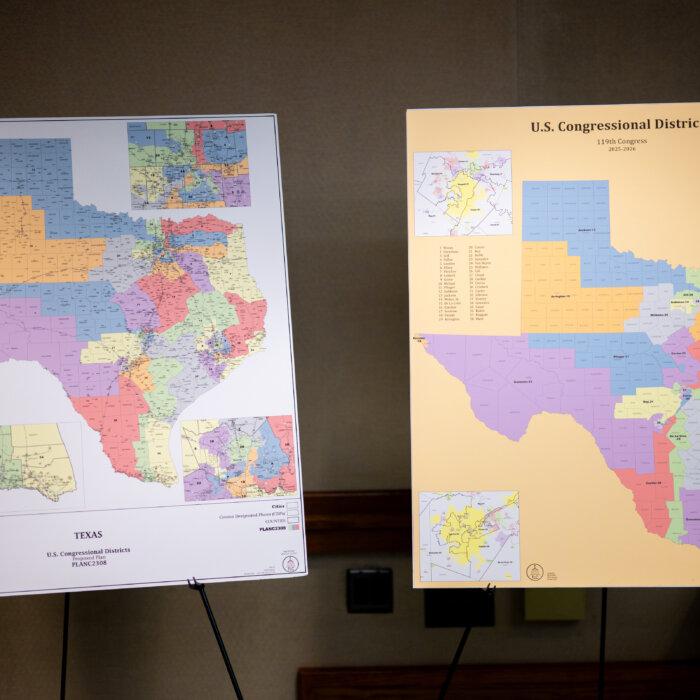
The redistricting plan hit a snag when six plaintiff groups, led by the League of United Latin American Citizens, sued to overturn the new maps, alleging they were explicitly drawn to disadvantage minority voters in the state.
A three-judge panel ruled 2-1 that the districts were racially gerrymandered.
Gerrymandering refers to the practice of drawing electoral districts to favor one political party or group over another.
Previous Supreme Court decisions have held that a state is allowed to gerrymander its maps to give one party an advantage, but that giving one race an advantage is a violation of the Voting Rights Act and the 14th Amendment of the Constitution.
The Voting Rights Act forbids states from enacting restrictions against the voting power of a protected class, and the 14th Amendment guarantees equal protection under the law.
“To be sure, politics played a role in drawing the 2025 Map. But it was much more than just politics. Substantial evidence shows that Texas racially gerrymandered the 2025 Map,” U.S. District Judge Jeffrey Brown wrote in his majority opinion.
Rather than impose a new map, Brown ordered the state to use its 2021 district layout.
The Dissent
Under normal circumstances, the dissenting judge and the majority would have an opportunity to review each other’s opinions—and address the opposing arguments—before publishing.
That did not happen in this case, according to U.S. District Judge Jerry Smith.
He began his dissent by saying that the majority only provided him with a final draft of its ruling minutes before publishing it. This forced him to publish his opinion separately the following day. It also meant the majority would not have to respond to his objections.
“In my 37 years on the federal bench, this is the most outrageous conduct by a judge that I have ever encountered in a case in which I have been involved,” he wrote.
“The ultimate question is whether unrestrained ideological judicial zeal should prevail over legislative choice. This isn’t my first rodeo.”
Smith, in his dissent, took the majority to task over multiple aspects of its reasoning, ending each section with the same declaration: “I dissent.”
He especially emphasized the lengthy testimony of Adam Kincaid, author of the new map.
In court, he said, Kincaid “went district-by-district and described his map-drawing process with painstaking detail,” showing that the new maps district lines were drawn with political considerations, not race, in mind.
Appeal
Texas quickly appealed the order to the Supreme Court, which temporarily halted the district court’s ruling, allowing Texas to move forward with the new map.
The high court was already wrestling with the issue of race-based redistricting.
In his dissent, Smith said Brown should not have blocked the maps before the Supreme Court resolved “the tension between Section 2 of the Voting Rights Act and racial-gerrymandering jurisprudence.”
Smith was referencing the case Louisiana vs Callais, where the Supreme Court heard oral arguments on Oct. 15, dealing with lawsuits over that state’s congressional maps.
As in Texas, a group of minority voters had filed suit alleging that Louisiana’s maps diluted minority voting power.
After a federal judge ordered the state to remake its map and add a second majority-minority district, a group of non-minority voters sued, alleging that the new maps were unconstitutional since they were race-based.
—Stacy Robinson