Survey: Epoch Readers Support Federal Policing of Washington, See Limits Elsewhere

Save
Survey: Epoch Readers Support Federal Policing of Washington, See Limits Elsewhere
President Donald Trump federalized control of the Washington D.C. Metropolitan Police Department (MPD) on Aug. 11, ordering 800 National Guard troops to the nation’s capital.

Supporters say these measures restore public safety and order, while critics warn of risks to local self-governance and civil liberties.

In our latest Epoch Survey, readers expressed a high level of support for federal policing in the nation’s capital.

Opinion was less firm on whether that strategy should be expanded to other cities and on the question of federal intervention in dealing with homeless people.

Strong Support for Federal Policing in Washington

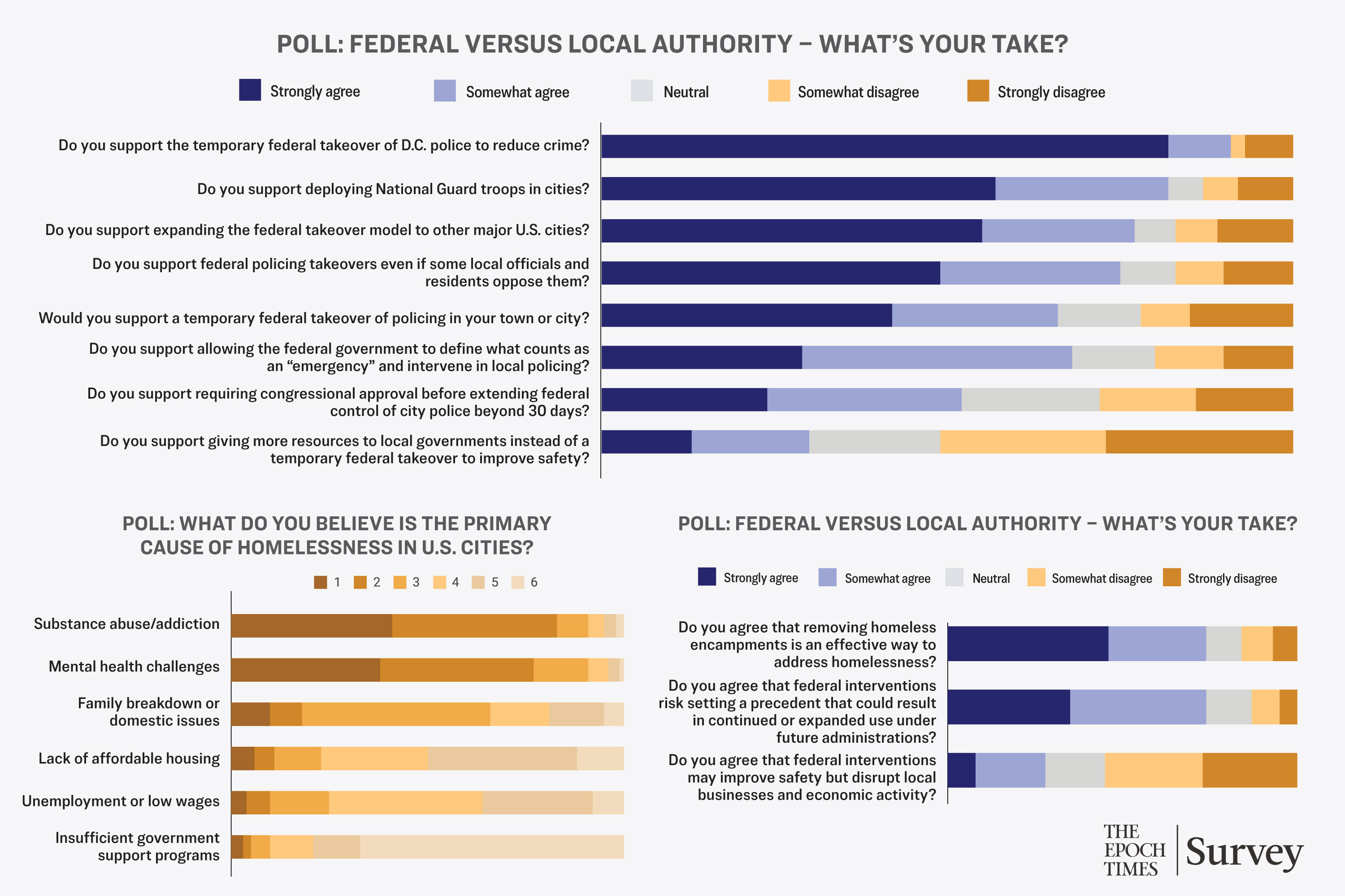
The vast majority of respondents (91 percent) supported a temporary federal takeover of Washington D.C. policing. Eighty-two percent strongly supported that move.

Support softened on the question of deploying National Guard troops to cities. Here, 57 percent strongly supported the move, 25 percent were somewhat supportive, and 5 percent were neutral.

Qualified Support for Federal Policing Elsewhere

Support fell steadily on questions of using executive authority to take over policing in other U.S. cities, as the president has suggested he may do.

The 91 percent support for federal policing in Washington dropped to 77 percent when the question was applied to federal policing in other cities.

A solid number, 75 percent, said they could support such a move even if opposed by local officials and residents, but fewer than half (49 percent) strongly supported it.

The number dropped again when readers were asked to consider federal policing of their own city or town.

Written responses to the question of whether federal policing should be extended outside Washington D.C., which is a federal district, revealed readers’ hesitations.

Many readers used phrases such as slippery slope, two-edged sword, and necessary evil to describe their thinking on the matter.

“Temporary interventions are indeed disruptive, but when needed ...  the benefit far exceeds the cost,” one reader said.

“Too much federal control leads to the end of democracy,” another wrote.

image-5908065
Armed National Guard members patrol the National Mall in Washington on Aug. 27, 2025. Madalina Kilroy/The Epoch Times
“Under normal circumstances, I would strongly oppose federal intervention in local policing,” one reader said. “However, these are not normal times.”

Limitations

A plurality (39 percent) somewhat supported the idea of allowing the federal government to determine what constitutes an “emergency.” A significant number (32 percent) were either opposed to that or neutral on the issue.

Nearly half (48 percent) supported requiring congressional approval to extend federal policing of U.S. cities beyond 30 days.

“A temporary takeover could give the local police a head start. Then the feds could move away,” a reader stated.

“Federal intervention should be seen as a temporary, ‘treating the symptom’ action, not a long-term solution,” another said.

A number of readers were concerned about aggregating too much power either on the federal government or the executive branch.

“We must remember that America was designed to be a republic, not a democracy; a plurality of states ruled by the people, not a uniform federated beast, with a president that we are ‘under,’” one reader said.

A bare majority (51 percent) opposed providing federal funds to troubled cities rather than a federal takeover.

image-5908070
Washington Metropolitan Police Department investigates a triple stabbing on H Street NE in Washington on Aug. 16, 2025. Andrew Leyden/Getty Images

Personal Factors Drive Homelessness

Trump campaigned on a pledge to address homelessness, and signed an executive order in March, creating a task force to ensure that “quality-of-life laws” in the nation’s capital are enforced.

Respondents identified personal issues rather than societal factors as the primary causes of homelessness.

Substance abuse and addiction ranked first, seen as the primary cause by 41 percent of respondents. Mental health challenges ranked second, and family breakdown or domestic issues ranked third.

image-5908072
A man gathers recyclables in Los Angeles on July 15, 2025. John Fredricks/The Epoch Times

Unemployment or low wages, lack of affordable housing came next, with insufficient government support programs ranking last.

Many readers identified ineffective government responses to social ills as a driving force.

“Excessive government aid creates poverty,” one responded.

“The government created this problem by letting big-business greed ship jobs out of the country,” another said.

“We must increase mental health care, which would include alcohol and drug abuse residential programs that are offered free of cost to those who need them. It’s a good use of our tax dollars,” another said.

Many readers added illegal immigration as a driving factor.

“Sanctuary cities encourage homelessness and illegal migration by offering them a free place to stay,” one reader said.

Another said, “The housing shortage is due to the millions of illegal immigrants who are here.”

Others expressed the idea that many people are homeless by choice. One reader said, “I believe living on the street, for some, is a chosen lifestyle.”

Other readers mentioned a lack of education, including both job and basic living skills, as a factor.

This reader poll was taken on Aug. 27–28, 2025, by email and social media and received 22,746 responses.
AD