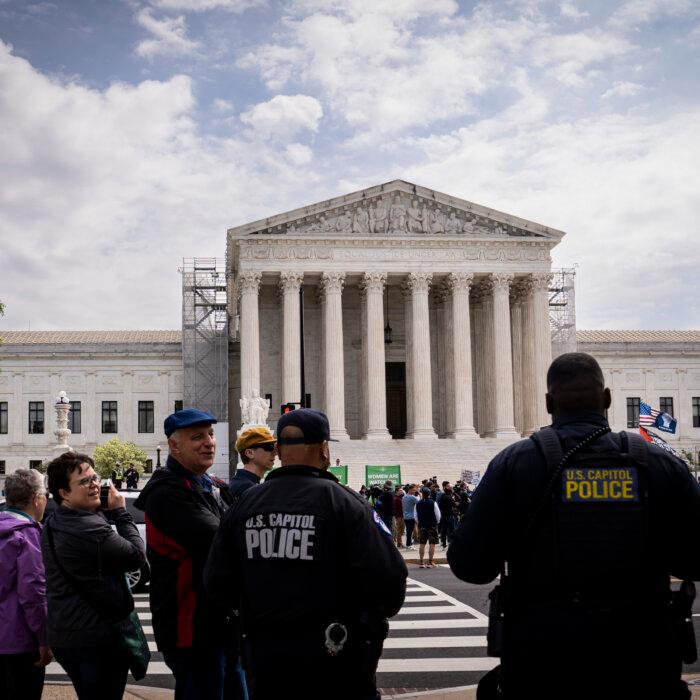
The Supreme Court indicated during oral argument on April 25 that its decision in former President Donald Trump’s immunity appeal would significantly impact future administrations—not to mention President Trump’s ongoing criminal cases.
“We’re writing a rule for the ages,” Justice Neil Gorsuch said during oral argument. He and Justice Ketanji Brown Jackson both made clear they were concerned about cases beyond President Trump’s, which has forced the court to grapple with what constitutes a president’s official conduct.
Trump argued that he enjoyed immunity from criminal prosecution for acts that fell within the outer perimeter of his official duties. However, his attorney, D. John Sauer, conceded during oral argument that some of the conduct in Special Counsel Jack Smith’s Washington indictment was private and therefore unprotected by immunity.
Lower court delays will likely result if the justices write a governing opinion that overhauls the nation’s concept of immunity. In both Georgia and Washington, the judges may have to dismiss certain charges and leave the prosecution with a case that resembles a “one-legged” stool, as Chief Justice John Roberts put it.
Oral argument left the impression that most justices were open to some form of immunity, although their respective versions could vary greatly.
John Shu, a constitutional law expert who served in both Bush administrations, indicated to The Epoch Times that the Supreme Court’s decision could be messy whereby justices file multiple concurrences and a plurality, rather than majority, governs.
“Very little instruction” could come from the eventual decision, Mr. Shu said, and the district court could make a decision that finds it way back to the Supreme Court on another appeal. “I certainly hope that doesn’t happen, because we’d end up right where we are today,” he said.
It’s unclear whether a majority of justices will agree with Trump’s argument that Congressional impeachment and conviction is the only way a president could subsequently face criminal prosecution in an Article III court.
Constitutional attorney Gayle Trotter thought the Supreme Court’s decision would impact Trump’s cases in Georgia, where he faces accusations similar to those in Washington, and Florida. “Both of those deal with what Trump and his lawyers would argue are official acts,” she told The Epoch Times.
Trotter also said that “the question of presidential immunity has profound implications for the presidency under the Constitution. Does the president need to do his job looking over his shoulder and wondering if the next administration will try to put him in jail for his choices?”
Oral argument showed the justices wrestling with whether the justice system could be trusted not to allow politicized or abusive prosecutions of presidents. Justice Samuel Alito, for example, referenced the old adage that a prosecutor could get a grand jury to indict a ham sandwich.
Justice Sonya Sotomayor, who seemed the most skeptical of Trump’s arguments, pushed back on Justice Alito and suggested that if the justice system failed, “it’s because we destroyed our democracy on our own.” She also suggested that some acts were “so fundamentally evil that they have to be protected against.”
Michael Dreeben, an attorney with the special counsel’s office, told the justices that in the district court, his side would be willing to “take a jury instruction that would say you may not impose criminal culpability for the [private] actions that he took. However, you may consider it insofar as it bears on knowledge and intent.”
President’s intent could play a role in determining immunity, although Trump’s attorney argued weighing that as a factor was inappropriate. Mr. Shu speculated that speculated that at least one of the concurrences may focus on how courts should weigh a president’s intent, if at all, when deciding immunity, assuming it is even ascertainable.
Timing could be crucial to determining the outcome of Trump’s various cases. Ruling for immunity would require more pre-trial work in both Georgia and Washington while also throwing Trump’s New York and Florida cases into question.
The end of June is when the justices are expected issue a decision, likely remanding the case back to the district court. The outcome of Trump’s New York trial, which has already started, theoretically could be appealed based on the Supreme Court’s decision while both the Georgia and Florida cases have uncertain trial dates.
Two attorneys told The Epoch Times that the Georgia trial likely wouldn’t start until after the election. “Even under the best of circumstances, it wasn’t going to start until next year,” Kevin O'Brien, a former assistant U.S. attorney, told The Epoch Times.
Delaying the cases might also push them past President Trump’s would-be inauguration and raise the prospect that he could pardon himself. Justice Gorsuch noted that “happily,” the question of presidents self-pardoning “has never been presented to us.”