


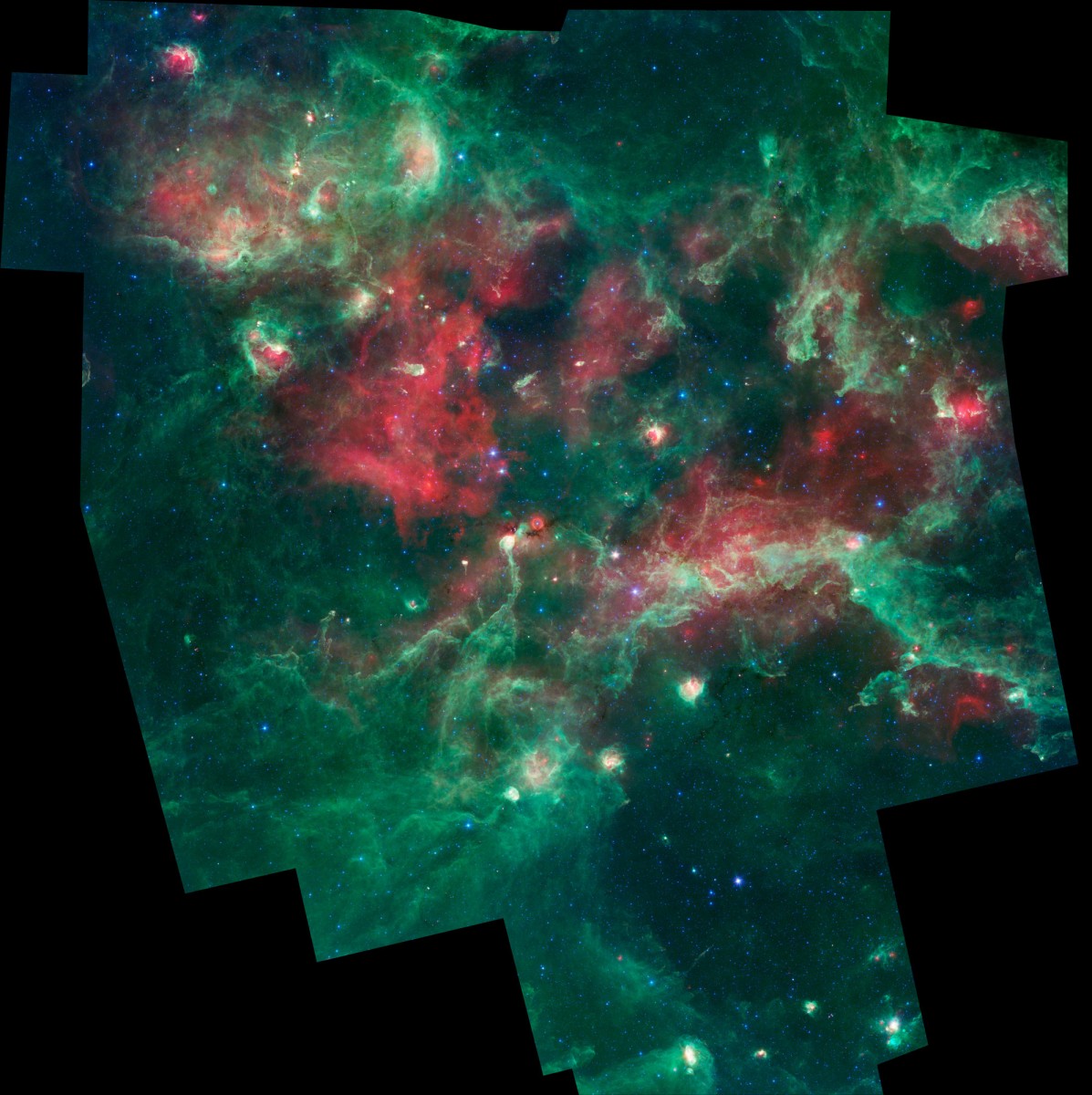
A new image from NASA’s Spitzer Space Telescope has revealed tumultuous star formation in the cloud of dust and gas known as Cygnus X, over 4,000 light-years away in the constellation of Cygnus the Swan.
Cygnus X spans more than 600 light-years and contains many thousands of stars, including many massive ones. The stars in stellar nurseries such as this gradually move away from each other over time.
“Spitzer captured the range of activities happening in this violent cloud of stellar birth,” said principal research investigator Joe Hora at the Harvard-Smithsonian Center for Astrophysics in a press release.
“We see bubbles carved out from massive stars, pillars of new stars, dark filaments lined with stellar embryos and more.”
The chaotic clouds are pocked with bubble-like cavities that form due to stellar winds and radiation from the biggest stars, which literally tear apart the cloud matter, causing some stars to be born and others to die.
“One of the questions we want to answer is how such a violent process can lead to both the death and birth of new stars,” said Sean Carey at the California Institute of Technology in the release. “We still don’t know exactly how stars form in such disruptive environments.”
Spitzer’s piercing infrared vision allowed the astronomers to view dusty parts of the region, showing infant stars shrouded by dust. Some are hidden inside dust pillars shaped like fingers, pointing toward the massive stars at the cloud centers, while others lie inside dark snake-like dust filaments.
“We have evidence that the massive stars are triggering the birth of new ones in the dark filaments, in addition to the pillars, but we still have more work to do,” said Hora. “The biggest results from this survey are yet to come.”


