NEW YORK—Shen Yun performers got word while still in costume at the final rehearsal before taking off for Hong Kong: seven sold-out shows in Hong Kong had been canceled. Seven crew members for the company had visas denied at the last minute.
Dancers and other company members for New York-based Shen Yun Performing Arts said the cancellation of the sold-out shows was most likely due to pressure on the Hong Kong government from Chinese communist authorities.
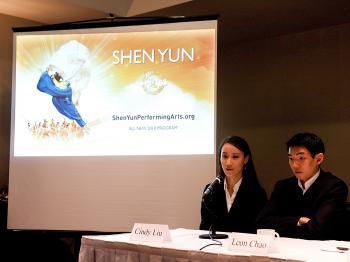
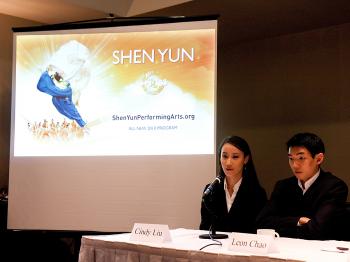
“The news was brought to us after our final dress rehearsal prior to departure,” said principal dancer Leon Chao at a press conference near Times Square Monday. “There was a long moment of silence, faces of devastation. Everyone was in complete shock. I had my bags packed already. Everybody’s dream on our team was to bring back Chinese culture to China.”
Shen Yun performs Chinese classical and folk dances, covering the many dynasties and ethnic groups that make up the nation’s 5,000-year heritage. Much of the traditional culture presented by Shen Yun has been lost, buried, or altered under the current regime in China.
The much-anticipated performances in Hong Kong were scheduled for Jan. 27-31. However, show organizers in Hong Kong were informed on Jan. 21 that visas for seven technical crew members were denied by immigration authorities, saying the jobs could be filled by local labor. One of the seven did later receive a visa to enter Hong Kong.
Company manager Vina Lee said the reason for refusing the visas was ridiculous.
“Our crew is part of the company, we cannot go anywhere without them,” she said. She said the visa application process in Hong Kong normally takes about four weeks and the company started the process on Oct. 13 last year.”
Production manager Gregory Xu said the decision was illogical and unacceptable. Technical staff cannot be replaced by training someone in one or two days, he said.
“You have to be trained for years,” Xu said. “You have to work with the dance, understand the dance, understand the music, and understand the production manager’s cues.”
Lighting engineer Chia-hwa Tsai was one of the seven whose visa application was denied. Tsai previously worked in a theater in Taiwan that hosted marquee companies such as American Ballet Theater, Disney on Ice, and the Royal Shakespeare Theatre.
“They all have their own lighting designer, sound engineer, and projection operator,” Tsai said. “It requires time to know the show and study and work together to provide the best effect on the stage. This is really a common practice in this industry.”
Dancers and other company members for New York-based Shen Yun Performing Arts said the cancellation of the sold-out shows was most likely due to pressure on the Hong Kong government from Chinese communist authorities.
“The news was brought to us after our final dress rehearsal prior to departure,” said principal dancer Leon Chao at a press conference near Times Square Monday. “There was a long moment of silence, faces of devastation. Everyone was in complete shock. I had my bags packed already. Everybody’s dream on our team was to bring back Chinese culture to China.”
Shen Yun performs Chinese classical and folk dances, covering the many dynasties and ethnic groups that make up the nation’s 5,000-year heritage. Much of the traditional culture presented by Shen Yun has been lost, buried, or altered under the current regime in China.
The much-anticipated performances in Hong Kong were scheduled for Jan. 27-31. However, show organizers in Hong Kong were informed on Jan. 21 that visas for seven technical crew members were denied by immigration authorities, saying the jobs could be filled by local labor. One of the seven did later receive a visa to enter Hong Kong.
Company manager Vina Lee said the reason for refusing the visas was ridiculous.
“Our crew is part of the company, we cannot go anywhere without them,” she said. She said the visa application process in Hong Kong normally takes about four weeks and the company started the process on Oct. 13 last year.”
Production manager Gregory Xu said the decision was illogical and unacceptable. Technical staff cannot be replaced by training someone in one or two days, he said.
“You have to be trained for years,” Xu said. “You have to work with the dance, understand the dance, understand the music, and understand the production manager’s cues.”
‘Just a Pretext’
Lighting engineer Chia-hwa Tsai was one of the seven whose visa application was denied. Tsai previously worked in a theater in Taiwan that hosted marquee companies such as American Ballet Theater, Disney on Ice, and the Royal Shakespeare Theatre.
“They all have their own lighting designer, sound engineer, and projection operator,” Tsai said. “It requires time to know the show and study and work together to provide the best effect on the stage. This is really a common practice in this industry.”