The U.S. Supreme Court could upend more than 330 criminal cases and strike down the most potent weapon in the Department of Justice’s arsenal against January 6 protesters.
The nation’s highest court on Dec. 13 took up a challenge to the felony the Justice Department uses most frequently to charge Jan. 6 defendants. The court granted certiorari to a petition of appeal from Joseph Fischer, 57, a Jan. 6 defendant from Jonestown, Pennsylvania.
Fischer is among the hundreds of Jan. 6 defendants charged with corruptly obstructing an “official proceeding”—the joint session of Congress that met to tally Electoral College votes and hear objections from lawmakers.
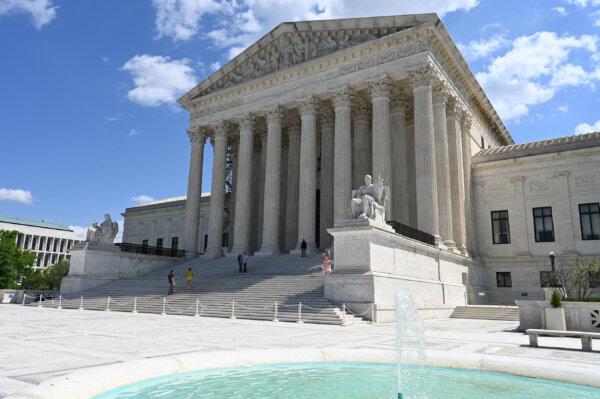
The U.S. Supreme Court is seen in Washington D.C. on April 23, 2023.Daniel SLIM/AFP via Getty Images
What put the Jan. 6 protesters in the sights of the DOJ is the unprecedented use of a 20-year-old evidence-tampering statute to prosecute them for delaying the counting of votes from the 2020 presidential election.
The statute reads:
Whoever corruptly

(1) alters, destroys, mutilates, or conceals a record, document, or other object, or attempts to do so, with the intent to impair the object’s integrity or availability for use in an official proceeding; or
(2) otherwise obstructs, influences, or impedes any official proceeding or attempts to do so, shall be fined under this title or imprisoned not more than 20 years, or both.
The charge has been levied in federal court against high-profile defendants—including former President Donald Trump, Oath Keepers founder Stewart Rhodes, and former Proud Boys chairman Henry “Enrique” Tarrio—and hundreds of lesser-known Jan. 6 figures.
Defendants who came to the U.S. Capitol well after Congress was evacuated on Jan. 6 were nevertheless charged with obstruction of an official proceeding. A number argued unsuccessfully at trial that they could not have obstructed Congress because they were not present in the Capitol when lawmakers left the House and Senate chambers.
Defense attorneys have said the maximum 20-year prison term that comes with a violation of 18 U.S. Code §1512(c)(2) puts tremendous pressure on defendants to take a DOJ plea offer rather than go to trial.
Critics of the DOJ say prosecutors’ use of §1512 has weaponized a statute never intended to address political protests or First Amendment activities. One legal researcher called it “dangerous.”
“If the Biden DOJ’s adventurism is allowed to stand, it will permanently change the ability of the government to suppress the rights of American citizens,” Jonathon Moseley told The Epoch Times. “Every American will be at the whim of any prosecutor to terrorize them.”
Retired Harvard law professor Alan Dershowitz said the protests at the Capitol were protected First Amendment demonstrations.
“Look, these were not obstructions of justice,” Mr. Dershowitz told Newsmax on Dec. 15. “These were attempts to exercise First Amendment rights to petition the government for a redress of grievances. Some of the people went too far and destroyed property, but those people who just tried to influence the congressional hearings were exercising their constitutional right.”
Edward Tarpley, a defense attorney who represented Rhodes in the first Oath Keepers trial in 2022, said the Supreme Court’s decision to hear the appeal is a “tremendous victory.”
“Virtually everyone agrees that this statute was never intended to be used the way the DOJ has used it against the January 6 defendants,” Tarpley told The Epoch Times.
The statute was enacted by Congress in 2002 as the Sarbanes-Oxley Act. It was intended to close a loophole that hindered prosecutions in the Enron and Arthur Andersen financial fraud cases. The previous version of §1512 only involved actions directed at other persons, not documents or evidence.
Defense attorney Joseph McBride believes the DOJ’s novel use of the law is based on “corruption and political hatred.”
“For the love of God, what do the Sarbanes-Oxley Act and election-related protests have to do with each other?”McBride said. “I’ll tell you, absolutely nothing.”
That was the view taken by U.S. District Judge Carl Nichols, who threw out the obstruction charge filed against Mr. Fischer and defendants Edward Jacob Lang, 28, of New York, and Garret A. Miller, 37, of Texas. Miller and Lang filed similar petitions of appeal with the Supreme Court, but the justices agreed to take up only the Fischer case.
In a March 2022 memorandum opinion, Judge Nichols said the charge against Miller “requires that the defendant have taken some action with respect to a document, record, or other object in order to corruptly obstruct, impede or influence an official proceeding. Miller, however, is not alleged to have taken such action.”
Judge Nichols said he was faced with a “serious ambiguity in a criminal statute.” Federal courts have traditionally exercised restraint when evaluating the reach of a statute and applied the rule of lenity to resolve any ambiguity in favor of the defendant, he said.
A three-judge panel of the U.S. Court of Appeals for the District of Columbia Circuit muddied the waters in April 2023 with a fractured 1-1-1 decision. Only a partial concurrence by one of the judges appeared to reverse Judge Nichols and uphold the DOJ’s broad interpretation of the law.
Among the complicating issues in the case is the lack of a definition for the term “corruptly” and whether the term “otherwise” in §1512(c)(2) refers to conduct listed in §1512(c)(1)—altering, destroying, mutilating, or concealing a record, document, or other object—or has a much broader meaning.
Judge Nichols concluded that “legislative history supports a narrow reading of subsection (c)(2).”
The court is likely to hear arguments in the case during its spring term.