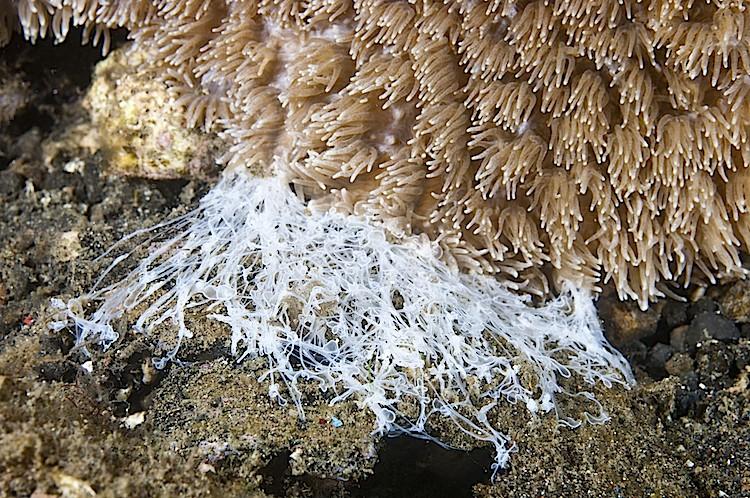
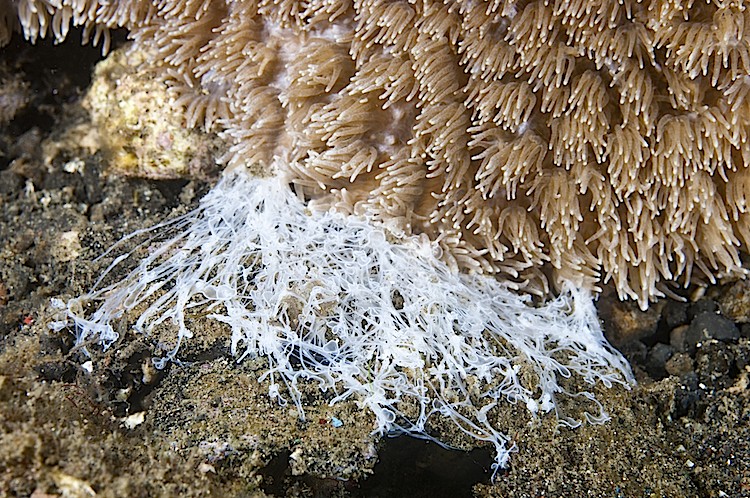
Several species of hard corals are capable of extruding long filaments from their stomachs to feed, including corals from the genera Favia, Favites, Scolymia, Pavona, and Cynarina.
Each coral polyp has a mouth leading down into a partitioned stomach cavity. The free edges of the partitions are extended into mesenterial filaments—convoluted tubes that can be extruded through the mouth or the body wall.
These mesenterial filaments release digestive enzymes and then absorb any nutrients digested.
The corals also use these filaments to attack and digest polyps of other coral colonies as they grow and compete for limited space on a reef.
Some of these corals also have sweeper tentacles which feature specialized stinging cells called nematocysts that can damage or kill coralline competitors.
In this video you can see a hard coral extending sweeper tentacles towards a soft coral in its vicinity.
Matthew Oldfield is a freelance photographer based in Bali, Indonesia, specializing in editorial and documentary images from both above and below the waves. He works primarily with charities, NGO’s, and other organizations working to conserve the environment, endangered species, and disappearing cultures.